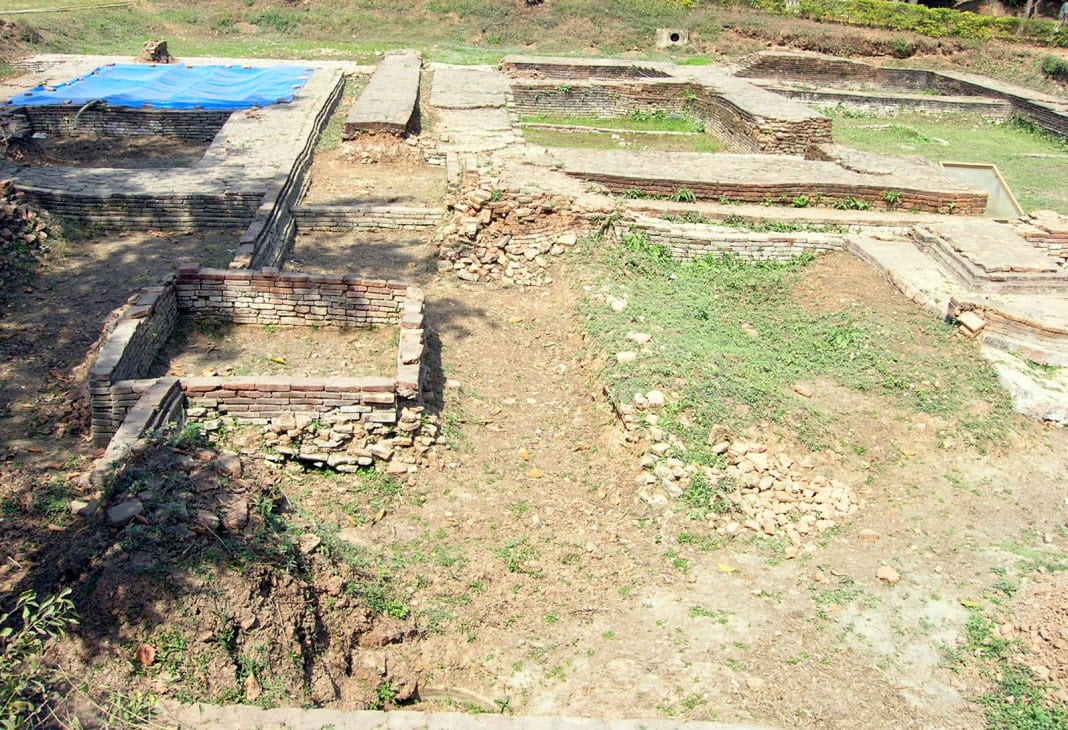
What survives of the valley’s prehistory is stone and fired clay, recovered from a handful of sites. Where it survives is itself a fact about the Brahmaputra. The river rebuilds its bed every season and reworks whatever is left on the plain, so almost every early find comes from the hills at the valley’s edge rather than from its floor.
Before the polished stone
The oldest tools come from the hills. In the Rongram valley of the Garo hills, in present Meghalaya, surveys from the 1970s onward recovered handaxes and cleavers of an Abbevillio-Acheulean cast, the earliest stone tools known from the northeast, and later a microlithic phase with small worked tools and a crude handmade pottery. The Garo hills have yielded more Palaeolithic-looking tools than anywhere else in the region. Almost none of them come out of a deposit with a secure sequence, so an attribution as bold as the Middle Pleistocene rests on the shape of the tools rather than on a dated layer.
The Neolithic signature
Two things define the age here. The first is the shouldered celt, an axe or adze with a cut-back haft. The second is cord-marked and basket-impressed pottery. Cord-marking is rare in the Neolithic of the Indian mainland and dominant across China and Southeast Asia, which places the valley’s Neolithic in an eastern world rather than a South Asian one. The valley is walled but not sealed. The Patkai, the Brahmaputra gorges and the southern hills are narrow gates onto Burma, Tibet and the Bay of Bengal, and the material came through them.
Daojali Hading, in the North Cachar hills, was dug in the early 1960s by M.C. Goswami and T.C. Sharma of Gauhati University, the first stratified Neolithic deposit excavated in the northeast. It yielded shouldered celts, four kinds of pottery, the grinders and querns of an everyday kitchen, tools of hard local fossil wood, and a piece of jadeite with no source in these hills, generally read as carried in from the direction of China. Sarutaru, a hillock in the Kamrup country about twenty-five kilometres southeast of Guwahati, was dug between 1967 and 1973 and gave nine ground celts of slate and sandstone with cord and basket-impressed pottery close to the Daojali ware. Selbalgiri in the Garo hills is a third. Hills and valley floor yield the same material, and the pots and grinders point to grain and to settled work.