Bohag Bihu (Rongali Bihu)
The spring festival of Assam. Seven days of dance, songs, new clothes, and the gamosa. Marks the Assamese new year and the start of the sowing season.
Bohag Bihu, also called Rongali Bihu, is in most popular accounts a single festival. In practice it is seven, observed across seven consecutive days that bridge the last week of Sot, the closing month of the Assamese year, and the first days of Bohag. The seven are not equally weighted. The cattle-bathing Goru Bihu and the people-bathing Manuh Bihu anchor the whole cycle, while Senehi Bihu and Mela Bihu give it its public face. But it is the week as a whole that is the festival, and to treat any one day as the whole is to misread the rhythm of it. That rhythm is the cycle Praphulladatta Goswami (source: Bihu Songs of Assam) documented through its songs.
A name and a calendar older than the creeds
The word Bihu does not descend from any temple vocabulary. On the reading most folklorists accept, it goes back to a Deori-Boro-Garo word, bisu, meaning joy. The Deori keep that same root alive in their own spring Bisu. So the festival it names is older than any of the religions later layered over the valley. The three Bihus track the agricultural year and nothing else. They are kept by Assamese-speakers of every faith. What they mark is the sowing, the lean wait and the full barn, and all of them share it. The antiquity is not only inferred from the name. The earliest written trace of the festival is a copperplate grant of the Chutia king Lakshminarayan, issued in 1401 and unearthed in 1935 at Ghilamara, near the Subansiri river in present-day Lakhimpur district. In it the king records a gift of land to a Brahmin named Ravidev, made on the auspicious occasion of the festival. The word the engraver cut into the copper is bisu, the old root itself. So the festival was already long established, and already an occasion solemn enough to date a royal grant by, when a fifteenth-century king thought to set it down on copper.
Goru Bihu, the day of cattle
The cycle opens on the last day of Sot, in most years around 14 April, with Goru Bihu, the festival of cattle. Cows and bullocks are washed at the village pond or river with mah-halodhi, a paste of turmeric and mati-mah pulses. Their horns are anointed with mustard oil. They are fed dighloti and makhioti, the long bitter herbs whose names form part of a Bihu song each child learns. Many households also feed the animals slices of lau and bengena, gourd and brinjal. The animals are then struck symbolically with the herb stalks as a blessing on the herd.
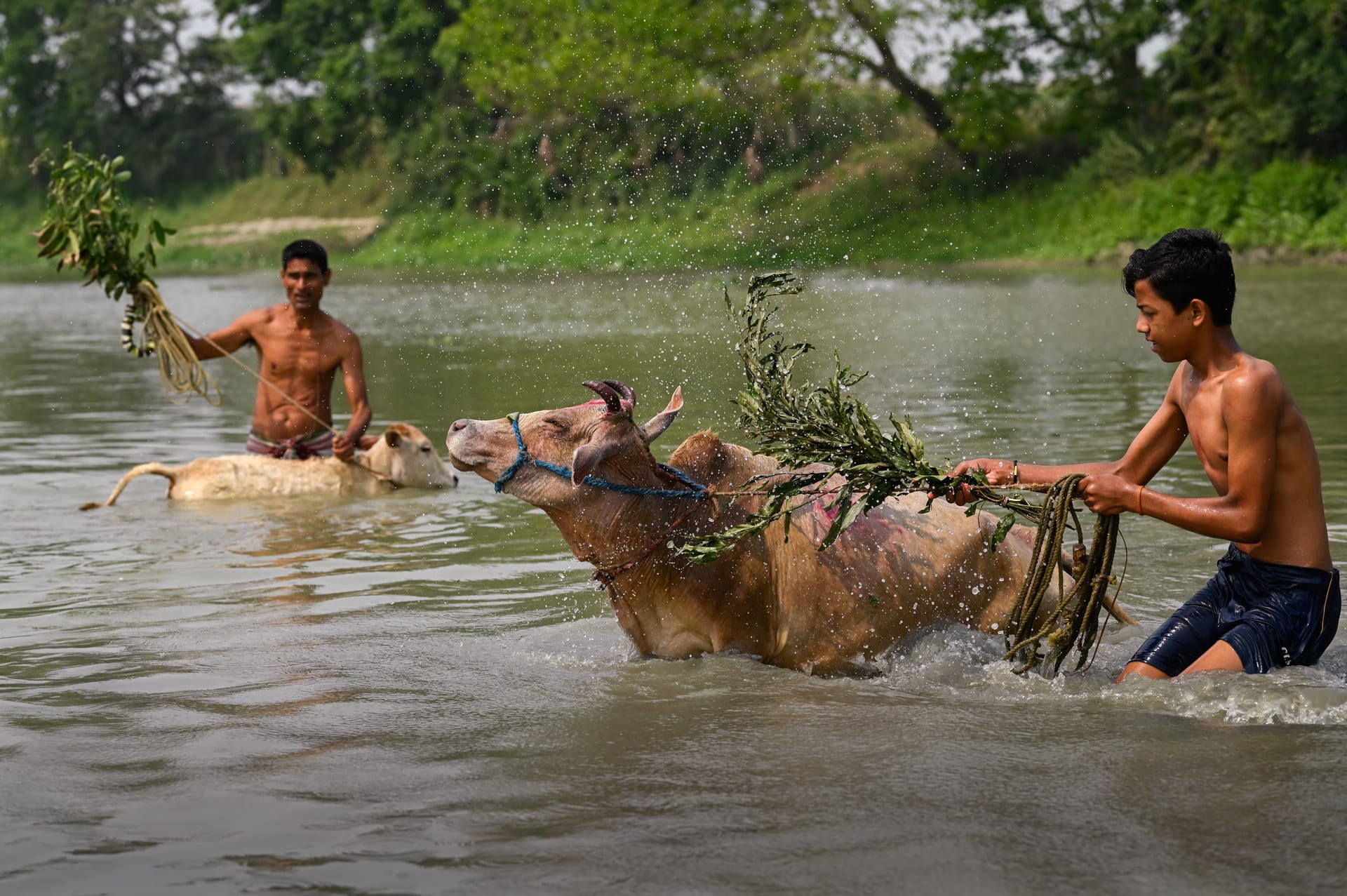
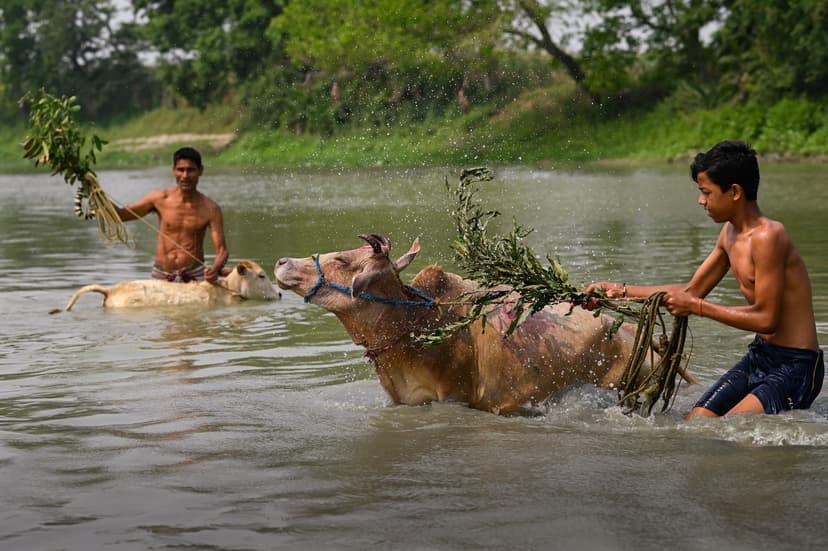
While the stalks fall, the cattle are addressed in a short formula whose more or less standard form across the valley runs:
Dighloti dighal pat, goru kobao jat jat. Makhioti makhi pat, makhi maro jat jat. Lau kha bengena kha, bosore bosore barhi ja. Mar xoru baper xoru, toi hobi bor bor goru.(Assamese)
“Long-leafed dighloti, long leaf, we strike the cattle as we go. Makhioti, leaf against the fly, we swat the flies as we go. Eat gourd, eat brinjal, grow bigger year by year. Your mother is small, your father is small, but you will be a great cow.”
The address is at once a blessing on the herd and a small piece of domestic theatre. Children learn it before they understand it. The cattle are then driven back to the family compound and released. The spent stalks are hung from the eaves of the cowshed, and towards evening a slow smoke is raised in the byre to keep off the flies. The household kitchen turns to the evening dishes, which lean on the new harvest of mati mah, urad and matikalai pulses. The village then waits for the following morning.
Manuh Bihu, the day of people
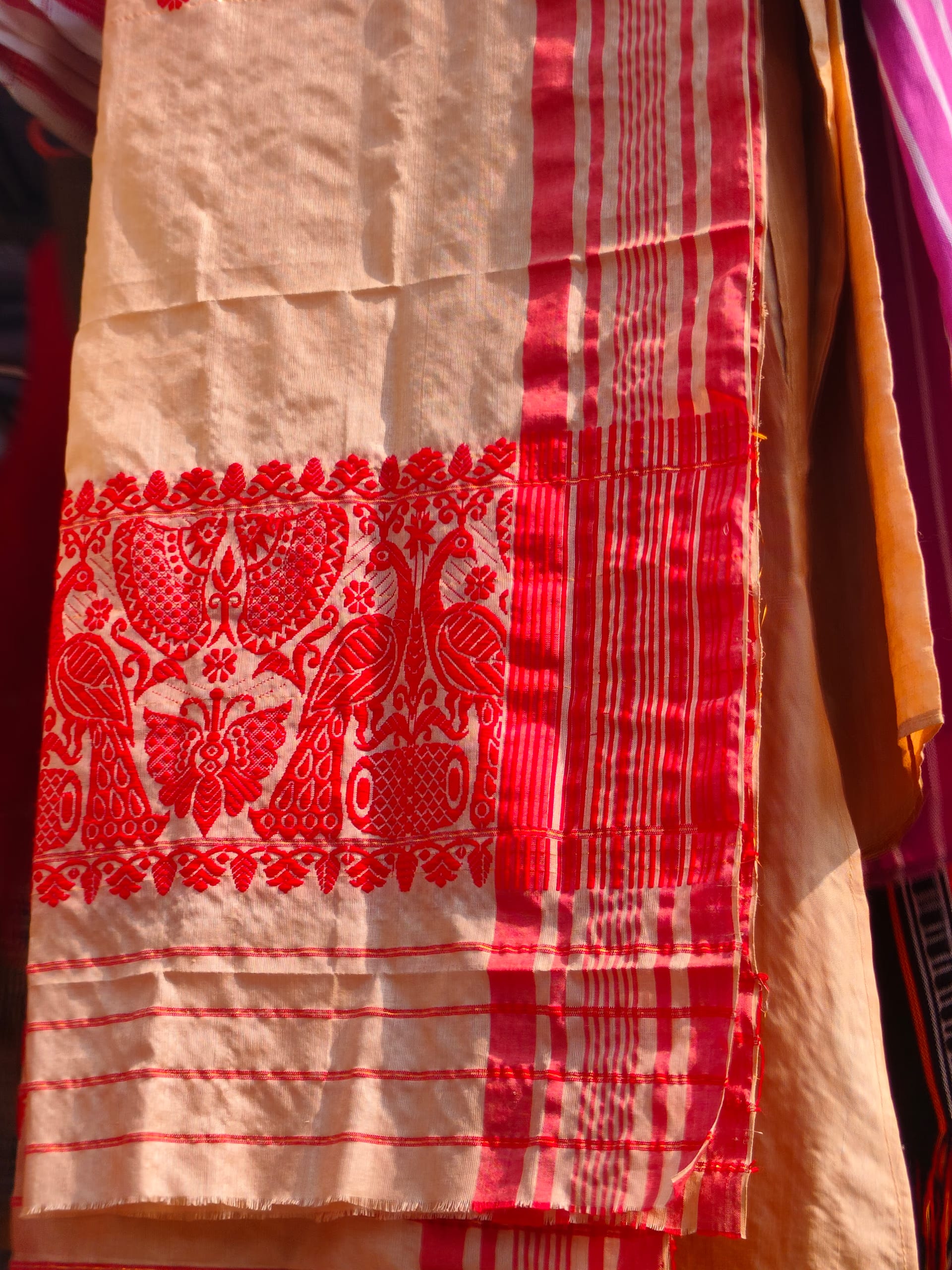
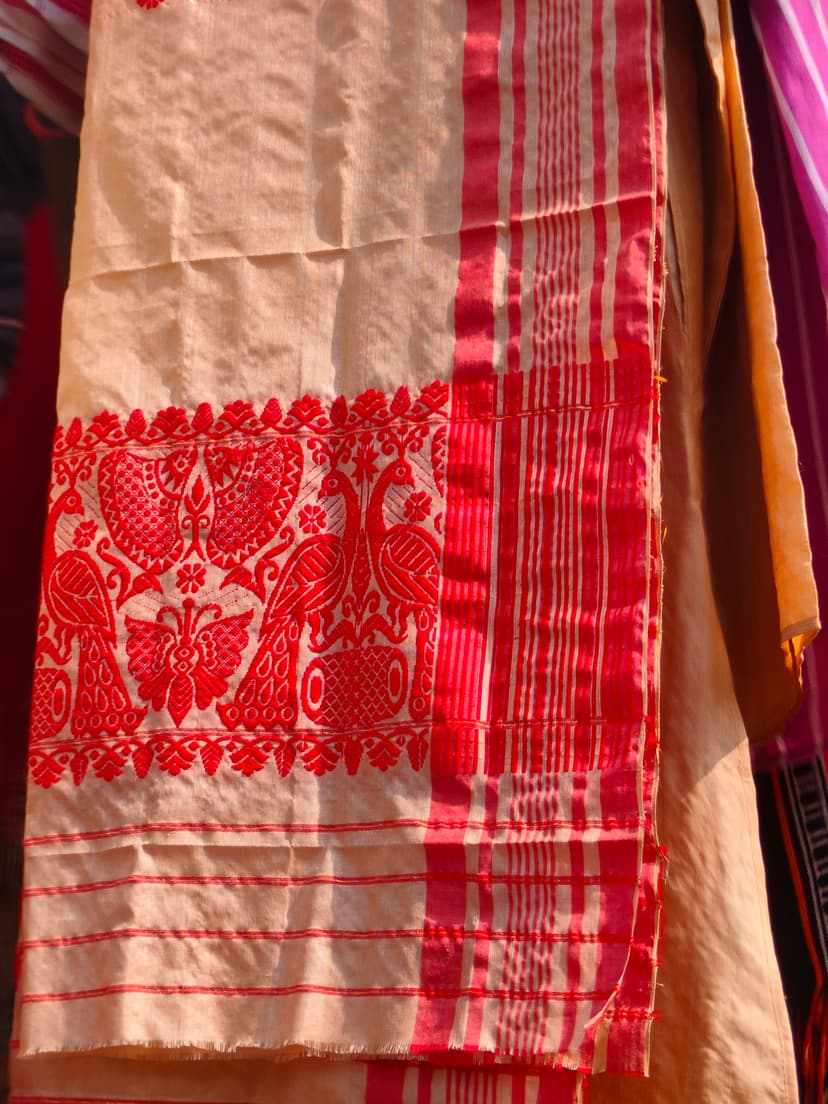
The first day of Bohag, traditionally the first of the Assamese new year and usually around 15 April, is Manuh Bihu. The day opens with a bath taken with the same mah-halodhi paste, a change into new clothes, and the exchange of gamosas across the household. A gamosa given at Bihu carries its own name, the bihuwan. The form of the exchange is precise. A younger person presents the gamosa to an elder with the hands held in front of the chest and the gamosa folded long. The elder receives it, lays it across the shoulder, and gives a small blessing. The sequence is repeated through the day in concentric circles outward from the household: parents and grandparents first, then older relatives, then friends, then teachers, then in many cases the local mandir or sattra. By evening, well-conducted households have given and received dozens of gamosas. The gamosa itself is a white cotton cloth, traditionally about a metre long and forty centimetres wide. It is bordered in red, often with a central woven motif in red, and sometimes with the giver's name inscribed near one end.
The five days that follow
After Manuh Bihu the cycle continues across five further days, each with its own name and emphasis. The day labels and their ordering vary somewhat across upper Assam, lower Assam and the Barak valley, but the standard form is preserved most consistently in the upper Brahmaputra districts. Even the list of seven is not fixed. Older village reckonings add Nangolor Bihu, the day of the plough and the field gear, while others keep Kutum Bihu, the day of kin, given to visits and meals shared with relatives. Some count the song-filled nights of Sot that precede Goru Bihu, the Raati Bihu and Sot Bihu, as part of the festival itself. In the form given here, the third day is Gosain Bihu, the day of the household deities. The family altar is bathed, redressed and reconsecrated. Offerings are made to the household tutelary, to the portraits of parents and grandparents, and to the Bhagavad-Gita or whichever text the house holds in honour. It is followed by Taator Bihu, the day of the weavers, when the household loom, the taat, is honoured and the year's first weaving is begun. In sattra communities the same day overlaps with the spring reconsecration of the namghar.
The two most public days come next. Senehi Bihu, the day of beloved persons, is given to the exchange of small gifts between friends and lovers: a gamosa, an ornament, in the modern era sometimes a hand-written card. In many districts it is remembered as Jiyori Bihu, the day on which married daughters return to their parents' homes. Among the unmarried young it is also the day on which the open Bihu dance of the village field, the Mukoli Bihu, is most likely to be held. Mela Bihu, the day of the fair, brings the organised village or town Bihu mela, where troupes gather from several villages and a Bihu competition often closes the day. In the larger towns Mela Bihu has become the most visible single day of the whole cycle, with public stages, song competitions and televised events built around it.
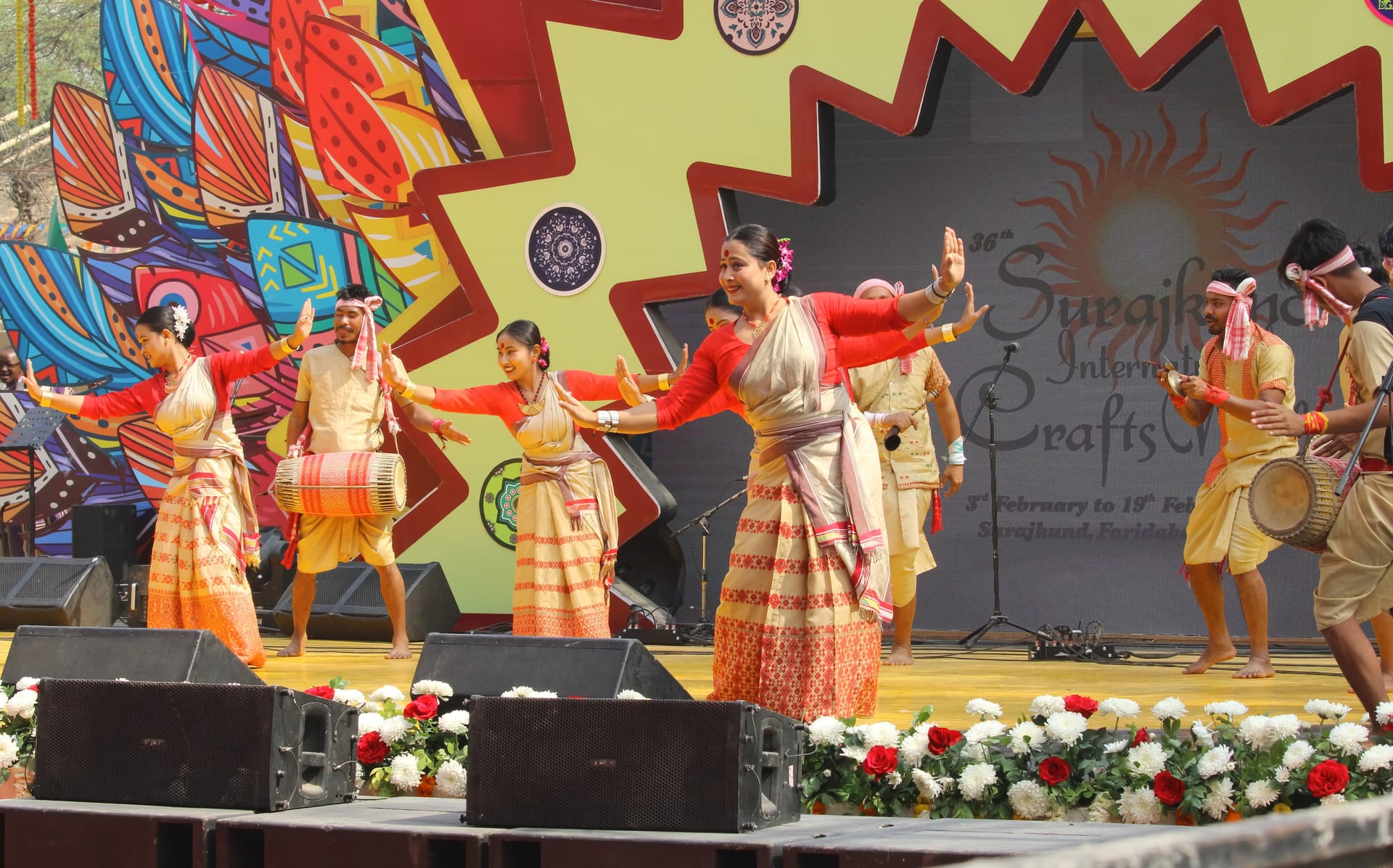
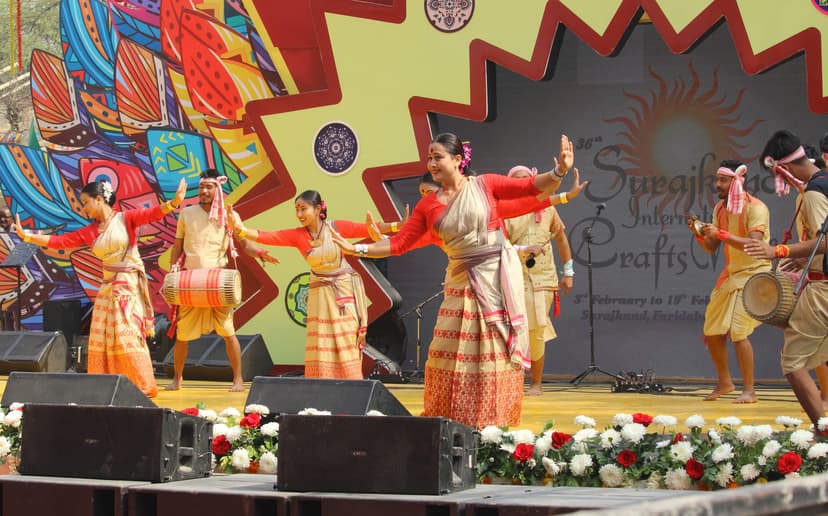
The week closes with Chera Bihu, in some districts Sera or Phato Bihu, and by its other name Bohagi Bidai, the farewell to Bohag. Households return to the ordinary rhythm of the new agricultural year. Families exchange the pithas made during the week, and the old clothes set aside on Manuh Bihu are formally given away to the household help or to those in need. The dhuliyas, the drummers who have carried the Husori from house to house all week, make their last circuit of the village.
Husori and Mukoli Bihu, the two performance forms
Two performance traditions move alongside the seven days: the door-to-door Husori and the open-field Mukoli Bihu. Both belong to the family of the Bihu dance, where their choreography is described in full. What matters to the calendar is how each is woven into the week. The Husori announces itself at the gate of each house, the podulimukh, with a roll of the dhol before the troupe enters the courtyard. It visits every household in the village over the course of the week. In return the family offers betel and areca laid out in a brass xorai, the pedestalled offering tray of the valley. The family also presents the troupe with a gamosa, sometimes adding a little money. Carried in this way from threshold to threshold, the festival is not merely watched. It is drummed through the whole settlement until every house has been sung over. The Mukoli Bihu, by contrast, is the open public Bihu of the village field. It is most likely to be danced on Senehi Bihu, when the young of the village gather under the dhol.
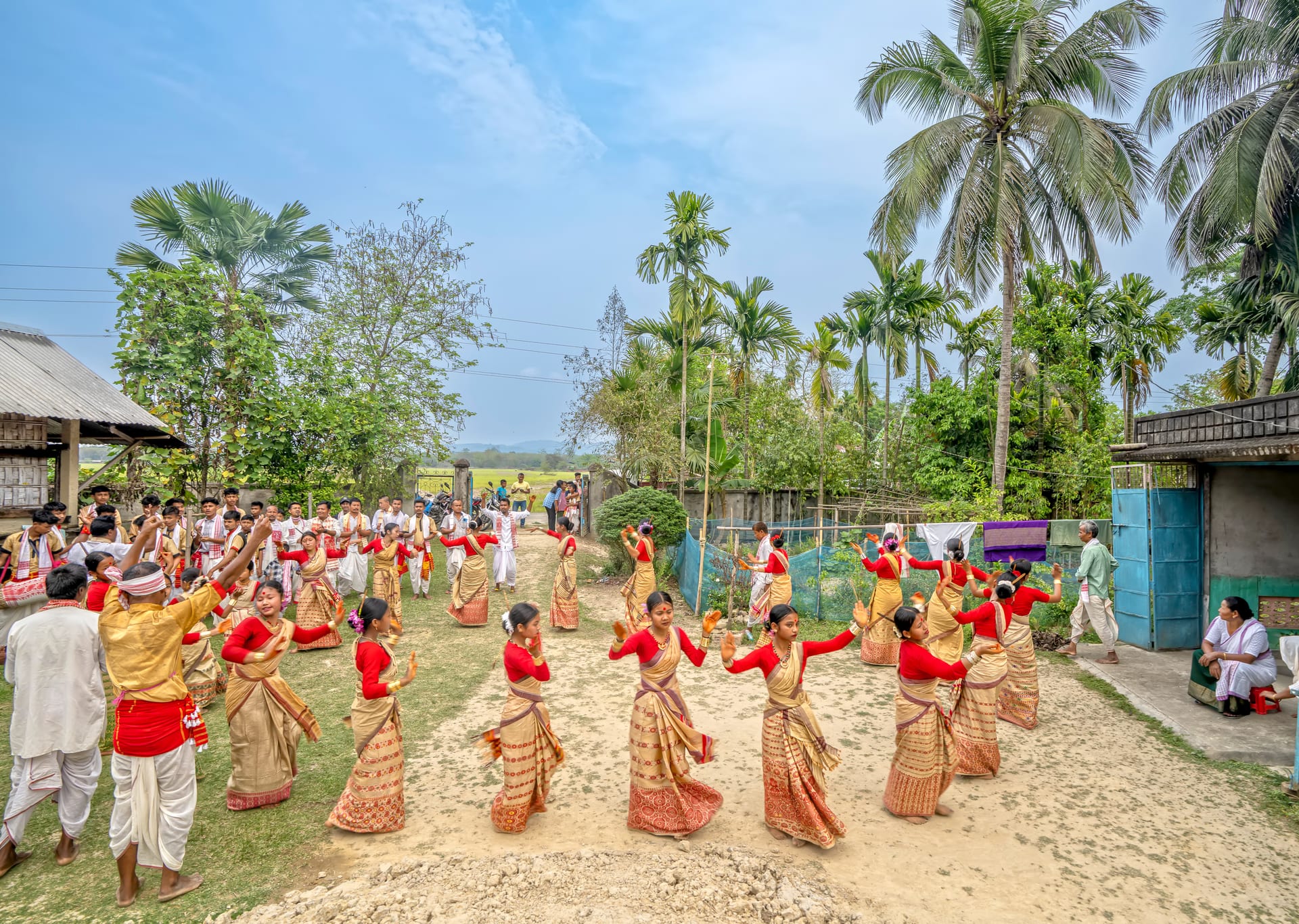
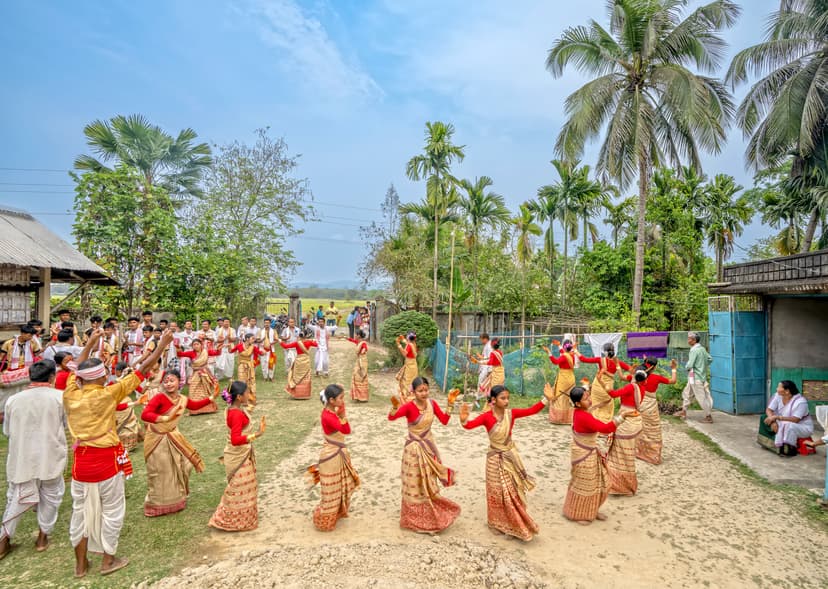
The historical relationship between Husori and Mukoli is sometimes presented as one of sacred and secular, but this is too clean a distinction. Husori troupes carry secular love songs in their repertoire and Mukoli circles frequently begin with a short invocation. The two forms share dancers, drummers, and singers across the same week. The difference is the venue more than the material.
The instruments and the songs
What carries the festival from courtyard to courtyard is its sound, and the sound is made by a small, fixed ensemble. Its leader is the dhol, the double-headed wooden drum of the valley, slung at the drummer's waist and played with a thin cane stick in one hand and the bare palm of the other. The dhuliya's opening roll announces the Husori at each gate, sets the tempo of the Mukoli circle, and does not stop until the dance does. Beside the dhol sounds the pepa, a reed pipe fitted into the curved horn of a buffalo. Its high, wailing call is the single most recognisable sound of Bihu, and the season is often said to begin when the first pepa is heard.
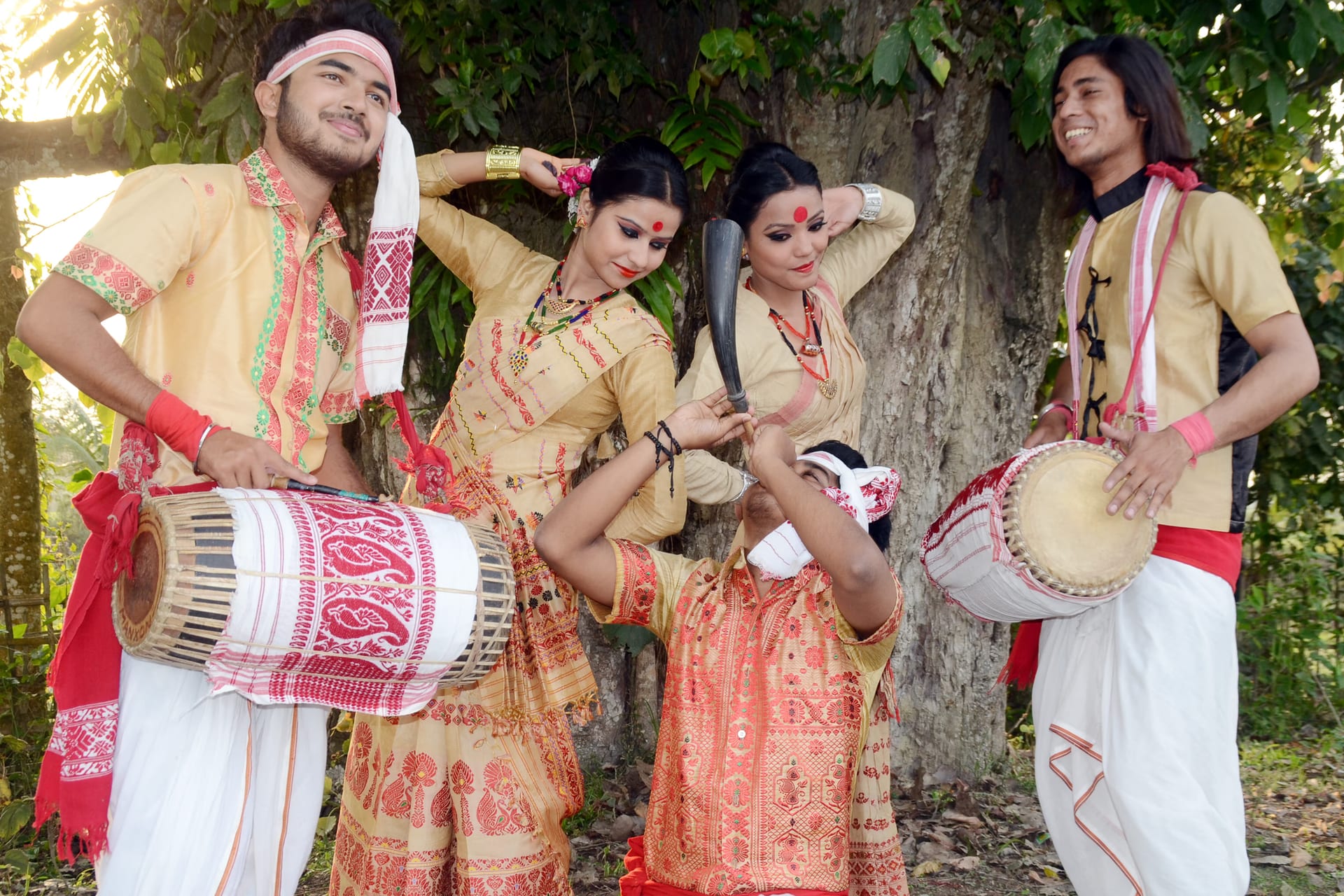
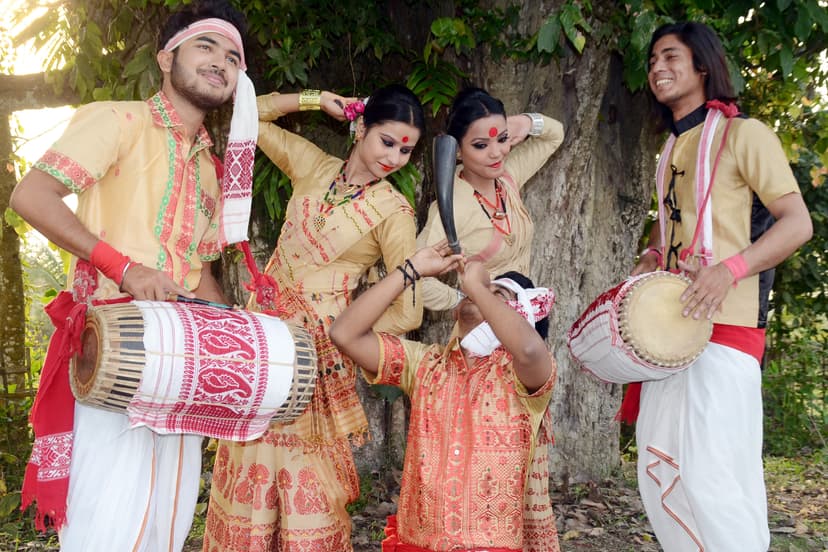
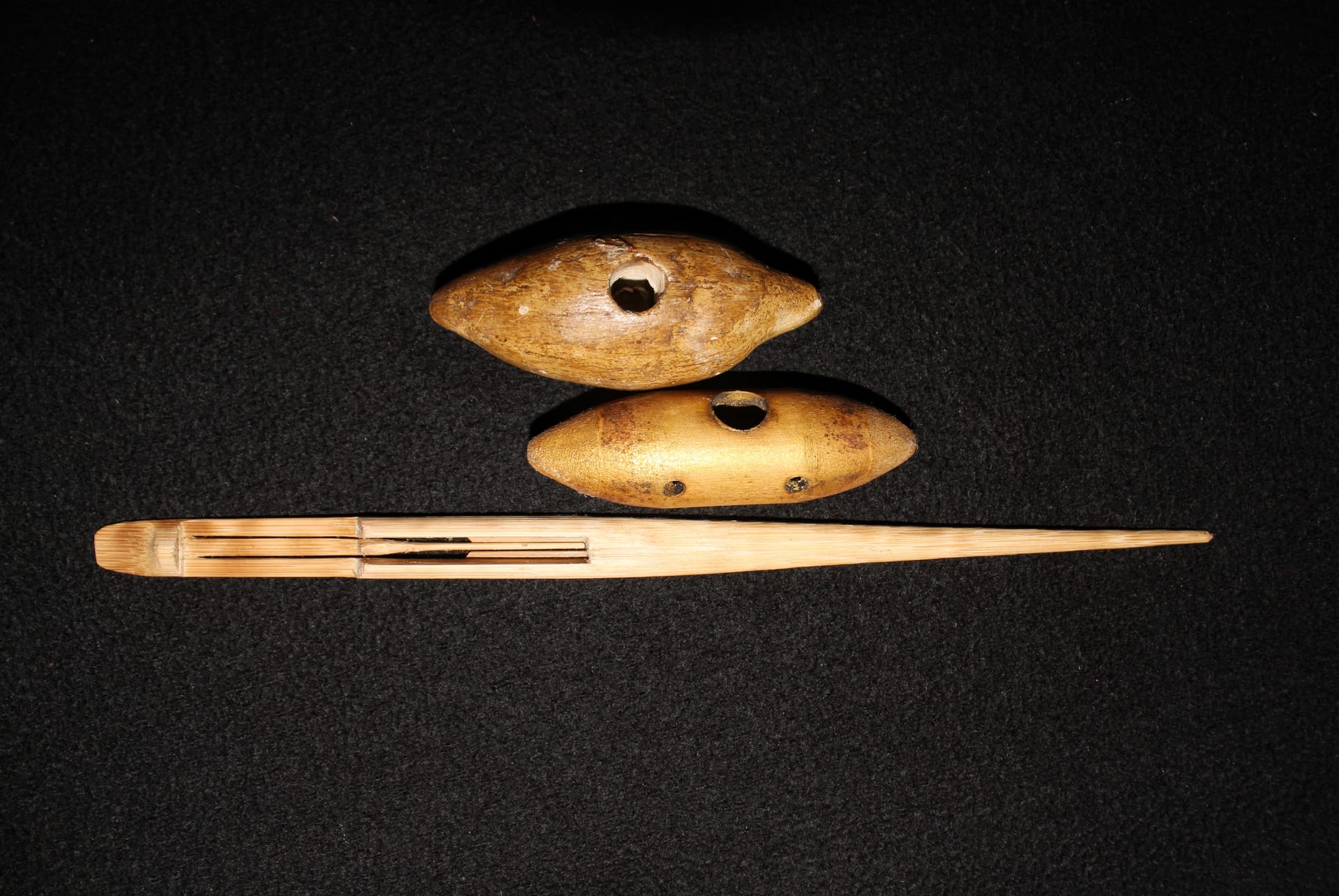
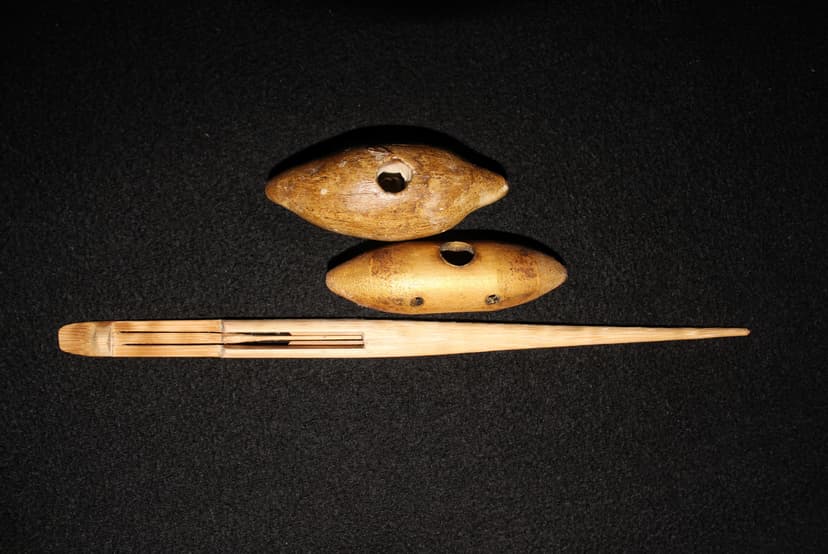
The rest of the ensemble comes from the village compound itself: bamboo, clay and a little brass. The gogona is a jaw harp cut from a single piece of bamboo. Its long split tongue is plucked while the frame is held against the teeth, and it is above all the instrument of the women, who dance with it and answer the dhol with its twang. The xutuli is a small whistle, most often of clay, whose fluttering call imitates birdsong. The toka is a length of bamboo split down the middle so that its halves clap against each other, and the taal are small brass cymbals that mark the beat. Almost the whole orchestra can be made from what the paddy country grows, which is fitting for a festival that marks the sowing.
Over this ensemble runs the vast repertoire of Bihu songs, the bihunaam. They are short rhymed couplets, composed anonymously and passed down orally, and they exist in the thousands, one of the largest bodies of folk poetry in the Assamese language. Their subjects are the subjects of the season: love and courtship above all, then the fields, the river, the rain, and a steady vein of teasing and satire. In the dance they are traded between the young men and the young women, verse answering verse. The Husori troupes carry a different and older layer of the same tradition, songs of blessing sung to each household in turn. It was through this whole body of song that Goswami read the festival, and the repertoire is still growing, on the mela stage as much as in the field.
The cycle across communities
Rongali Bihu is observed by Assamese-speaking communities across religion: Hindu, Muslim, Christian, Sikh, the Sankarite sattra tradition, and the non-affiliated alike. It is also the moment in the calendar at which the agricultural community of the valley most visibly overlaps the agricultural community of the plains generally. The Bodo Baisagu falls in the same week. Across recent decades, Baisagu and Rongali Bihu mela days have come increasingly to share the same urban performance spaces. The modern public scale of the festival is considerable. On 14 April 2023 a mass performance of 11,298 dancers and drummers at the Indira Gandhi Athletic Stadium in Guwahati was entered in the Guinness World Records as the largest Bihu dance at a single venue. Such spectacles are recent, and they sit atop a festival whose weight has always lain in the courtyard and the field. The festival is, in any honest accounting, an agricultural new year rather than a religious one. That is perhaps the most important single fact about it.