
Madan Kamdev is the richest surviving sculptural site of ancient Kamarupa. It is a ruined temple complex on a wooded hill in the Kamrup country north of Guwahati. The shrines themselves have long collapsed. The carved stone they were raised from still lies scattered across the hillside in great quantity, and so freely erotic, that the site has earned the name the Khajuraho of Assam.
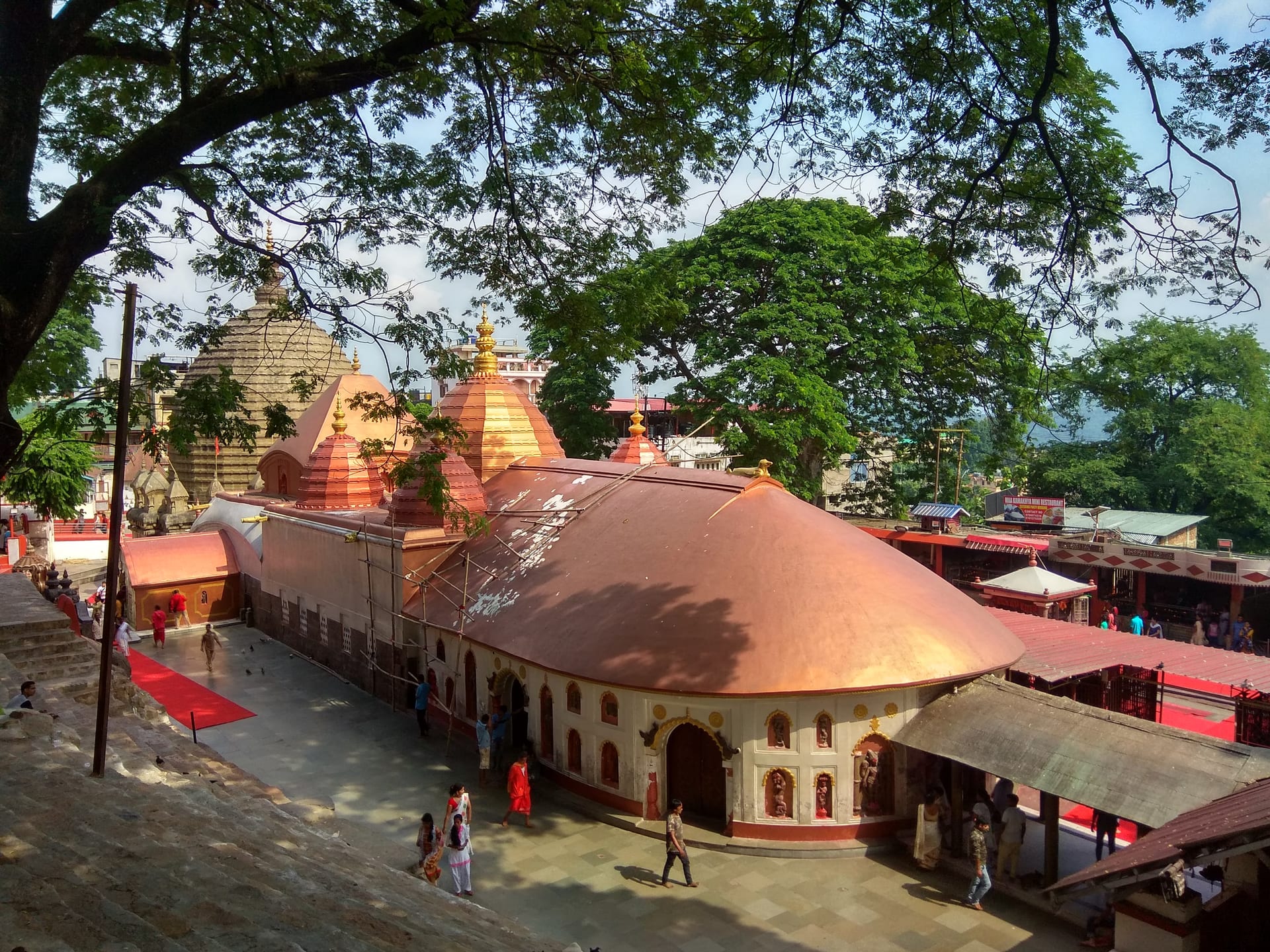
The place takes its name from Madan and Kama, both names of Kamadeva, the god of love. Local legend holds that here Kamadeva was burned to ash and then restored. The gods had sent him to break Shiva's meditation and turn the ascetic's heart toward Parvati. When his flower-tipped arrow stirred Shiva's senses, the enraged god opened his third eye and reduced Kama to ashes. At the pleading of Rati, the love-god's widow, Shiva revived him bodiless, present everywhere and visible nowhere. From that state comes his epithet Ananga, the bodiless one. That is only the first recovery. The fuller tradition holds that later, in this land, he regained his lost form, his rupa, and that recovery is the story behind the name Kamarupa itself. The whole chain, from Sati's death through the burning to the land's name, is told as a lore.
The Three Names of the Land
Pragjyotisha, Kamarupa, Asam. A valley that has worn three names across three ages, each with its own legend, from the place of eastern light to the name the whole country carries still.
The same burning is claimed by more than one Kamarupa site. Among them is the island of Umananda, whose older name Bhasmacala, the hill of ashes.

The last flowering of a kingdom
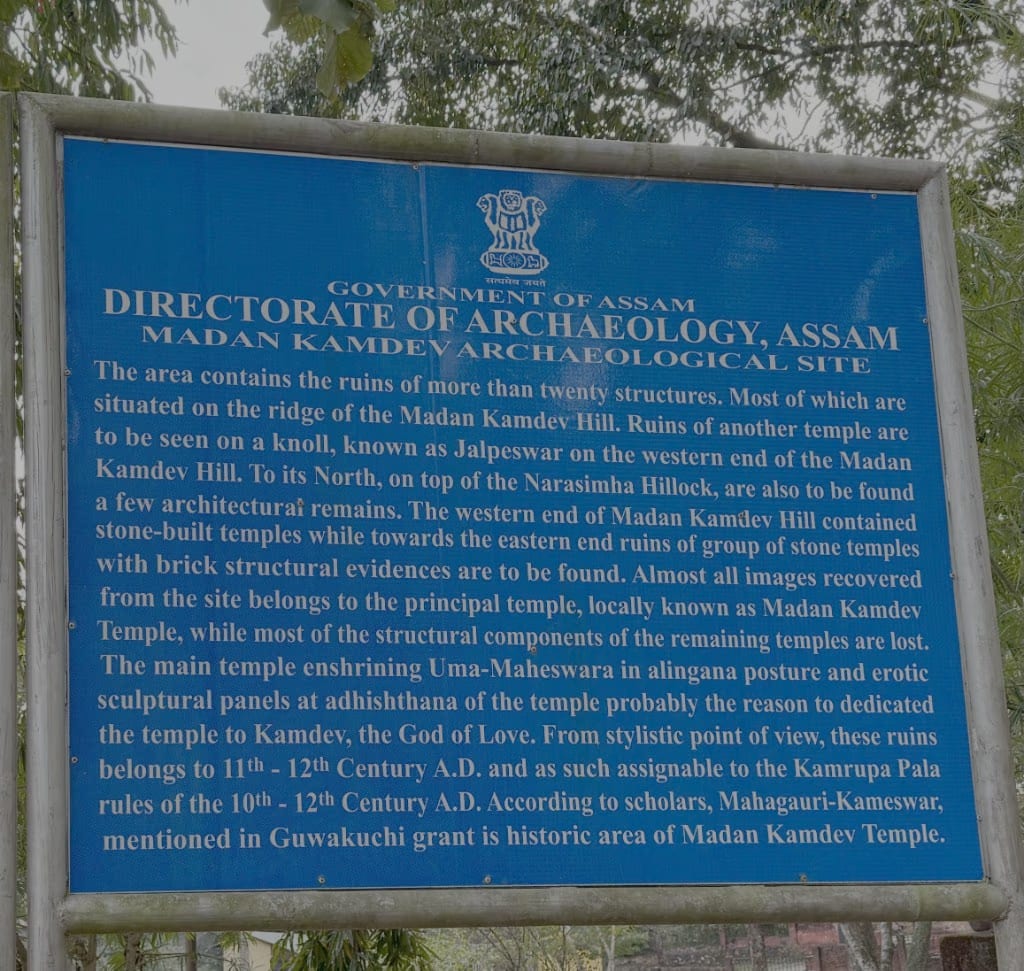
The complex is the work of the Pala dynasty of Kamarupa, the last of the valley's three classical houses. They held the country from about 900 to 1100 from their seat at Durjaya in the North Guwahati country. Under kings like Ratnapala the kingdom reached the last flowering of its classical culture, and Madan Kamdev is its most astonishing surviving monument. On the evidence of its style the ruins are dated to the tenth through twelfth centuries, the Pala age and a little beyond. The area holds the remains of more than twenty structures strung along the ridge, a dense scatter of carved stone spread over roughly half a kilometre. Almost every image recovered belongs to the principal shrine, the temple locally called Madan Kamdev. Its main image was Uma-Maheshvara, Shiva and Parvati embraced, raised above a base carved with erotic panels.

The temple and its carvings
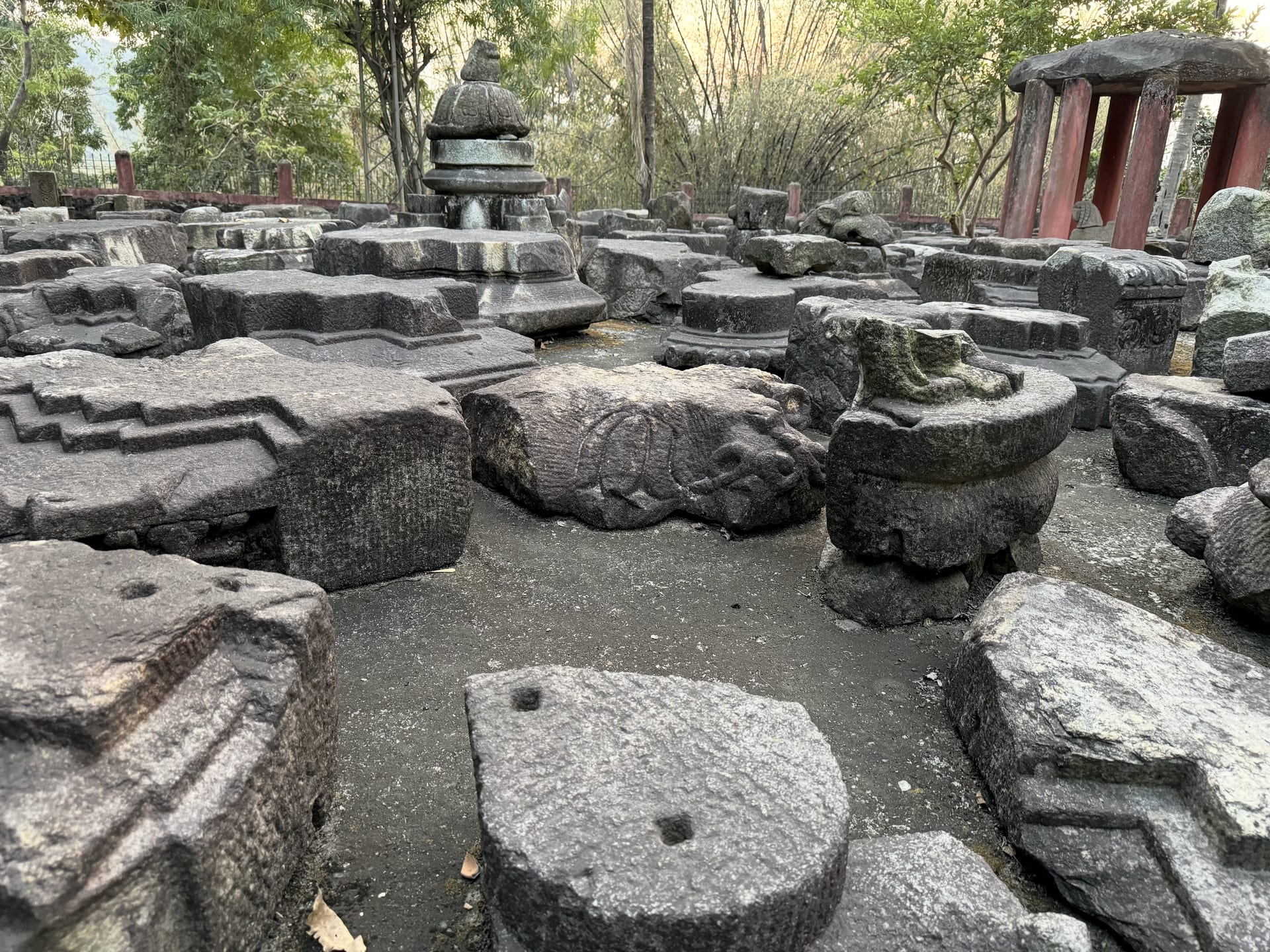
The site drifted at the edge of scholarly notice for more than a century. The British administrator Edward Dalton saw it in the eighteen-fifties. Assamese antiquarians wrote it up in the nineteen-forties. The Archaeological Directorate of Assam took it in hand in 1977 and brought the buried complex back to light. Much of the recovered stone is now gathered in an open collection on the site itself, among the still-buried foundations. The carving is read course by course from the temple base upward. The moulded plinth, the adhishthana, runs with friezes of small figures above bands of floral and lion-mask ornament.
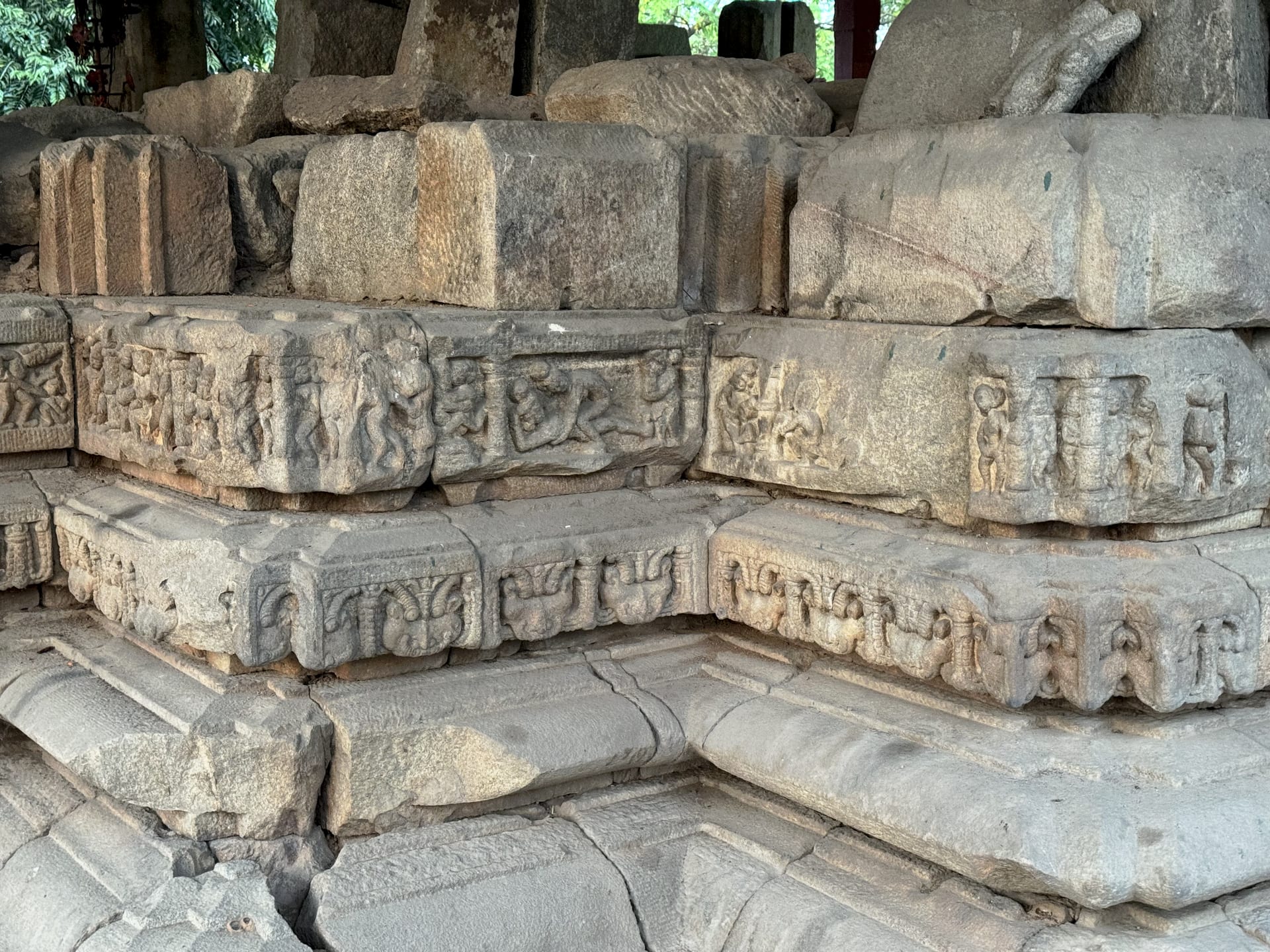

Above it the deities stand in pillared niches. They are worked in the dense, rounded manner of the eastern-Indian school, but in a vocabulary distinctly Kamarupi rather than borrowed.
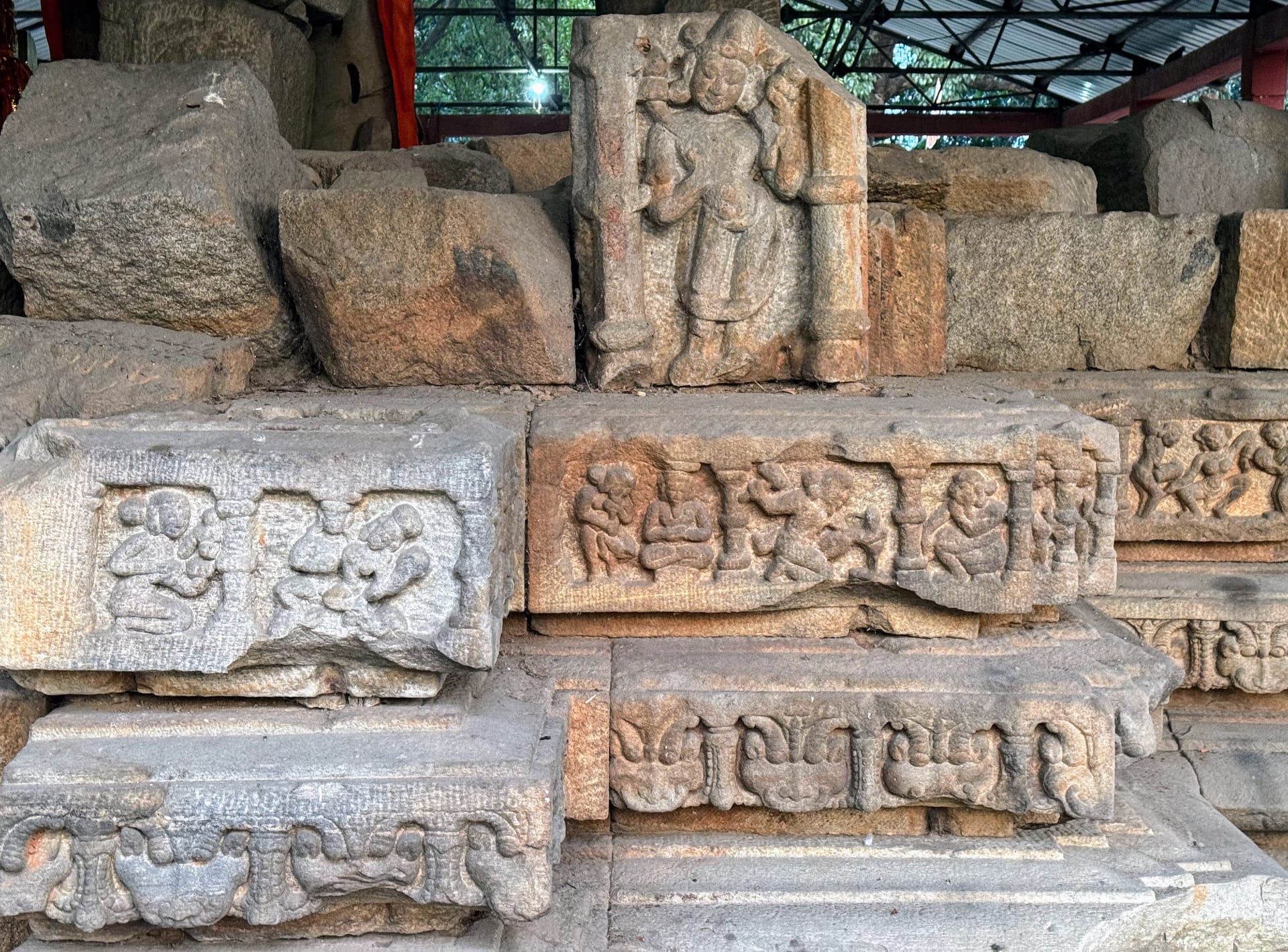

The recovered pantheon ranges across the Saiva and Sakta iconography that dominated the kingdom's religion. It includes a six-headed Bhairava and a four-headed Shiva, the embracing Uma-Maheshvara, Ganesha, the sun-god Surya, Saraswati and Vishnu, the wish-tree Kalpavriksha, and a crowd of attendant apsaras, musicians and animal figures. The full range of that late temple art, set beside Da Parbatia and the other valley sites, is treated in the chapter on Material Culture.
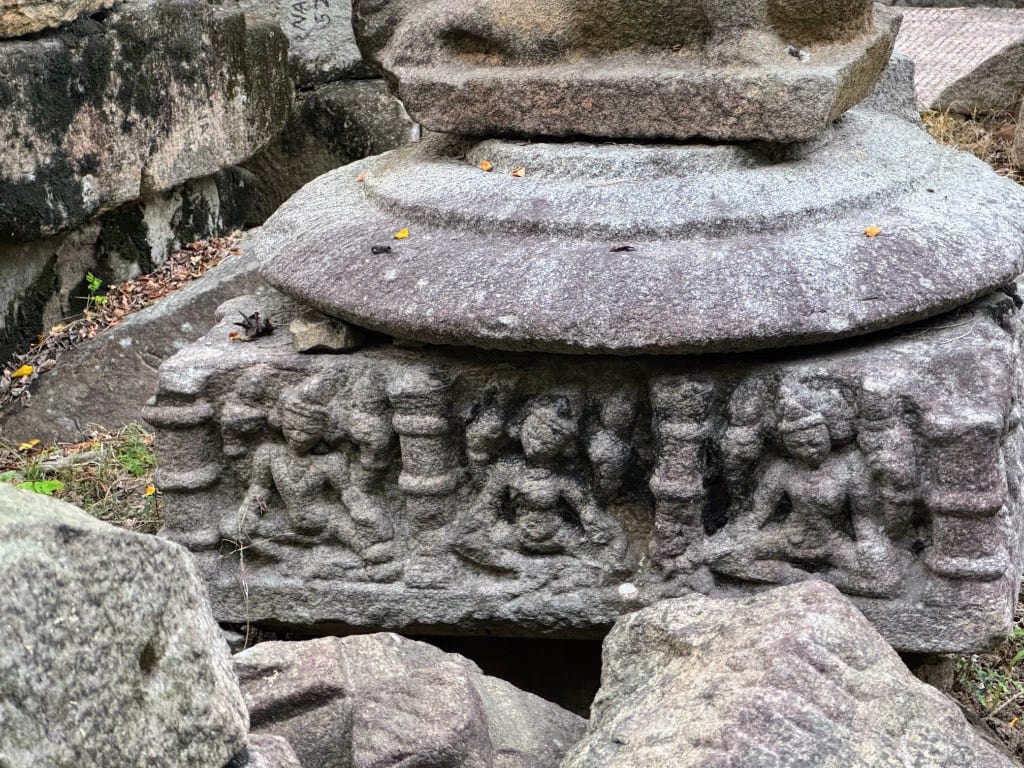

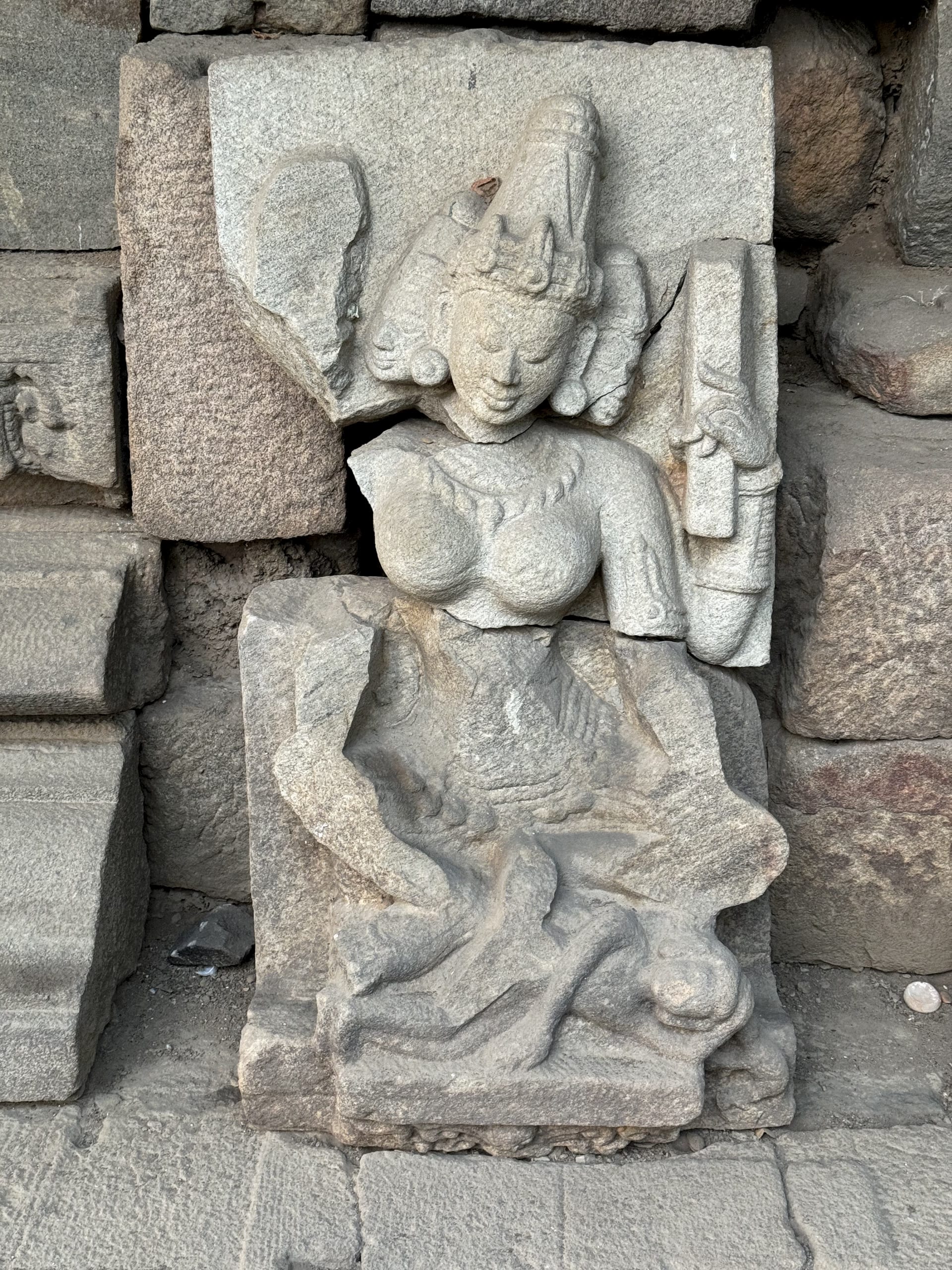
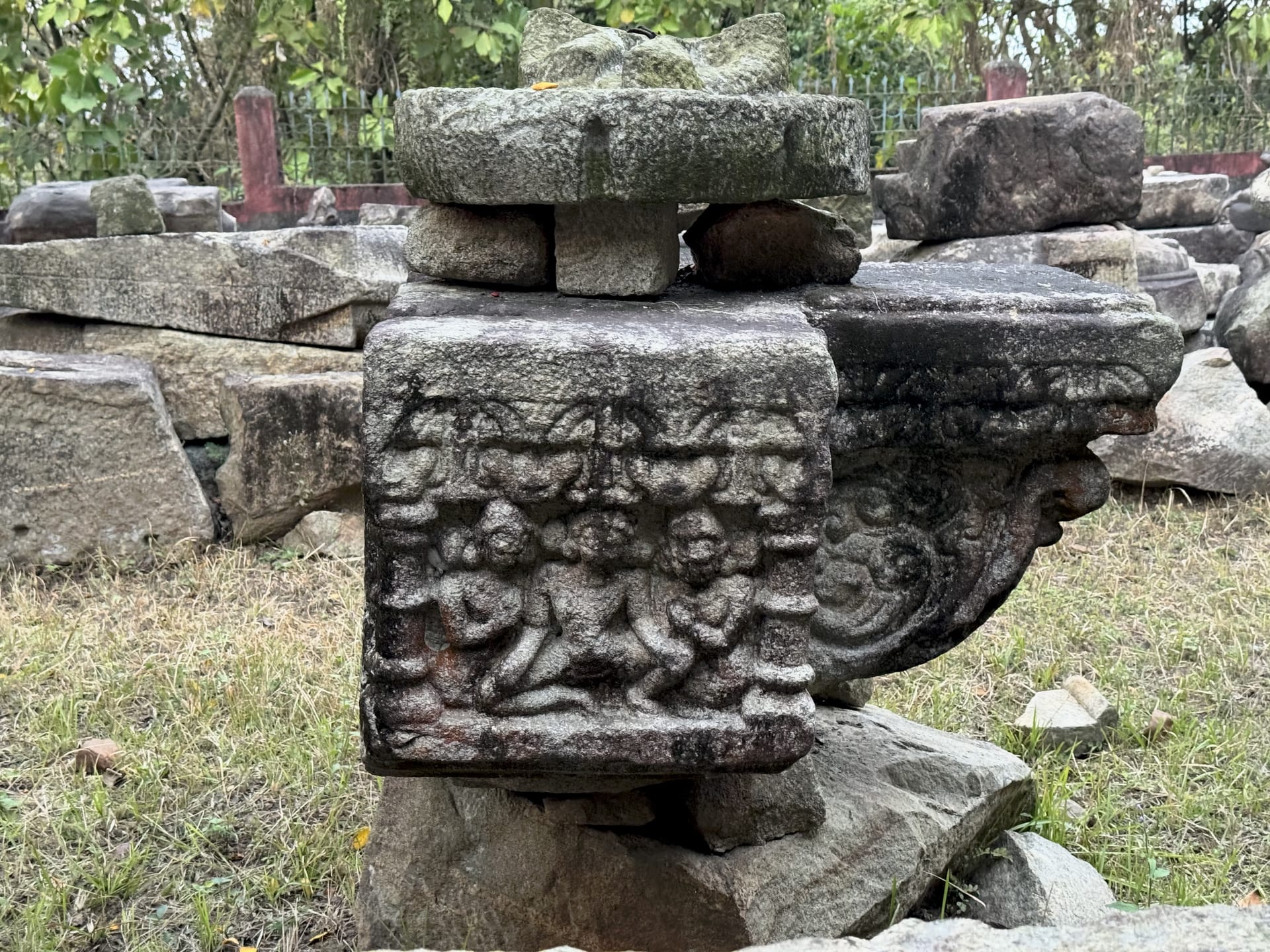
The finest of the recovered images are the crowned celestial women, carved with the full, ornamented refinement of the Pala manner. Scattered among them lie the members of the buildings themselves, the ribbed amalaka crowning-stones and the carved brackets that once framed the towers. The erotic sculpture that gives the site its name sits within this religious programme. The tantric current strong across the region reads it as the union of male and female principles from which creation flows, the same current that centres on nearby Kamakhya. Madan Kamdev therefore carries an unusual weight. It is one of the very few places where the religious art of Kamarupa can be seen in quantity rather than in single stray images.


Sheltered in the retreat of 1206
By one local tradition the hill has a place in a much later story. When the shattered remnant of Bakhtiyar Khalji's cavalry came down from Tibet in 1206 and found the bridge home broken, the trapped column is said to have sheltered in a tall temple near the crossing. Some remember that refuge as the ruined shrine country of this hill. The full disaster of that year is told as a lore.
Bakhtiyar's March to Tibet
In 1206 Bakhtiyar Khalji led ten thousand horsemen toward Tibet. A few months later, after the mountain roads, local resistance and floodwaters closed around them, barely a hundred returned.
Visiting
Madan Kamdev lies on a wooded hill near Baihata Chariali, a short drive north of Guwahati, and can be seen in a half-day. An on-site collection gathers much of the recovered sculpture among the still-buried foundations, so the visitor comes for the carved stone rather than for any standing temple. It pairs naturally with Kamakhya, where the tantric worship that fell silent here is still living ritual, and it is close enough to combine with the Saiva site at Hajo. The drier months from November to March are the most comfortable for the walk up to the ruins.