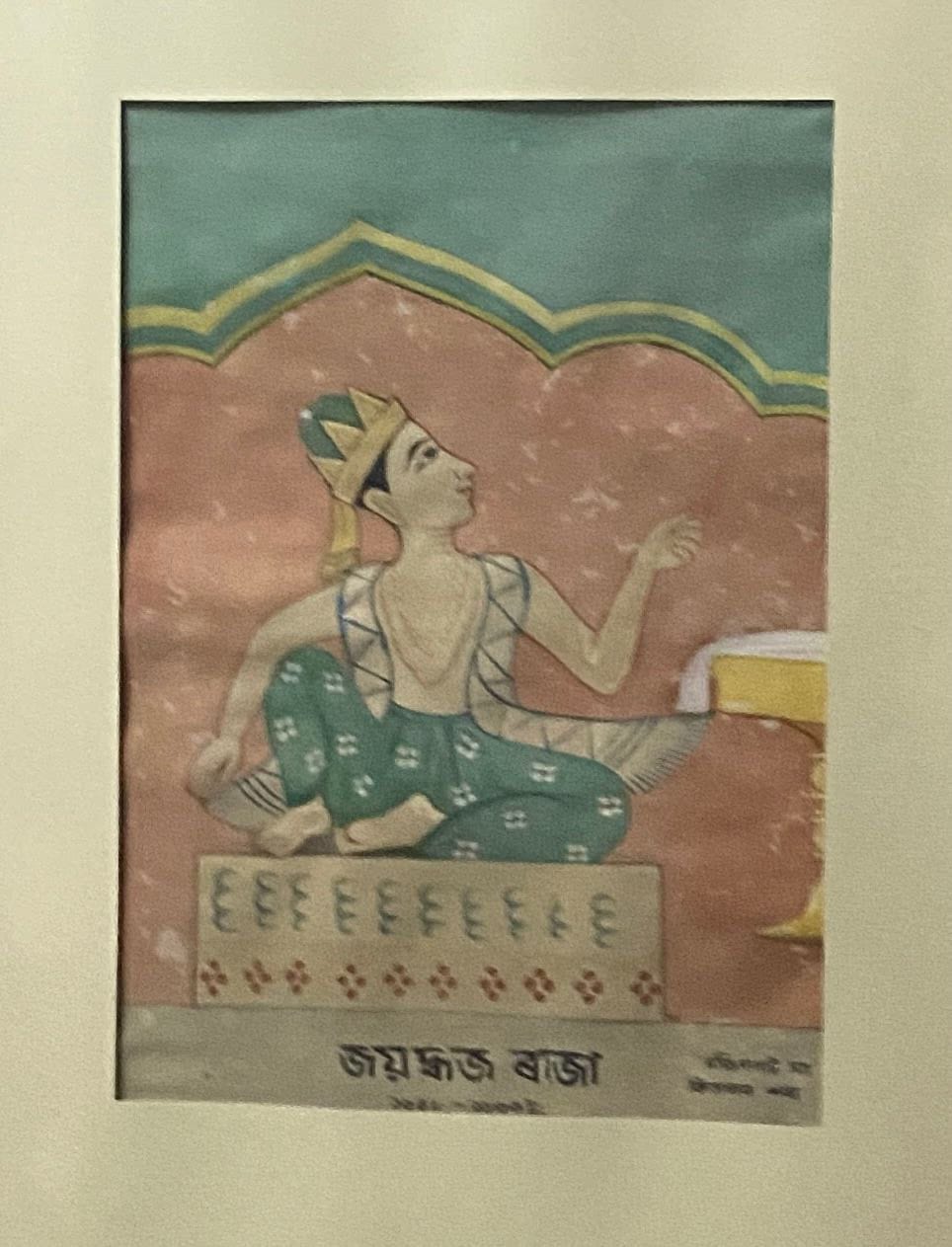
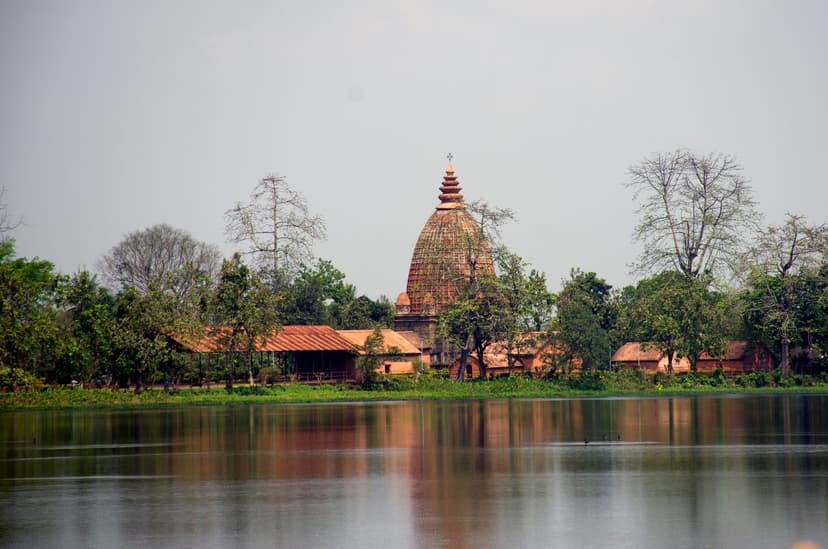
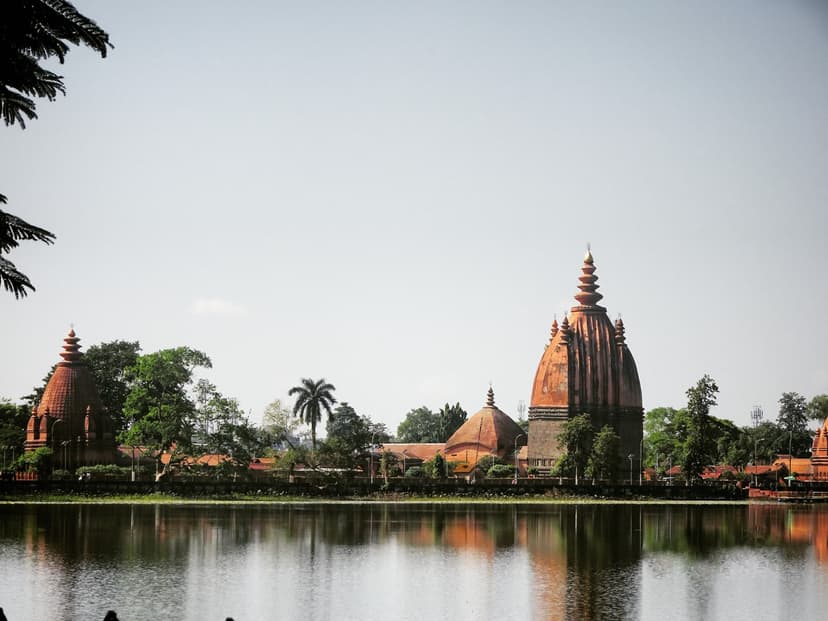
One of the longest-lived kingdoms in the recorded history of the Brahmaputra valley began as a war-band of a few thousand people coming down the wrong side of the mountains. Sukaphaa was a Tai prince of the Mong Mao country, on the present Yunnan-Myanmar border. By tradition he set out with a following of some nine thousand, with a few hundred horses and a couple of elephants. Around 1228 he brought them over the Patkai range at the Pangsau pass into the upper valley. The buranjis fix that date as the start of Ahom history. What he founded would last almost exactly six centuries, until 1826. What follows is not concerned with the man. His life is told in his own biography. It is concerned with the kind of state that the founding generation set in motion, between Sukaphaa’s crossing and his death around 1268.
A valley already full
Sukaphaa did not enter empty land. The upper plains he reached were already held by settled peoples: the Morans and the Borahis in the easternmost reaches, the Chutia kingdom on the northeastern flank around Sadiya, and the powerful Kachari kingdom to the south. The whole of early Ahom history is the story of how a small immigrant elite made and kept a place among them.
The decision that shaped everything afterward was not to rule as a closed conquering caste. The early Ahoms took wives from the Moran, Borahi and other local communities and drew them into the new polity. This was a deliberate policy of absorption rather than subjugation. A people who had crossed the Patkai in the low thousands could not have governed the valley any other way. The choice became a structural habit. Across six centuries the kingdom would repeatedly fold conquered or neighbouring peoples into its census and its labour rolls, rather than hold them at arm’s length. The band carried in a Tai language and a Tai religion. Over the same centuries these would slowly give way to Assamese and to the religions of the plains. That was the long price of its openness.
Charaideo and the first institutions
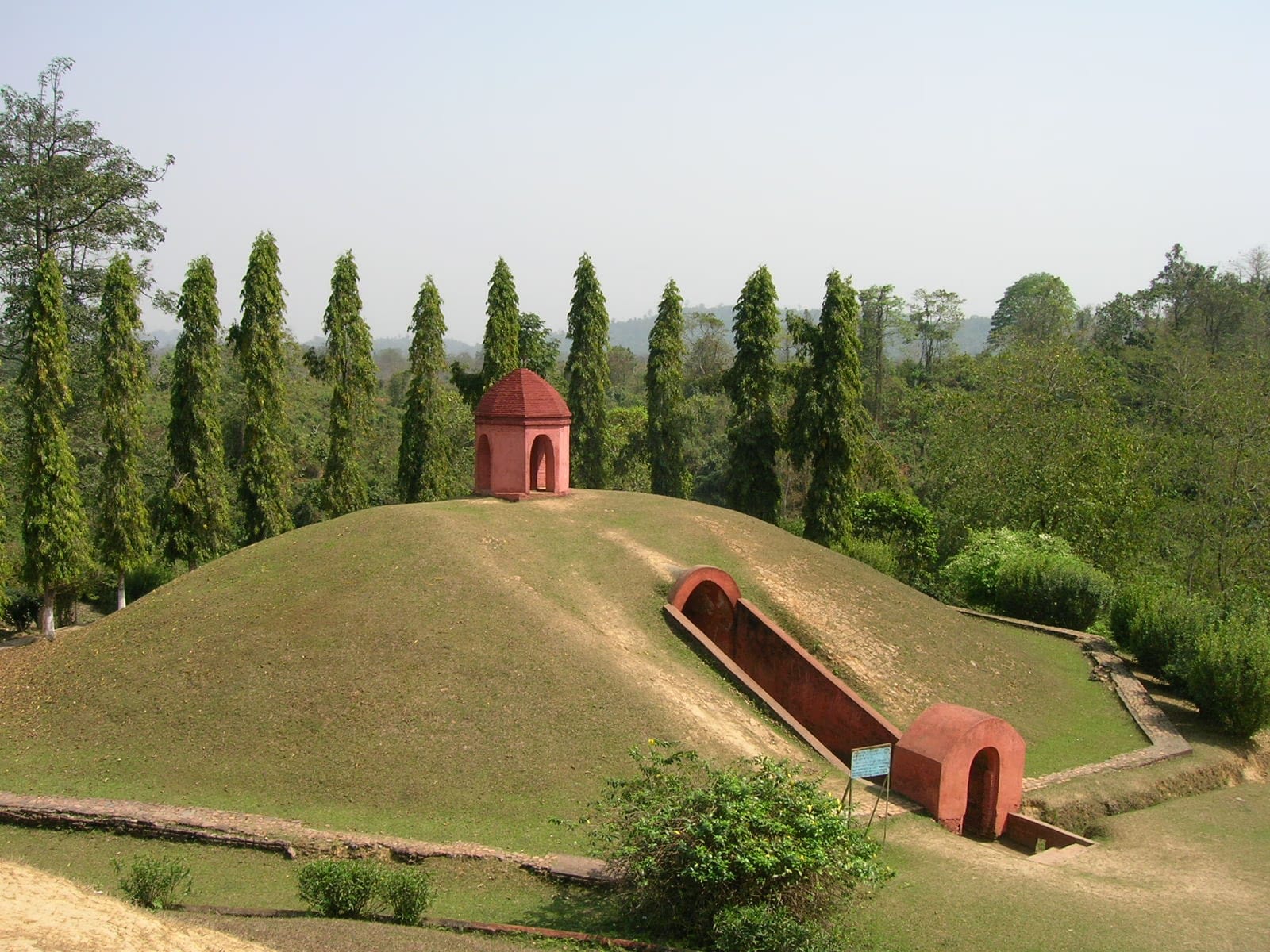
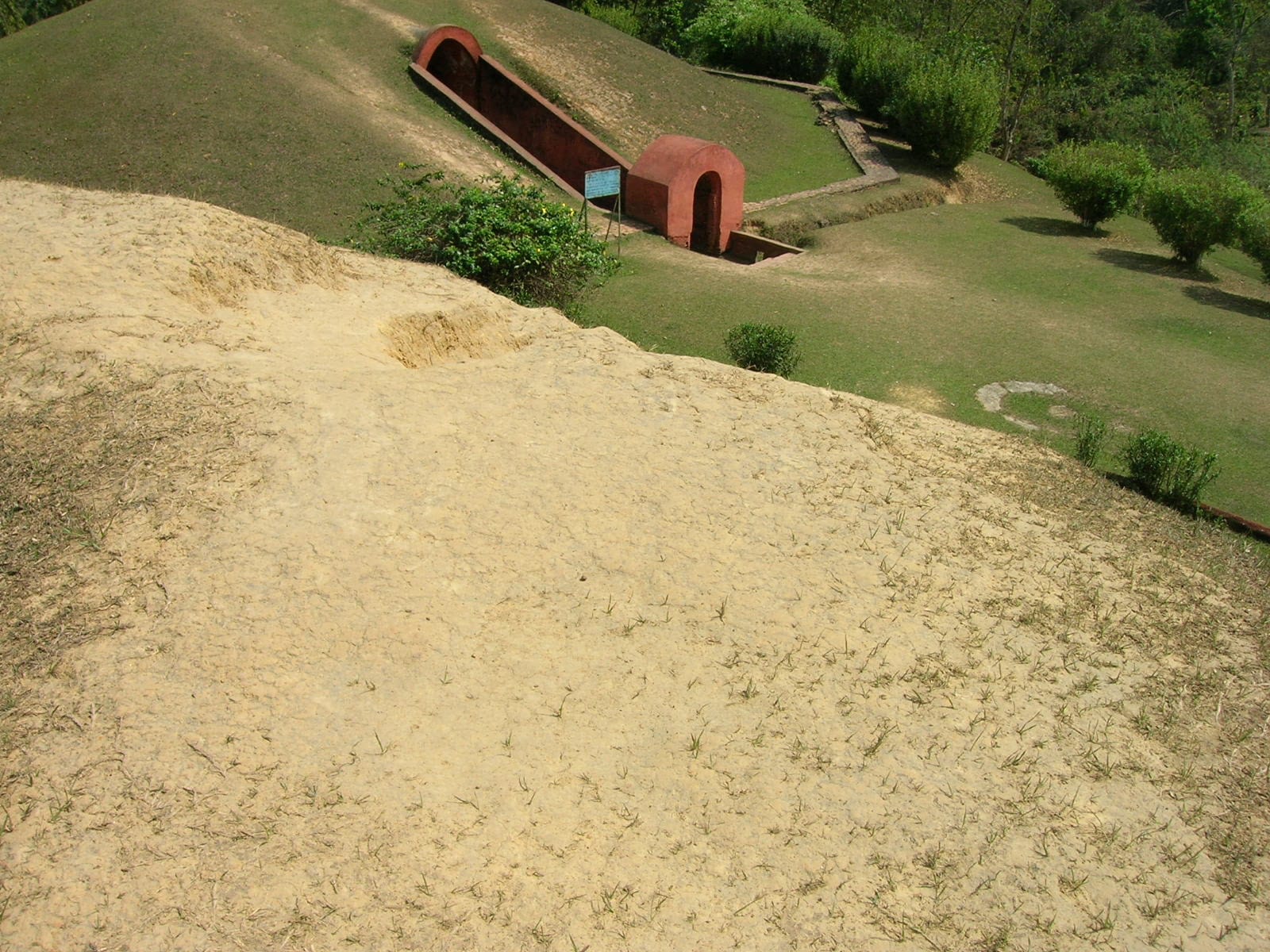
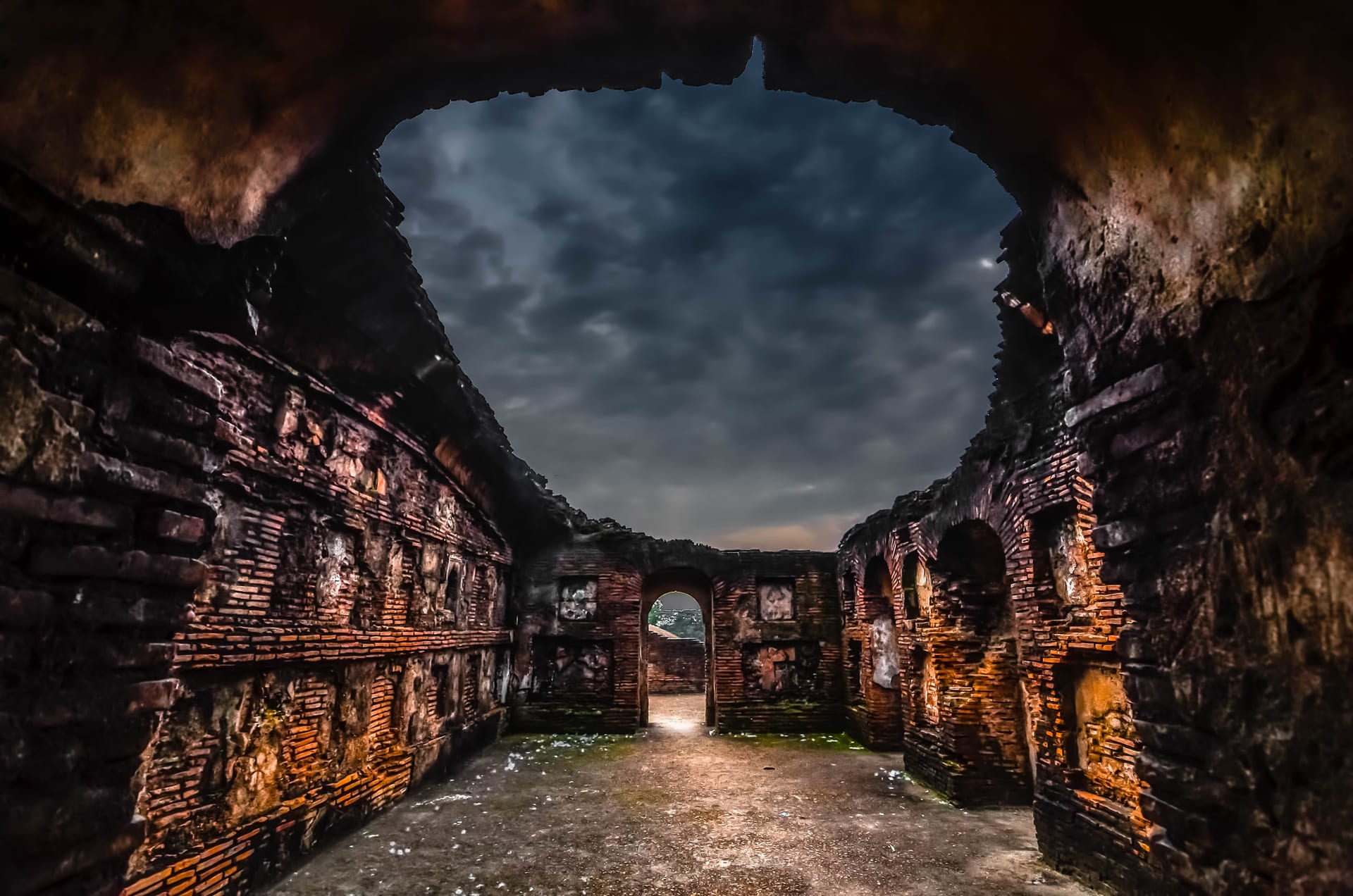
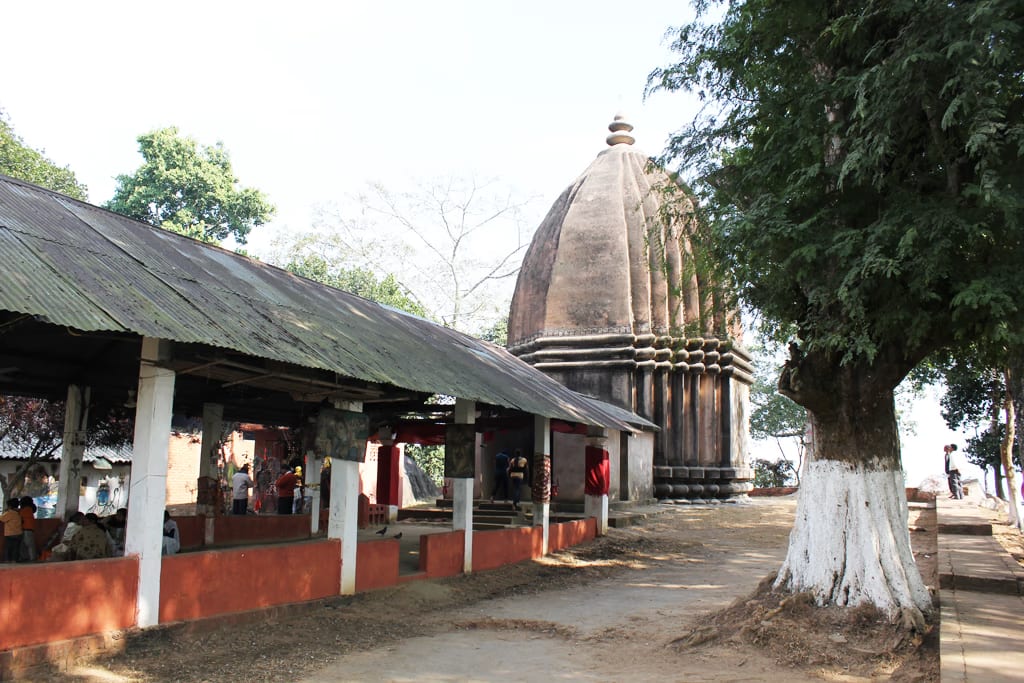
For roughly the first decades after the crossing the band did not settle at all. It moved through the country between the Buridihing and the Dikhow, holding one temporary seat after another. The chronicles name a string of them, from Namrup near the hills to Tipam and Habung, before a lasting capital was chosen. The band tested ground and people at each stop before committing to a seat. Around 1253 Sukaphaa fixed a capital at CharaideoPlace to visitCharaideo MaidamsThe royal necropolis of the Ahom dynasty, inscribed by UNESCO in 2024., a low range of hills. It became the dynastic necropolis, where the royal maidams still stand. These are the burial mounds of the Ahom kings.
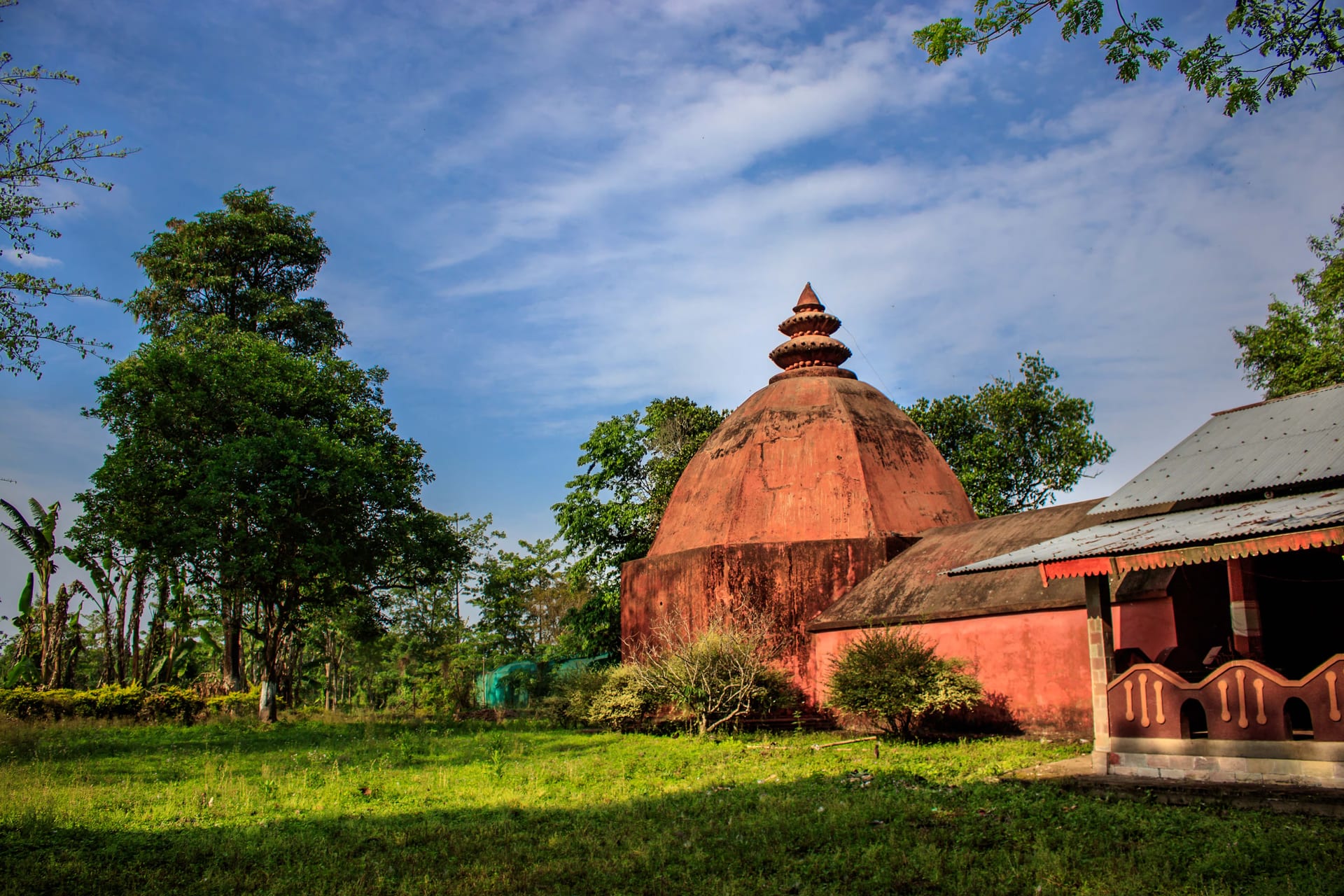
Plate 1.A royal maidam at Charaideo. A royal maidam at Charaideo: the earthen burial mound rises over a brick-vaulted chamber, its arched entrance set into the hillside.Photograph: Mozzworld · CC BY-SA · Wikimedia Commons
With a seat came the seeds of a state. Sukaphaa himself is remembered by the honorific Chaolung, from the Tai words for lord and great. The king ruled as the Swargadeo, the lord of the heavens. This was a sacral kingship that the Ahoms brought with them from the Tai world. Beneath him sat the great hereditary councillors. They would later crystallise into the offices of Burhagohain and Borgohain, the two original ministers of state. The administration of land and labour that would become the paik and khel systemAhom · Chapter 8Paik and KhelHow the state organised labour, land, and war. also traces its first form to these early reigns.
Sukaphaa died around 1268 having secured a foothold, not yet a kingdom. His immediate successors, Suteuphaa and then Subinphaa, held and slowly widened that foothold without dramatic expansion. For more than two centuries the Ahom state remained one upper-valley power among several. The transformation into the dominant kingdom of the valley belongs to a later reign, that of Suhungmung, with which the next chapter opens.
2. Consolidation
From the quiet centuries to Pratap Singha, 1268 to 1641
From the death of Sukaphaa around 1268 to the death of Pratap Singha in 1641, the Ahom state turned from a hill war-band’s foothold into the organised kingdom that would dominate the valley. The change was not steady. For the first two and a half centuries little of dramatic note is recorded. Then, in a single reign at the close of the fifteenth century, the kingdom’s scale changed. A century later its institutions were rebuilt to match. This chapter keeps to the political backbone. The wars with the Mughals that begin in the next century have their own chapter.
The quiet centuries, 1268 to 1497
The successors of Sukaphaa, Suteuphaa, Subinphaa, Sukhaangphaa, Sukhrangpha and the rest, ruled a compact upper-valley polity for roughly nine generations without expanding it greatly. The reigns are not empty of incident. Boundaries were pressed against the Chutias and the Nagas. The capital shifted among CharaideoPlace to visitCharaideo MaidamsThe royal necropolis of the Ahom dynasty, inscribed by UNESCO in 2024., Charagua and Charing. In 1376 the Swargadeo Sutuphaa was lured to a regatta on the Safrai by the Chutia king and there treacherously murdered. This was an unsettled account the dynasty would not close until it destroyed the Chutia kingdom a century and a half later. The western frontier also stirred. Sukhrangpha (reigned about 1332 to 1364) pressed the Kamata kingdom from the east in the years when the Bengal Sultanate under Ilyas Shah and Sikandar Shah was driving into KamarupaKingdomKamarupaVarman, Mlechchha and Pala dynasties, mentioned in the Allahabad pillar inscription of Samudragupta, visited by Xuanzang. from the west. A generation on came the reign of Sudangphaa (1397 to 1407), the “Bamuni Konwar” or Brahmin prince said to have been raised among the Brahmins of Habung. His reign began the quiet seepage of Brahmanical influence and Hindu custom into the Ahom court, long before the kings took Hindu titles. It also bound the Ahoms into the western defence. When Ghiyasuddin Azam Shah of Bengal pressed Kamarupa at the turn of the fifteenth century, Kamata answered with a matrimonial alliance with Sudangphaa’s house, and by tradition the allied courts drove the sultan’s forces back beyond the Karatoya. But across these centuries the Ahoms remained one power among several in the east, and the buranjis record the period in brief. The significance of the long quiet is structural: the absorptive society founded by Sukaphaa held together, generation after generation, until it was strong enough to expand.
Plate 1.Ghuguha Dol near Habung. Ghuguha Dol near Habung in Dhemaji, a brick memorial tied in tradition to the Bamuni Konwar raised among the Brahmins of this country.Photograph: Laltamil123 · CC BY-SA · Wikimedia Commons
Suhungmung and the great expansion, 1497 to 1539
The reign that ended the quiet was that of Suhungmung, the Dihingia Raja (1497 to 1539), the hinge on which the whole later history turns. He annexed the long-rival Chutia kingdom in stages, taking Habung by 1512 and completing the conquest in 1523 to 1524. This brought the Sadiya country and its frontier office into the Ahom system. He broke the Kacharis and took their capital at Dimapur in 1536, driving the dynasty to withdraw and rebuild later at Maibang in the hills.
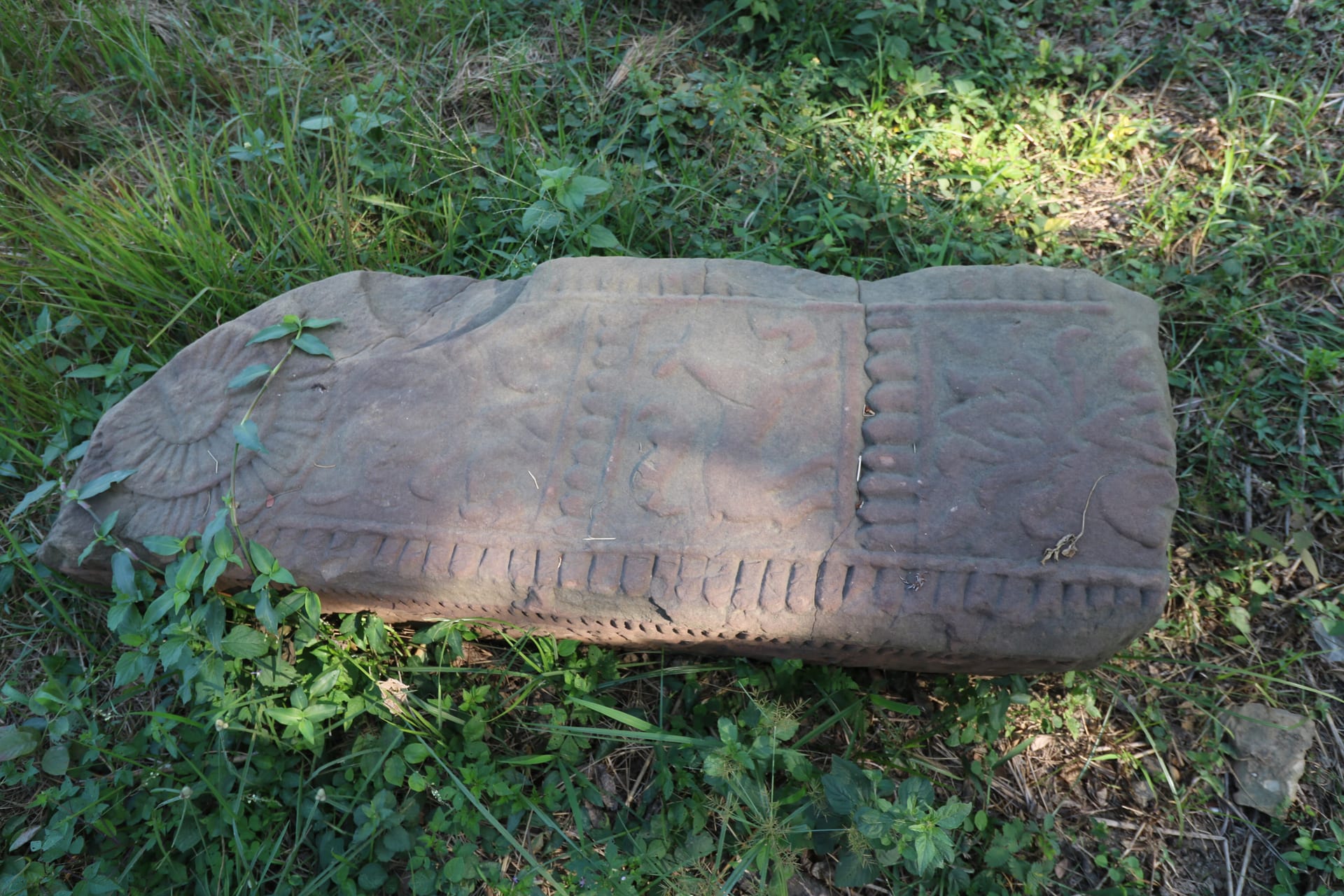
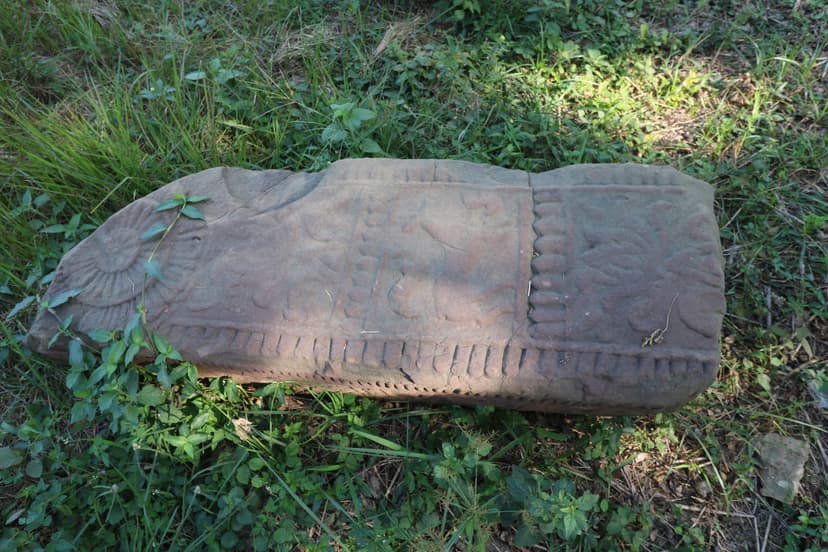
Plate 2.Dimapur ruins. A fallen carved slab among the Dimapur ruins, capital of the Dimasa-Kachari that Suhungmung's Ahoms broke in 1536, its lotus rosette and relief showing the masons' dressing.Photograph: কুমুদ ঘোষ · CC BY · Wikimedia Commons
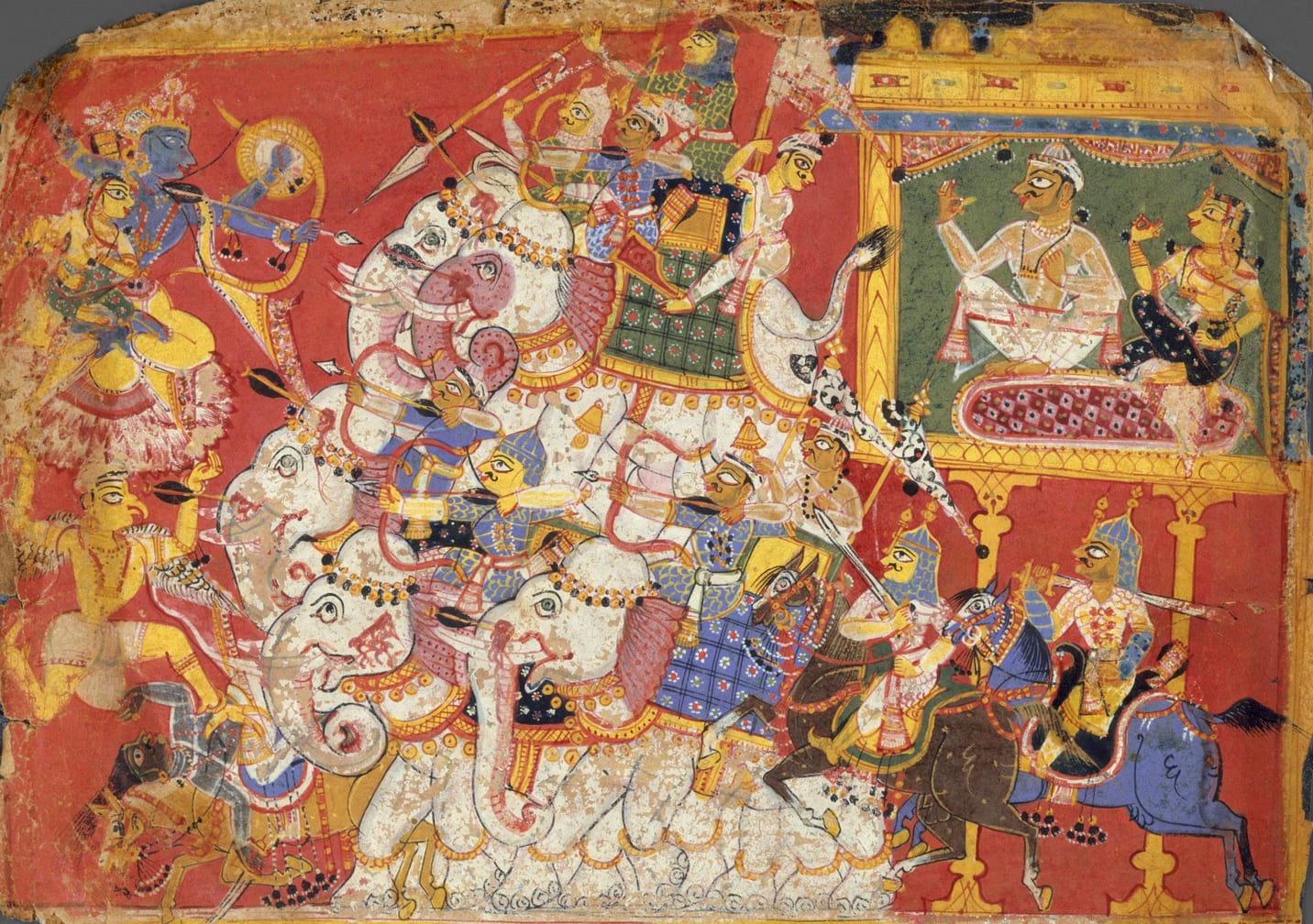
His reign also met the first serious Muslim invasions from the Bengal Sultanate. An early raid in 1527 was thrown back to the Burai river, but the hardest test was Turbak’s war of 1532 to 1533. Turbak came up the valley with cavalry, elephants and cannon, and the first encounters went against the Ahoms, breaking an army under the prince who later ruled as Suklenmung. The Ahoms fell back, rebuilt, and turned the war on the water at Duimunisila near Tezpur in March 1533. Turbak was killed soon after by the Bharali, and the Ahoms chased his shattered force west to the Karatoya, carrying home the captured guns that brought firearms into the valley in force. In that war the warrior-widow Mula Gabharu fell. Captives from Gaur were settled in Assam and remembered as the Goria among the Muslims of Assam.
Woven in a Night
MB
Monimoy Bujarbaruah
An Ahom noblewoman could not weave her husband the armour-cloth that was held to make a warrior unkillable. When he fell, she armed a band of women and rode to the war herself.
In 1527 he added a third great councillor to the two the kingdom had always had, appointing Konsheng as the first Borpatrogohain over the objections of the Burhagohain and the Borgohain, on the argument that a state this size now needed three. Those three Gohains, with the Borbarua and the Borphukan created a century later, would form the council of five, the patra mantris, that governed the kingdom until the end.
Suhungmung was the first Ahom king to take a Hindu title, Swarganarayan, beginning the slow Hinduisation of the dynasty. Under him the Assamese language and Brahman officials entered the administration. He is also credited with the first recorded census of the population, a survey ordered around 1510 to reorganise the militia. By his death the kingdom reached from the eastern hills deep into the central valley, with conquered peoples folded into its rolls and labour levies. It is his line that all later Swargadeos descend from.
Suklenmung, Sukhaamphaa, and the mid-century, 1539 to 1603
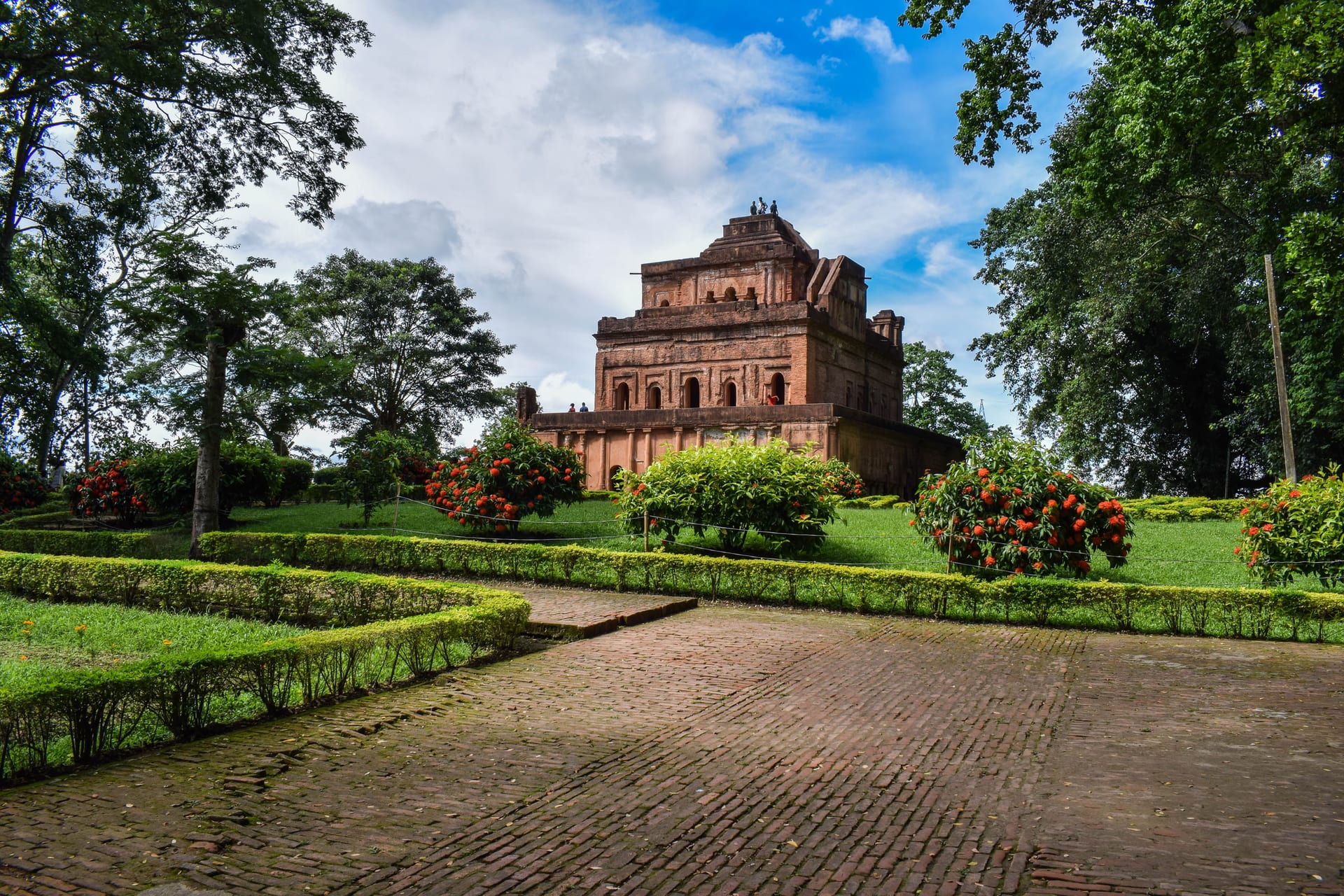
Suhungmung was murdered in 1539, and the kingdom he had enlarged was held and consolidated, rather than greatly extended, by his successors. Suklenmung, the Garhgaya Raja (1539 to 1552), moved the capital to GarhgaonPlace to visitKareng Ghar (Garhgaon Palace)Garhgaon served as the Ahom capital from 1540 under Suklenmung. Its surviving multi-storeyed brick palace, the Kareng Ghar, is from Rajeswar Singha's rebuilding in 1752. around 1540. That seat would serve the dynasty for most of the next two centuries. He continued the wars on the Kachari and Naga frontiers. His successors, among them Sukhaamphaa, the Khora Raja (1552 to 1603), faced the rising power of the Koch kingdom in the west. The Koch general Chilarai overran the Ahom capital in the 1560s, and the Ahoms recovered only by treaty and tribute. The lesson of those defeats was that the loosely governed kingdom needed a firmer administrative spine. It was learned by the king who came next.
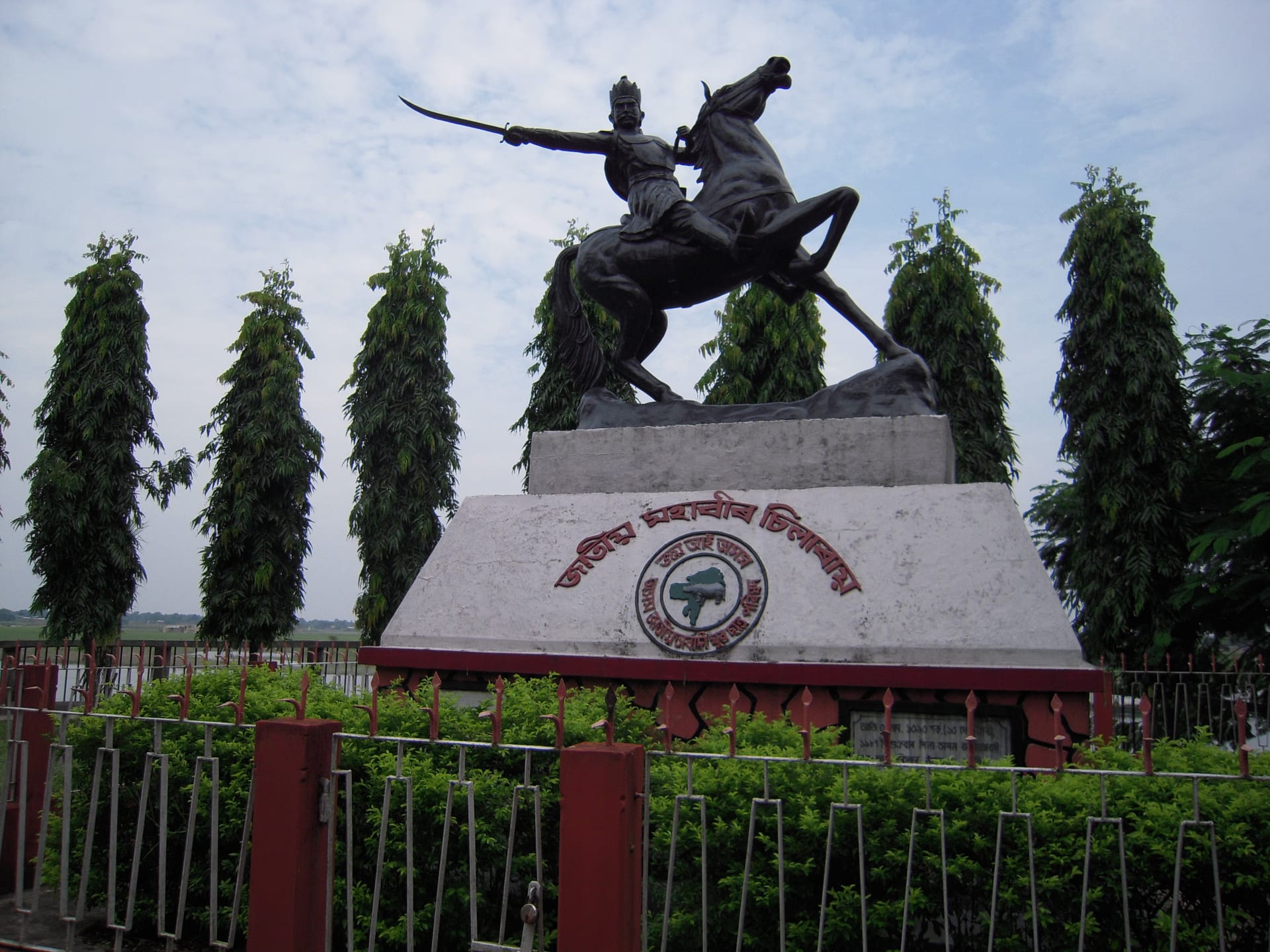
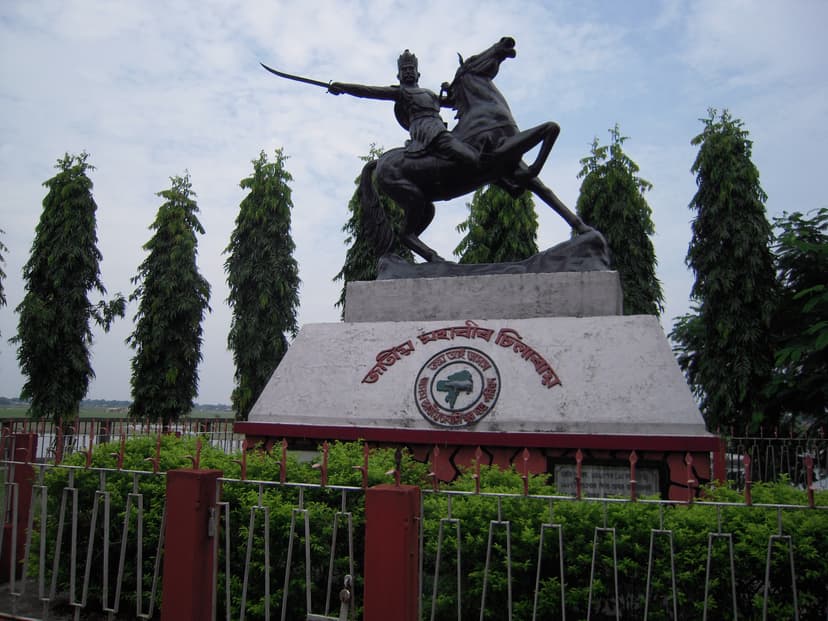
Plate 3.Chilarai, the Koch general who overran the Ahom capital. An equestrian statue of Chilarai at Dhubri, the Koch commander shown mounted with sword raised.Photograph: Wahabdr · CC BY-SA · Wikimedia Commons
Pratap Singha and the building of the state, 1603 to 1641
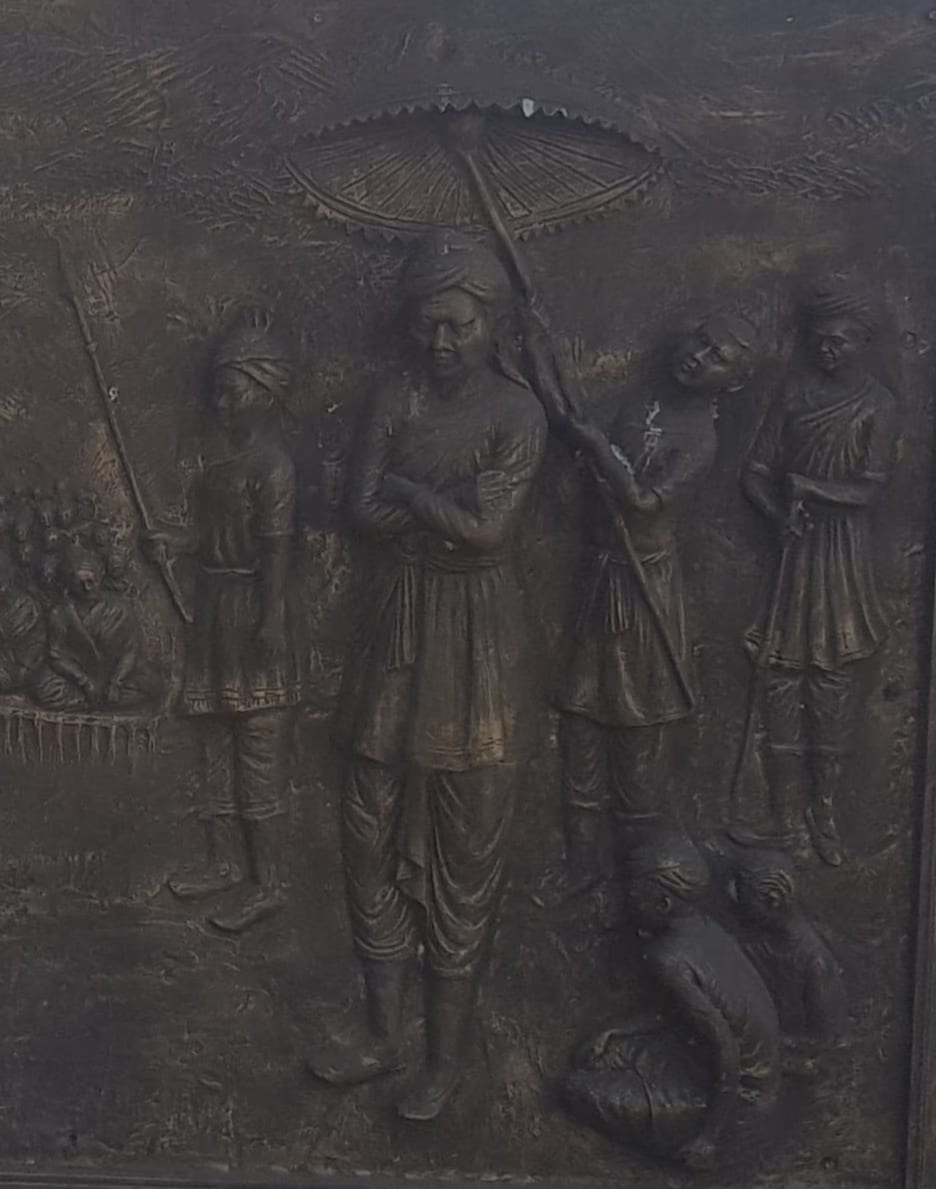
Susenghphaa took the Hindu name Pratap Singha and is remembered as the Burha Raja. He reigned from 1603 to 1641. After Suhungmung, he is the great institution-builder of the dynasty. Facing a Mughal power newly established in Bengal, he reorganised the western frontier and the machinery of the state. He created the high offices of Borbarua and Borphukan. The first was a chief executive and judicial officer over the country east of the Kaliabor. The second was a viceroy with near-sovereign powers over the western frontier. His first Borbarua, the commoner-born Momai-Tamuli Borbarua, carried out a census of the population and a thorough overhaul of the paik and khel systemAhom · Chapter 8Paik and KhelHow the state organised labour, land, and war. of obligatory labour and militia. To settle the thinly held frontier the king moved population where it was needed, resettling several thousand families in the sparsely peopled Marangi tract. The administrative architecture Pratap Singha set in place was the great offices, the militia rolls, and the frontier viceroyalty at GuwahatiPlace to visitGuwahatiThe oldest continuously settled city in the region and today the metropolis of northeastern India.. His reign also opened the long struggle with the Mughals. The first phase of the Ahom-Mughal war over the Kamrup frontier was settled in the treaty of 1639, which fixed the boundary with the empire on the Barnadi in the north and the Asurar Ali causeway in the south. That wider collision is the subject of the next chapter.
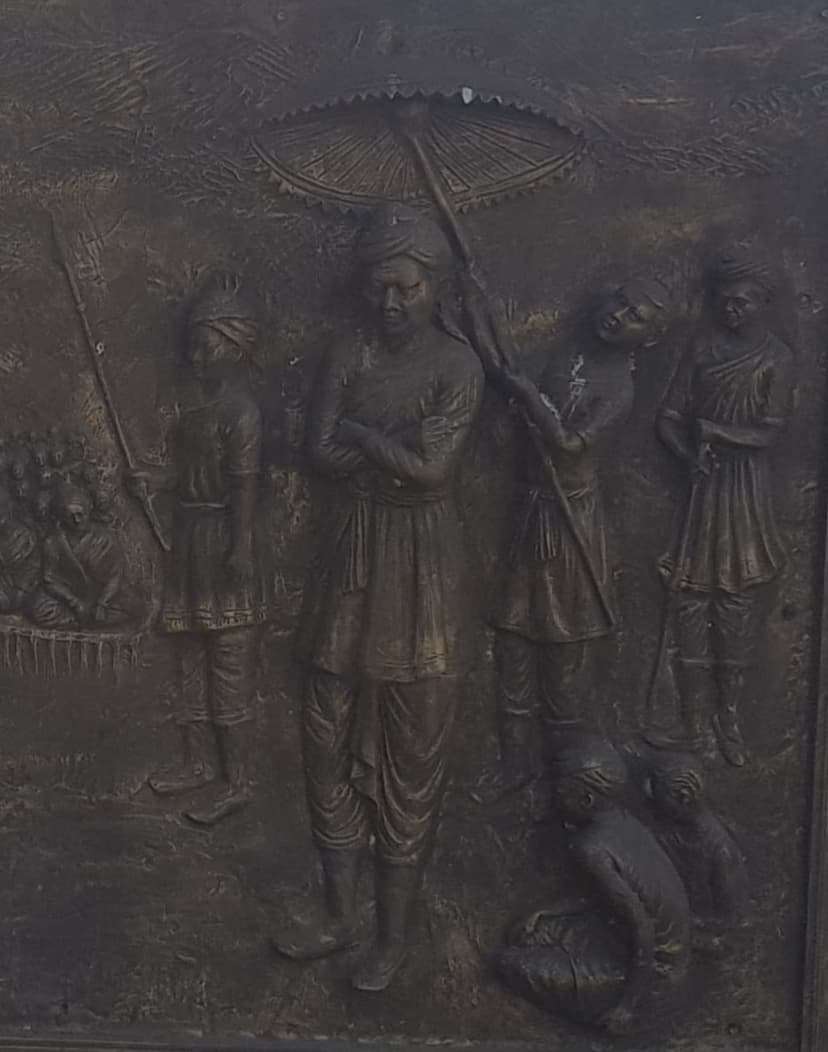
Plate 4.Momai Tamuli Borbarua, the first Borbarua. A commemorative bronze relief of Momai Tamuli Borbarua, the commoner who became Pratap Singha's first Borbarua, standing beneath a ceremonial parasol with attendants.Photograph: ComparingQuantities · CC BY-SA · Wikimedia Commons
3. The Ahom-Mughal Wars
Mir Jumla to Itakhuli, climaxing at Saraighat in 1671
For most of the seventeenth century the Ahom kingdom’s defining struggle was with the Mughal empire to its west. The two powers met along the Brahmaputra, and the prize, again and again, was GuwahatiPlace to visitGuwahatiThe oldest continuously settled city in the region and today the metropolis of northeastern India. and the frontier district of Kamrup. The conflict ran in waves. It began with the first Mughal probes around 1615 and ended with a final settlement in 1682. This long war is what made the Ahom kingdom a military state. Its most famous single day was the battle on the river at Saraighat in 1671.
The first rounds, 1615 to 1639
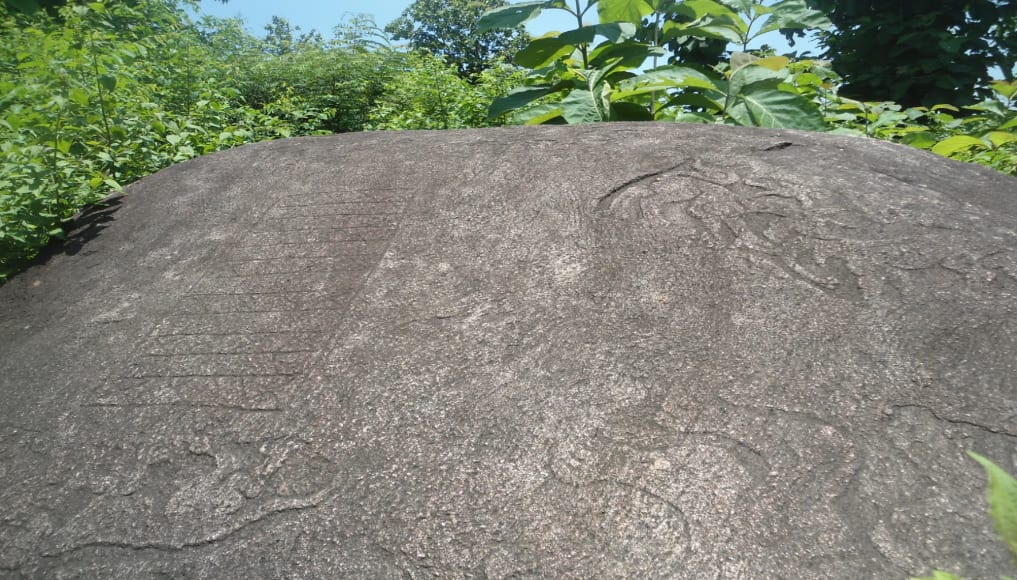
The first round was fought under Pratap Singha. A Mughal expedition under Abu Bakr came up the river in 1615, on the pretext that the Ahoms had punished an imperial trader. Early in 1616 the Ahoms destroyed it at the mouth of the Bharali, before the fort of Samdhara near Tezpur. The record keeps that first ruin as the battles of Bharali and Samdhara, and Pratap Singha had the victory cut into rock. For years afterwards he fought on through proxies in Kamrup. In 1636 the Ahoms swept back down the valley, taking SualkuchiPlace to visitSualkuchiWeaving town on the north bank of the Brahmaputra. Household looms for centuries; today the engine of Assam's silk industry. and the shrine-town of HajoPlace to visitHajoHayagriva Madhava temple, Powa Mecca and Buddhist associations make Hajo a rare confluence of pilgrimage.. On the ground that campaign was led by the client raja Balinarayan, who had carried the fight to the Mughal posts for two decades. A reinforced Mughal army recovered the ground in 1638 and killed him at Singri. The Ahoms answered at Duimunisila, where forces under Momai-Tamuli Borbarua broke the combined Mughal and Koch advance in a three-day fight on the water. The Treaty of Asurar Ali closed this round in February 1639. It fixed the boundary between the Ahom kingdom and the Mughal empire along the Barnadi on the north bank and the Asurar Ali causeway on the south, just west of Guwahati.
Plate 1.The Bhomoraguri rock inscription. The Bhomoraguri rock near Tezpur, its Assamese lines recording the Ahom victory at Samdhara in 1616.Photograph: Geniacs · CC BY-SA · Wikimedia Commons
Mir Jumla’s invasion, 1662 to 1663
During the Mughal war of succession, Jayadhwaj Singha seized Guwahati and pushed the Ahom frontier far to the west. When Aurangzeb had won his throne, the reckoning followed. The most dangerous Mughal stroke came in 1662, when Mir Jumla, Aurangzeb’s governor of Bengal, marched up the valley with a large army and a river fleet. On the way he occupied Koch Bihar, in December 1661, and renamed it Alamgirnagar for his emperor. Aurangzeb’s orders had charged him with the conquest of Assam, and by the accounts of his own camp he dreamed further, of the valley as a road toward Burma and China. He took Guwahati, then the empty Ahom capital itself. King Jayadhwaj Singha abandoned GarhgaonPlace to visitKareng Ghar (Garhgaon Palace)Garhgaon served as the Ahom capital from 1540 under Suklenmung. Its surviving multi-storeyed brick palace, the Kareng Ghar, is from Rajeswar Singha's rebuilding in 1752. and withdrew into the hills of Namrup. The Mughals occupied the heart of the kingdom through a ruinous monsoon. Night raids, flood and disease wore the invaders down as much as open battle did. In January 1663 the two sides came to terms at Ghilajharighat. The Ahoms accepted a vassal peace. They ceded everything west of the Bharali river on the north bank and the Kallang on the south, Guwahati included, and paid besides in treasure and hostages, sending a daughter of the royal house, Ramani Gabharu, to the Mughal court. Mir Jumla did not enjoy the victory. He died on his boat on 30 March 1663, on the march back to Bengal. Jayadhwaj Singha died soon after, by tradition of grief at the humiliation.
Mir Jumla's Retreat
MB
Monimoy Bujarbaruah
In 1662 Aurangzeb's ablest general took the empty Ahom capital and thought he had won Assam, until the monsoon, the floods and the fever rotted his army to nothing.
Chakradhwaj Singha and the recovery of Guwahati, 1667
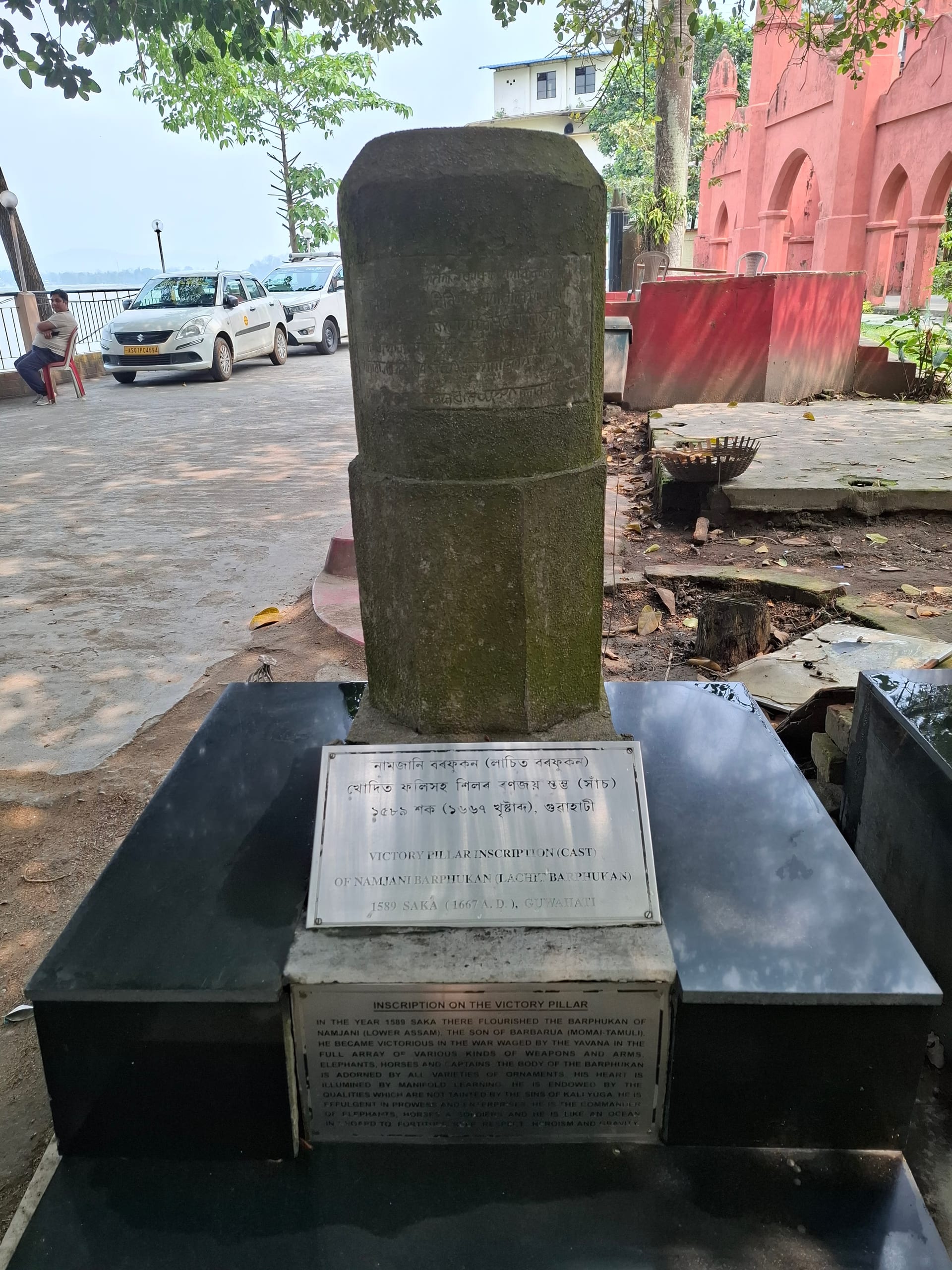
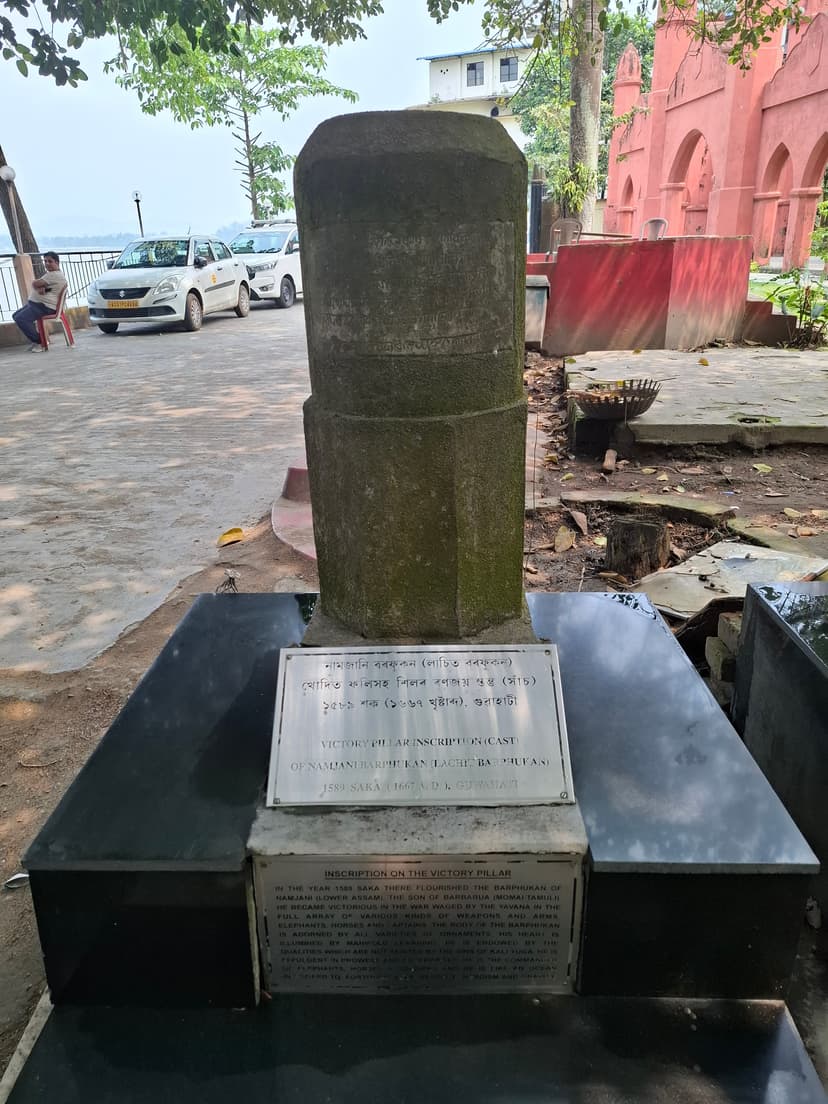
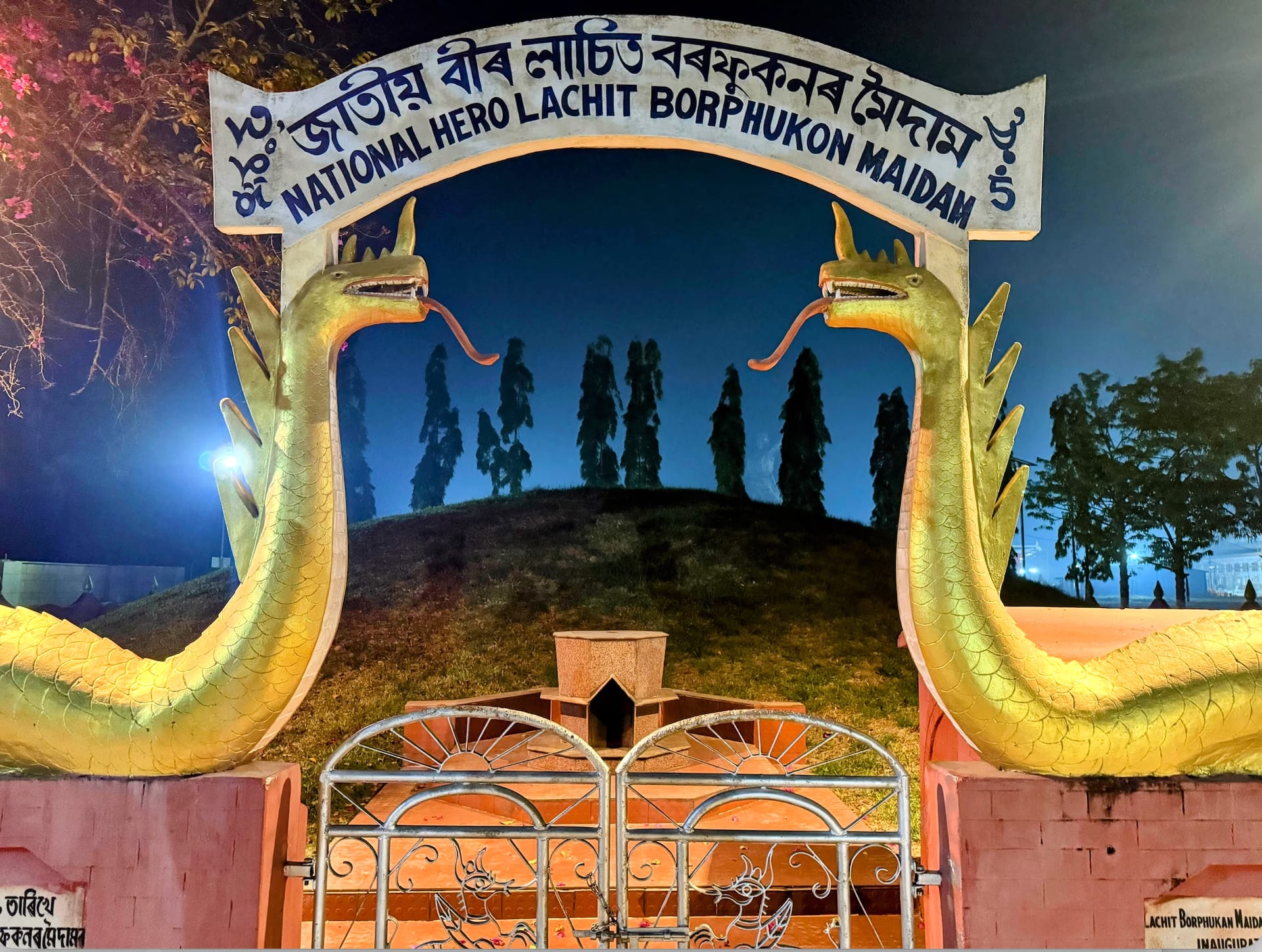
Jayadhwaj Singha’s successor Chakradhwaj Singha refused to accept the settlement as permanent. “Death is preferable to a life of subordination to foreigners,” the buranjis have him say. He spent his reign rebuilding the army and the river fleet for a war of recovery. In that effort he leaned on his Burhagohain, the senior minister Atan Burhagohain. Atan Burhagohain was the civilian architect of the war. He held the administration steady through its supreme effort. In November 1667 an Ahom force under Lachit Borphukan stormed the Mughal post at Itakhuli and retook Guwahati. This threw the frontier back to the Manas. A cast victory pillar of that year still stands beside the Brahmaputra at Sukreswar. It names him as Namjani Barphukan, son of Momai Tamuli, victor of the war against the Yavana.
Plate 2.Lachit’s victory pillar of 1667. The cast victory pillar of Namjani Barphukan (Lachit), dated 1589 Saka (1667), at Sukreswar park by the Brahmaputra.Photograph: Pinakpani · CC BY · Wikimedia Commons
Aurangzeb’s answer was to send a far larger expedition under Ram Singh I of Amber to recover it. That expedition is what ran onto the rocks at Saraighat. The defence rested on earthworks, and the war’s most famous story belongs to their building. A rampart at Guwahati was left half-raised through the night, and Lachit, finding his own maternal uncle asleep as the officer in charge, beheaded him on the spot with the words that no uncle is greater than the country. The place is known still as Momai Kata Garh, the fort where the uncle was cut down. The campaign did not go all the Ahoms’ way on land. At Alaboi, on the plain north of Guwahati, in early August 1669, they fought a pitched battle against Ram Singh’s cavalry. They lost it heavily. The buranjis put the dead at some ten thousand. The war would be decided not on land but on the river.
Saraighat, March 1671
SaraighatAhom · Chapter 3The Ahom-Mughal WarsThe seventeenth-century war that made Assam a military state. lies on a narrow stretch of the Brahmaputra just west of Guwahati. There the river is squeezed between Aswaklanta on the north bank and the Nilachal hill on the south. For an army descending from Bengal it is the last place the river can be forced. For an army defending the upper valley, it is the first place it can be held. The engagement came in March 1671. The Mughal vessels were crowded into the narrows and lost room to manoeuvre. The smaller, faster Ahom war-boats broke them on the water, under the mortally ill Lachit Borphukan. The Mughal fleet fell into disarray when its admiral, Munnawar Khan, was shot dead in the fighting. Ram Singh withdrew up the river. It was the high-water mark of the kingdom. After it the Mughal frontier never again reached past Guwahati for long. Lachit himself did not long survive the victory. He died the following year, in April 1672.
The Night of Saraighat
MB
Monimoy Bujarbaruah
A dying general, a wavering fleet, and the river that kept the Mughals out of Assam.
The last round, and Itakhuli, 1682
The victory of 1671 did not quite end the war. In a later turn the Mughals recovered Guwahati once more, in March 1679, after the Ahom viceroy Laluksola Borphukan gave it up without a fight. He had conspired with Muhammad Azam Shah, then the Mughal governor of Bengal and the husband of the Ahom princess Ramani Gabharu, for a promised four lakhs of rupees. The frontier remained disputed through the dynastic troubles of the late 1670s. The definitive settlement came in August 1682, under the newly secure king Gadadhar Singha. The Ahom advance carried the forward posts and beat the imperial fleet on the water, and the Mughal garrison abandoned Itakhuli without a fight. The empire was driven back to the Manas river. The field campaign was carried by the Borbarua and the frontier commanders. The king did not take the field in person. But it was won in his name and under his restored authority. The recovered confidence of the throne stood behind it. That line held for the rest of the kingdom’s life. From 1682 the Mughal empire made no further serious attempt on Assam. The valley turned from external war to the internal reconstruction and cultural flowering of the chapters that follow. How the traitor sold the river gate, and how Gadadhar won it back at Itakhuli, is told as a story.
Itakhuli, 1682
MB
Monimoy Bujarbaruah
Saraighat is the battle the songs remember. But the river gate it defended was sold to the empire eight years later by Lachit's own brother, and it was won back for good in 1682, at a rock called Itakhuli.
Among those hunted was a Tungkhungia prince living under the name Gadapani. He slipped into the hills and frontier country and stayed hidden for about two years. His wife, Joymoti, would not tell where he was. Seized and taken to Jerenga Pothar near the heartland, she was tortured for many days rather than betray him, and she died of her wounds. Her silence kept him alive. In 1681 the desperate court brought that fugitive down from the hills as Gadadhar Singha. He was formally crowned the next year as Supatphaa, founder of the Tungkhungia line. He broke the kingmaking nobles who had nearly dissolved the state. He recovered Guwahati and the western frontier from the Mughals at Itakhuli in 1682.
Itakhuli, 1682
MB
Monimoy Bujarbaruah
Saraighat is the battle the songs remember. But the river gate it defended was sold to the empire eight years later by Lachit's own brother, and it was won back for good in 1682, at a rock called Itakhuli.
That victory finally closed the long Mughal war. And he restored the authority of the Swargadeo. He was a hard, centralising ruler, made harder by what he had survived. He also turned on the neo-Vaishnava monasteries, in particular the Moamoria establishment. His persecution of the Mahantas planted a grievance the kingdom would harvest disastrously three generations later, in the Moamoria rebellionAhom · Chapter 5The Moamoria RebellionThe forty-year insurgency that broke the state.. He also put the revenue on a measured footing. Surveyors were brought in from Koch Bihar and Bengal, the survey began around Sivasagar, and it fixed the bigha of 14,400 square feet that Assam still uses. The earliest Ahom copper-plate grants of land to Brahmans and temples date from his reign. To his reign tradition assigns the Dhodar Ali, the great trunk road of upper Assam, whose story is told with the kingdom’s roads and earthworks in The Stone CapitalAhom · Chapter 12The Stone CapitalJoysagar and the dols, the Ali roads and embankments, and the corvée that raised a built landscape..
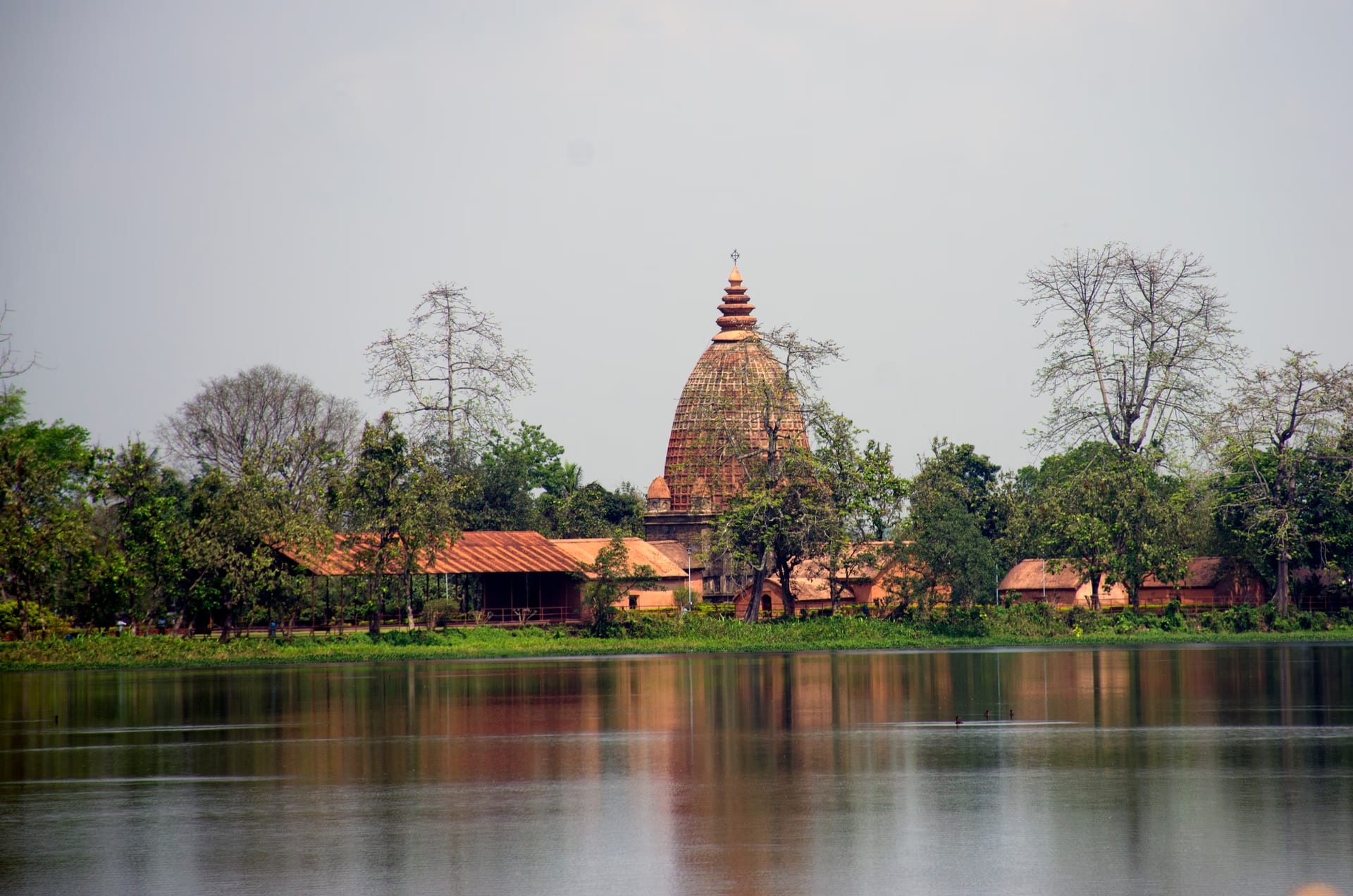
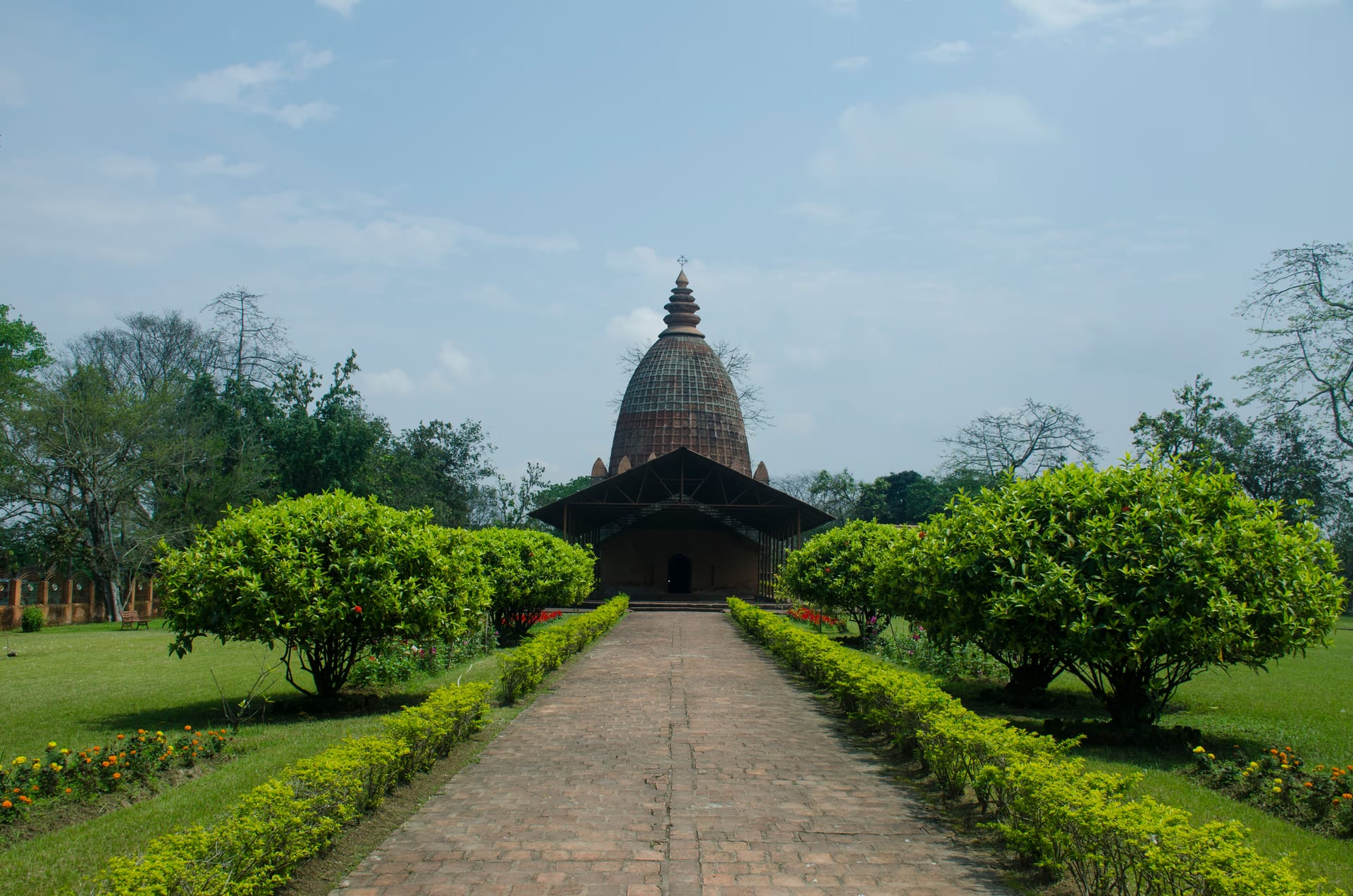
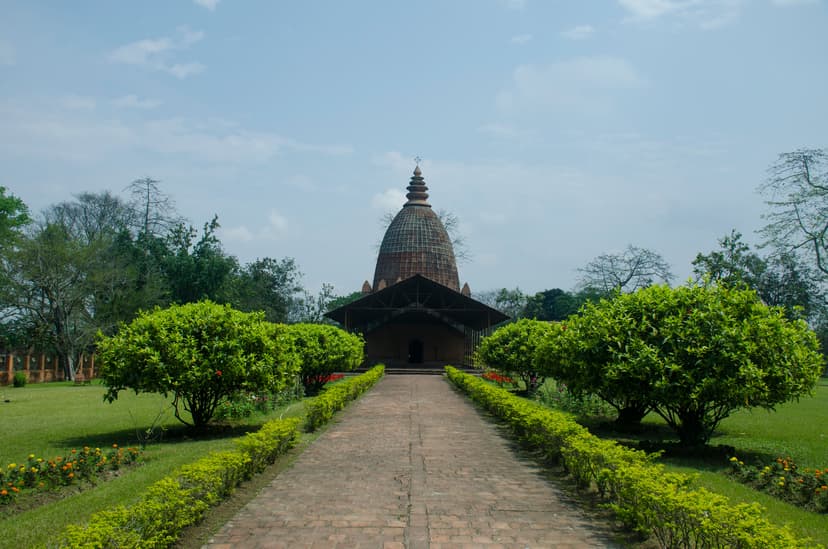
Plate 1.The Joydol at Joysagar. The Joydol at Joysagar down its garden walk, the paved path and clipped hedges leading to the ribbed Ahom dol tower, a bankside shrine raised under Rudra Singha.Photograph: Rangan Datta Wiki · CC BY-SA · Wikimedia Commons
Siva Singha, Pramatta Singha and the temple city, 1714 to 1751
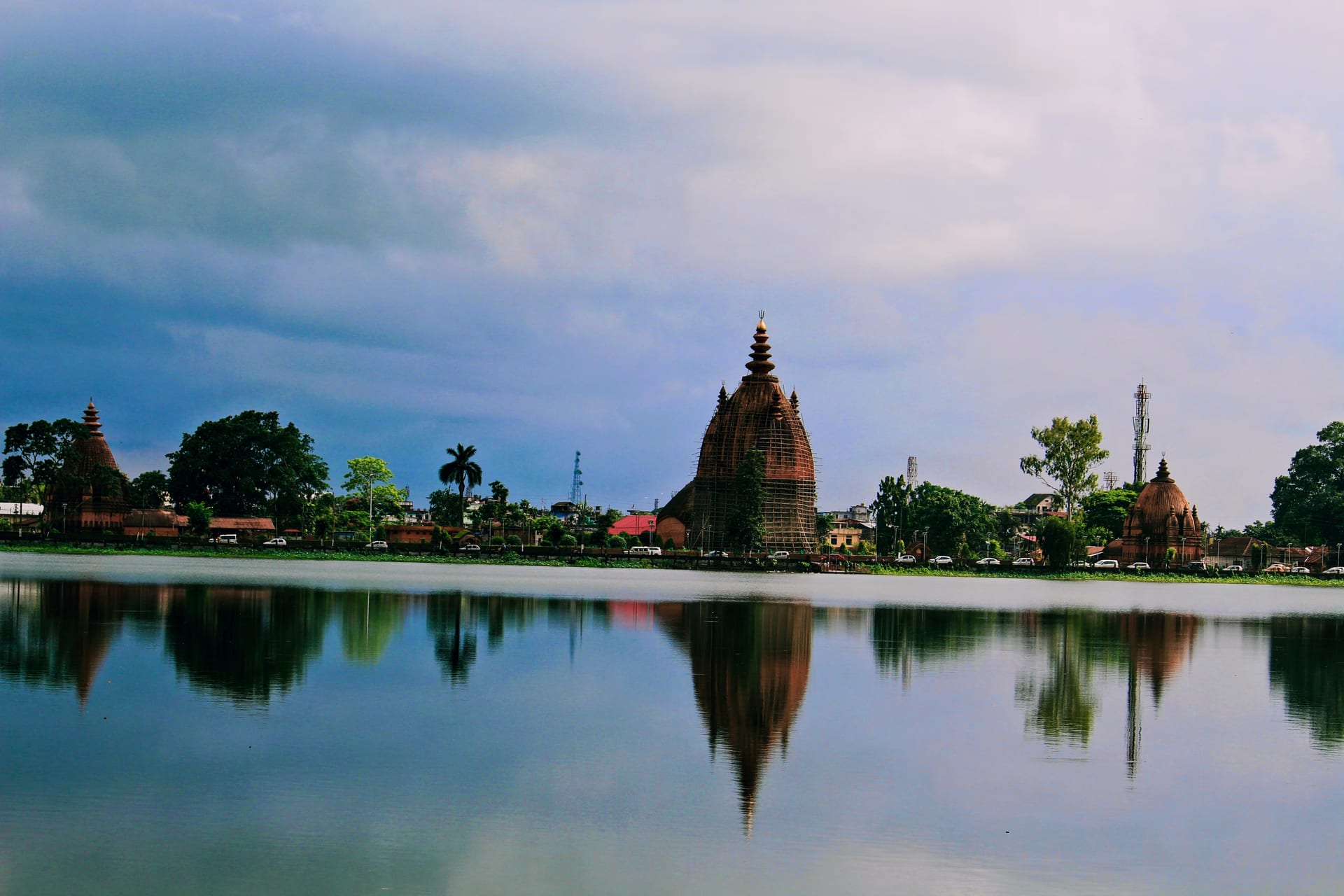
Plate 2.The three temples on the Sivasagar tank. The three temples beside the Sivasagar tank, the tall Sivadol flanked by the Vishnudol and Devidol, mirrored in the water.Photograph: KDutta1982 · CC BY-SA · Wikimedia Commons
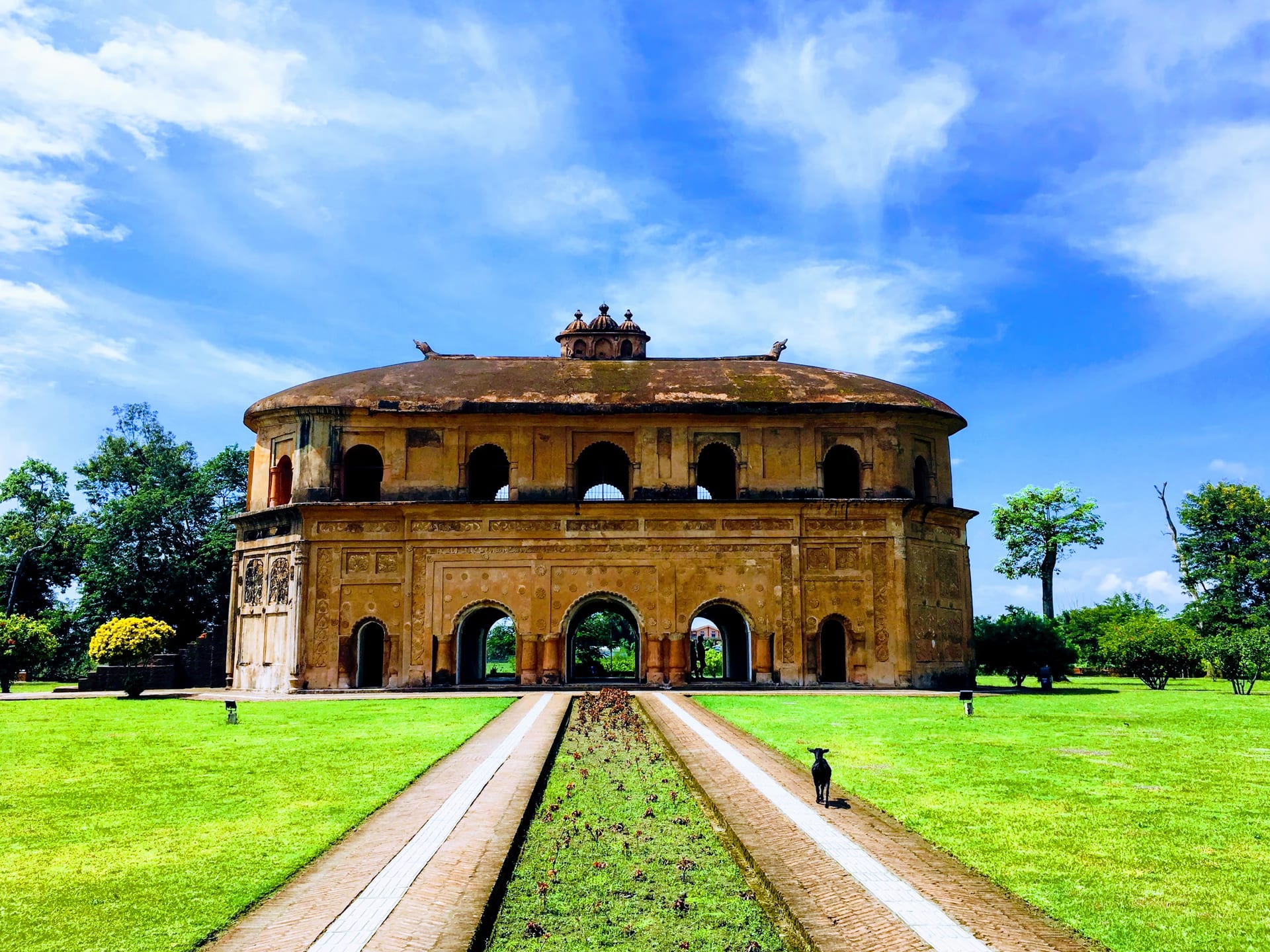
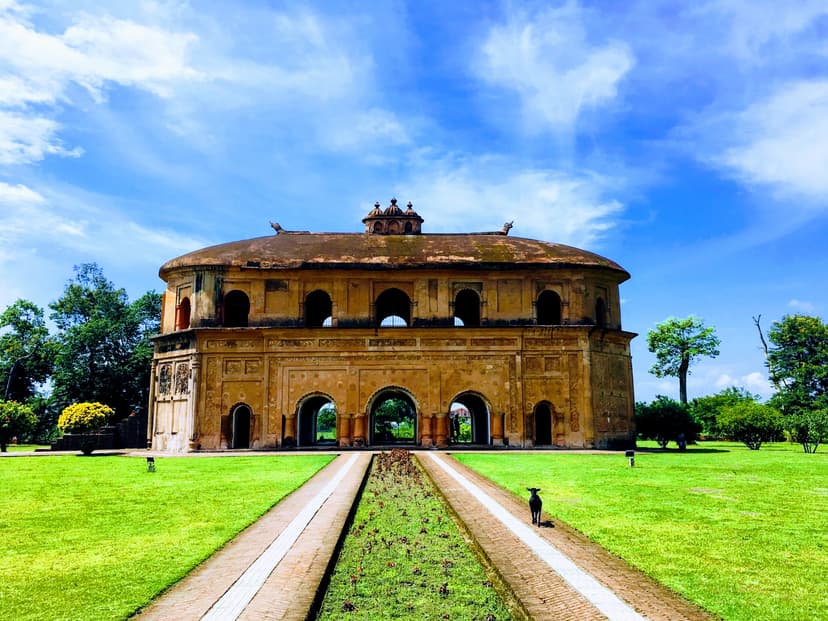
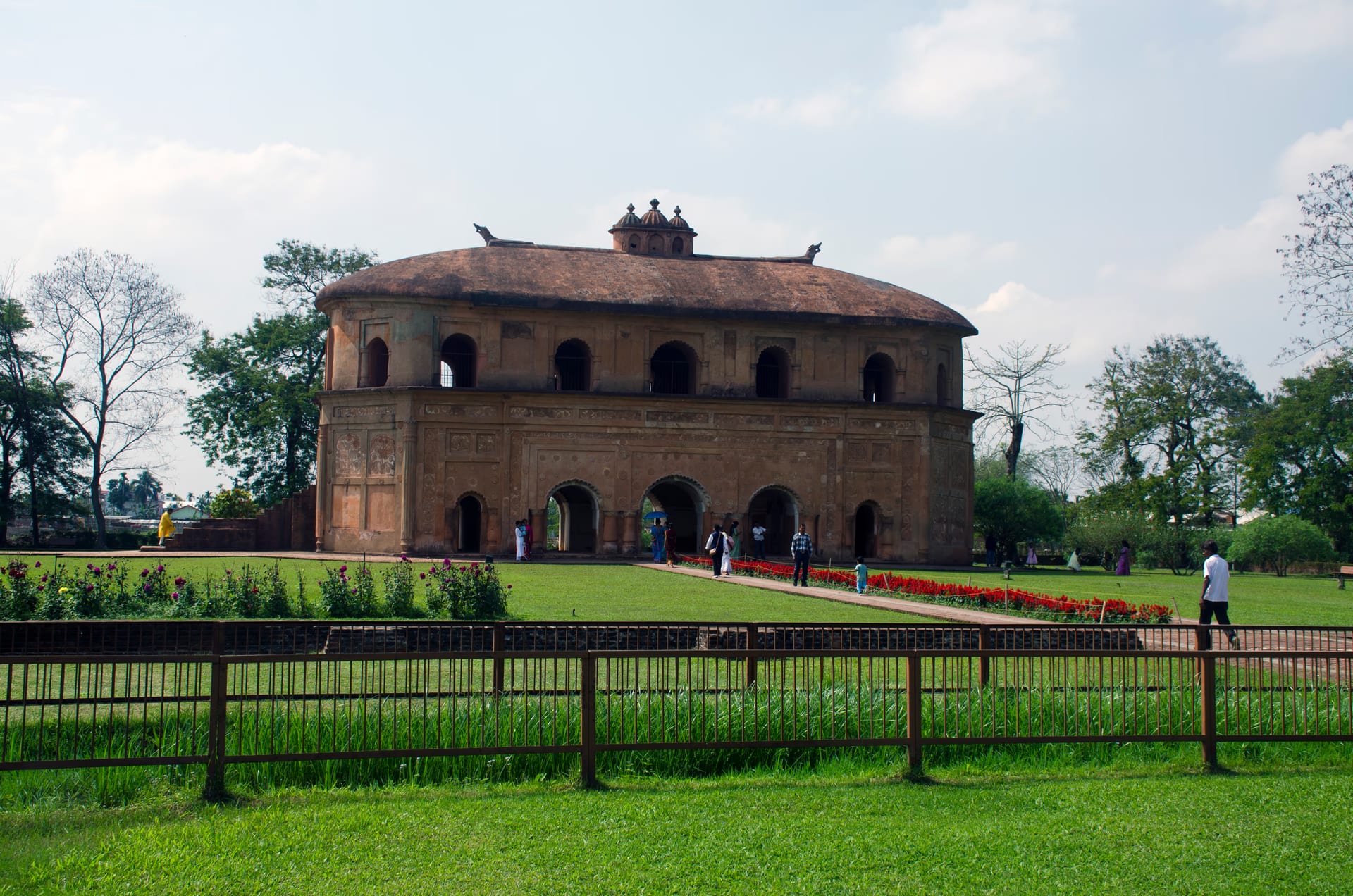
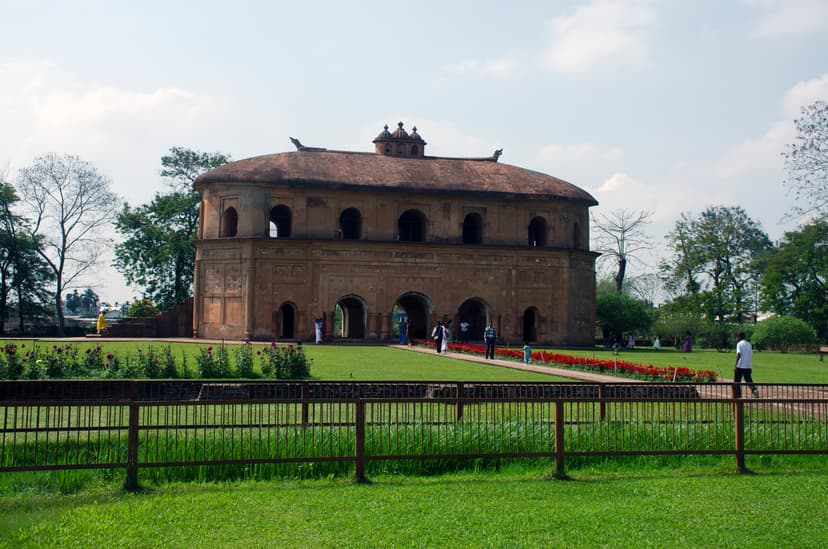
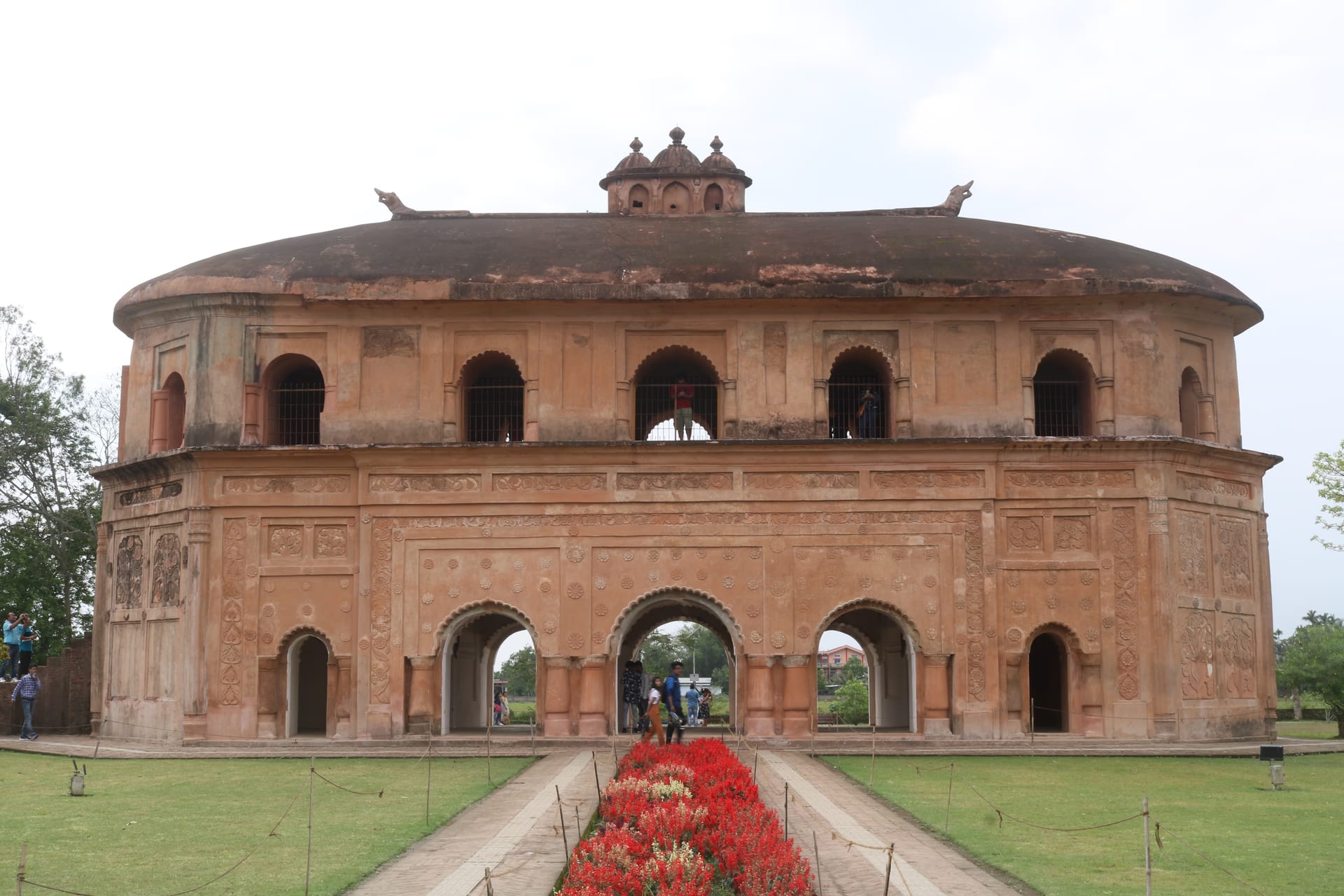
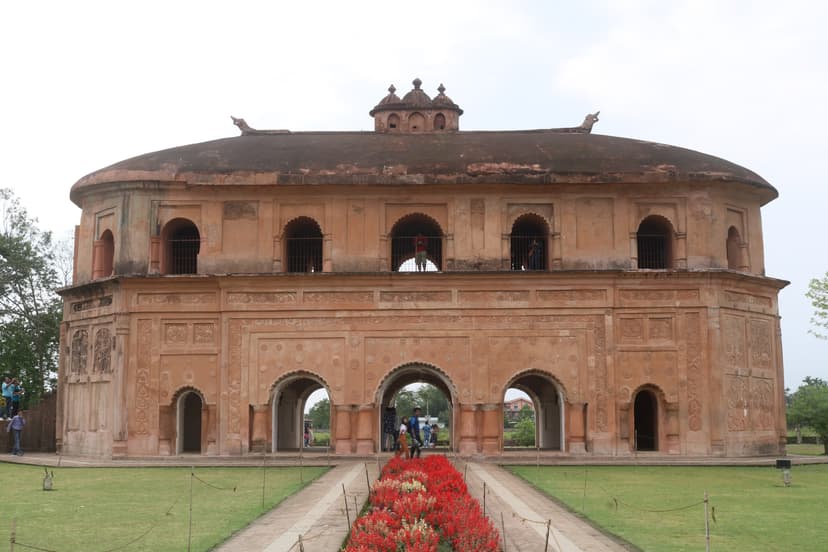
Plate 3.The Rang Ghar at Rangpur. The Rang Ghar from the front, the garden path running to the three arches of the lower storey. From this oval grandstand the Ahom court watched the games on the field below.Photograph: Dr Jagga · CC BY-SA · Wikimedia Commons
5. The Moamoria Rebellion
1751 to 1805
The rebellion that broke the Ahom state came not from outside but from within. The Moamorias were the followers of the Mayamara, or Moamara, sattra. This was a neo-Vaishnava monastic order, founded by the preacher Aniruddhadeva around the turn of the seventeenth century, which stood apart within the Vaishnava fold as a non-conformist order drawing its followers from the very people the high castes looked down on. Its lay disciples were numerous in upper Assam. They included paiks, officers and frontier communities such as the Morans and Chutias. They had long served the kingdom. They had also long been ill-used by its court. Their Mahantas were persecuted under Gadadhar Singha and Siva Singha. Under Siva Singha’s Bar-Raja Phuleswari the injury ran deeper still. By tradition she summoned Vaishnava Gosains, among them the head of the Moamara sattra, to a Durga puja and had sacrificial blood smeared on their foreheads. To men who refused all animal sacrifice this was a deep defilement. They never forgave it. That episode is told with the court’s turn to SaktismAhom · Chapter 10ReligionThree currents inside one state..
The rising, 1751 to 1786
Rajeswar Singha (1751 to 1769) ruled over the last years of outward calm. Able but indolent, he left the government to the Borbarua Kirti Chandra. That overbearing administration sharpened every grievance, the Moamorias’ above all. The kingdom looked strong. It sent an army as far as Manipur to put Bhagyachandra back on his throne. But the social order beneath the court was nearer breaking than it seemed. The paik system was strained by forced labour, and a large, organised religious community was full of resentment.
The insurrection broke out in 1769, in the reign of Lakshmi Singha. It was the explosion of that long resentment, not its beginning. The sacrificial blood under Phuleswari, and the later pressure under Kirti Chandra, had already made the Moamara sattra a powder-keg. By tradition the spark itself was a personal humiliation. A Moamoria man, Ragha Neog, was flogged after failing to supply elephants to the court. The rising that followed was swift. The rebels routed the royal forces and, in November 1769, seized the capital at Rangpur. For a time they placed their own men on the throne, enthroning a rebel king in the Ahom capital itself. They spared Lakshmi Singha his life only at the intercession of the Mayamara Mahanta, whose word still bound his followers even in their fury. Then the king’s party recovered the city in a vengeful reaction. The Manipuri queen Kuranganayani is credited by tradition with a decisive hand in that recovery, and in the killing of the rebel leader who had seized power. The dates are close-set. Ragha Neog was flogged on 15 September 1769, the rebels held Rangpur by 21 November, and the court killed Ragha and took the capital back on 14 April 1770.
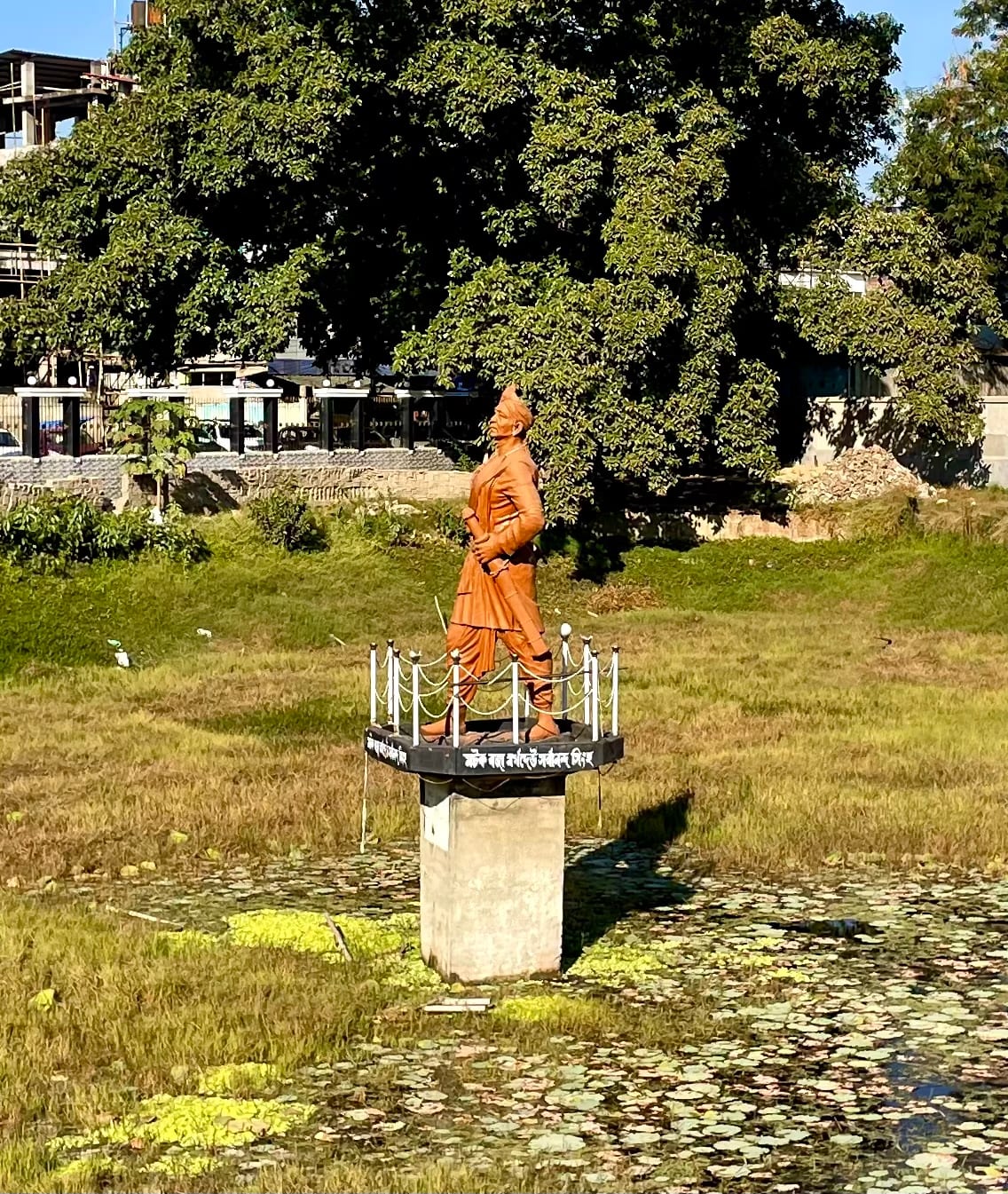
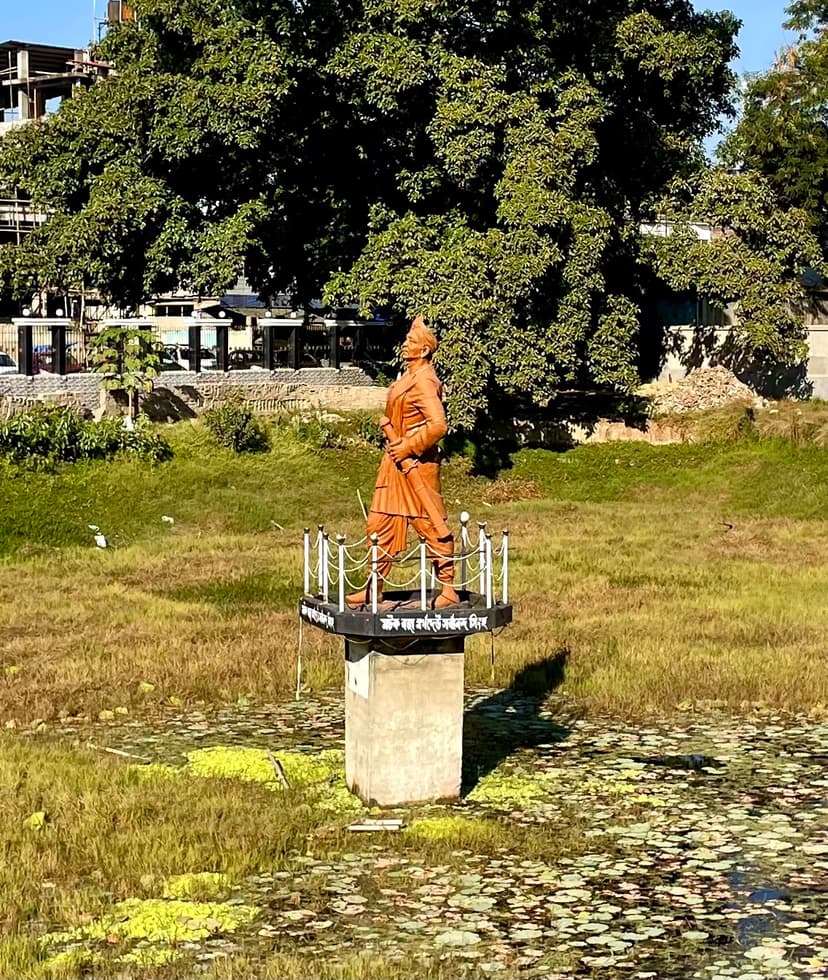
It was not a single revolt but the first of many. The Moamorias rose again in 1782, falling on Gaurinath Singha during the Bihu festival, and a third time from 1786, when the rising drew in the Dafla and Bahatia country as well. Each time they crowned a king of their own, Ramakanta in 1769 and Bharat Singha in the later risings, and each time the court answered with executions and the harrying of whole districts. Beside Ragha the buranjis name Naharkhora Saikia and Govinda Gaoburha among the leaders who kept the war alive. The rebels drew above all on the Morans and other frontier and service communities of the upper valley, the Chutias, gold-washing Sonowal Kacharis, potters and weavers, and on disaffected Ahom nobles. Out of that disorder a breakaway power established itself around Bengmara, the modern Tinsukia. This was the Motok kingdom, led by Sarbananda Singha, and it was never fully reabsorbed.
Plate 1.Sarbananda Singha, who led the breakaway Motok kingdom. Statue of Sarbananda Singha, first ruler of the Matak kingdom, in the Tinkunia Pukhuri tank at Tinsukia.Photograph: AjayDas · CC BY-SA · Wikimedia Commons
Loss of control, 1786 to 1805
Under Gaurinath Singha (1780 to 1794) the state effectively lost control of its own territory. The rebels held much of upper Assam, the capital was repeatedly threatened, and the king fled downriver to GuwahatiPlace to visitGuwahatiThe oldest continuously settled city in the region and today the metropolis of northeastern India.. Unable to govern, he did what no Ahom king had done before and appealed to the East India Company. In 1792 Lord Cornwallis sent Captain Thomas Welsh with a small force. Welsh restored Gaurinath Singha and imposed an uneasy order, pressing up the Brahmaputra and taking Rangpur itself on the eighteenth of March 1794. Recall orders reached him that April, under the new Governor-General who had replaced Cornwallis, and the force was drawn back out of the valley. The episode mattered out of all proportion to its size. It was the first British military intervention in Assam. And it taught the Company how weak the kingdom had become. That knowledge was filed away in Calcutta, to be acted on a generation later.
Plate 2.The Bengmara country at Tinsukia, seat of the breakaway Matak state. A large excavated tank at Tinsukia, the town that grew on the plain of Bengmara, of the kind local memory ties to the Matak chiefs.Photograph: Meghali Moran09 · CC0 · Wikimedia Commons
The rebellion was contained rather than won. This happened under Kamaleswar Singha and the long ascendancy of the prime minister Purnananda Burhagohain. The state slowly recovered the upper country. In 1805 Purnananda sent a force to retake Bengmara from Sarbananda Singha. The fighting ended not in conquest but in a settlement. Sarbananda kept the title Borsenapati and practical control of the Matak country, holding it as a tributary in nominal independence of the Ahom throne. The broader rising was spent by about the same year. But the cost could not be repaired. A generation of bloodletting had drained the valley of people, of order, and of the paik manpower on which the army and the economy ran. By tradition roughly half the population of the kingdom is said to have perished across the long war and the famines it brought. The old paik and khel system, the very backbone of Ahom government, never fully recovered. In its place the court leaned on paid mercenary soldiers, a change that marked how far the kingdom had fallen from the ordered state of a century before. The Ahom kingdom survived the Moamoria rebellion. It did not recover from it. A state this hollowed out could not defend itself against the next shock. That next shock was the Burmese, and it is the subject of the chapter that follows.
6. The Burmese Invasions
1805 to 1824
In the end, the Ahom kingdom was destroyed by its own factions. They called in a foreign army. The state emerged exhausted from the Moamoria rebellion. It was held together less by the boy-kings of the line than by their prime minister, the Burhagohain Purnananda. He governed in all but name from the 1790s. The crisis that ended the kingdom grew out of a quarrel at the top of that government.
The feud that opened the door, 1805 to 1816
The break came between Purnananda Burhagohain and Badan Chandra Borphukan, the viceroy of Lower Assam at GuwahatiPlace to visitGuwahatiThe oldest continuously settled city in the region and today the metropolis of northeastern India.. As Burhagohain, Purnananda held the first office of the state. The Borphukan was his chief officer in the west, seated at Guwahati and responsible for the whole of Lower Assam and its dealings with the frontier. Charges of extortion and misgovernment reached the capital against Badan Chandra. Purnananda marked him for arrest and moved to bring him down.
Badan Chandra did not wait for the summons. He fled westward, out of the kingdom and into British Bengal. From there he made his way to the Burmese court, then at Amarapura on the Irrawaddy. He sought an audience with the king, Bodawpaya, the ruler who had already carried Burmese arms into Arakan and Manipur on Assam's borders. Badan Chandra told the court that Assam was misruled and ripe for the taking, and asked for an army to set matters right and himself in power. The appeal fell on ready ears. A grievance from within was exactly the opening an expanding power needed, and it turned a court quarrel into an invitation. Badan Chandra was now a man with both a claim against his own government and a foreign army behind it. The kingdom he invited them into was hollowed out. Its treasury was drained, its fighting strength gone, its throne held by weak kings and its real command split between rival nobles. It could not meet the danger that its own feud had summoned.
The three invasions, 1817 to 1822
The first Burmese army crossed the Patkai late in 1816. Early in 1817 it routed the Ahom forces at Ghiladhari. Purnananda Burhagohain died as the enemy advanced, and his son Ruchinath succeeded him as Burhagohain. The Burmese then installed a settlement favourable to Badan Chandra and withdrew. Badan Chandra was soon assassinated in the factional bloodletting that followed. The Ahom court did not hold together after him. The rival princes of the line each looked for a foreign patron.
A second invasion came in 1819. Its aim was to prop up the king the Burmese favoured, Chandrakanta Singha, against his rivals. They reinstated him early that year and made his kingship theirs to grant. But Chandrakanta chafed at his overlords. He objected to their killing of Ahom nobles and began to fortify against them. That defiance brought the third and final invasion. The third campaign opened in 1821 under the Burmese commander Mingimaha Tilwa. He drove Chandrakanta out and, late that year, set a puppet on the throne, Jogeswar Singha, a prince with no real power while the Burmese held all of it. Chandrakanta fought back from the west and retook GuwahatiPlace to visitGuwahatiThe oldest continuously settled city in the region and today the metropolis of northeastern India.. In answer the Burmese king Bagyidaw sent his finest general, Maha Bandula, with an army of some twenty thousand. Bandula broke Chandrakanta at Mahgarh near Jorhat in April 1822, and his forces routed the king again in June. Only then did the Burmese stop propping up Ahom kings and rule the valley directly, with Mingimaha Tilwa proclaimed its ruler.
Plate 1.General Maha Bandula. Statue of the Burmese general Maha Bandula, who completed the conquest of Assam in 1822, shown in campaign dress with a plumed helmet.Photograph: Kantabon · CC BY-SA · Wikimedia Commons
The Manor Din
The occupation is remembered in Assam as the Manor Din, the days of the Burmese. It was a time of massacre, enslavement and flight. It emptied whole districts. It is still a byword for catastrophe. The dead and the deported were beyond counting. Many were carried off to Burma or killed, and refugees streamed into British Bengal, into Bhutan and into Cachar. The deposed Ahom claimants, Chandrakanta Singha among them, fought on from the frontier. They never recovered their country. The kingdom was founded on Sukaphaa’s policy of absorbing its neighbours. It ended under an occupier who absorbed nothing and took everything. The grudge that opened the door, the three Burmese invasions, and the emptied districts the survivors could only call the Manor Din are told as a story.
The Burmese Days
MB
Monimoy Bujarbaruah
One nobleman's grudge invited three Burmese armies over the eastern mountains, in a terror remembered as the Manor Din that ended six centuries of Ahom rule.
What ended the occupation was not Assamese recovery. Burma now stood on the edge of British Bengal, and in 1824 the East India Company went to war. The clearing of the valley, and the treaty that ended the Ahom kingdom, are told in YandaboAhom · Chapter 7YandaboThe treaty that handed Assam to the British..
7. Yandabo
End of the kingdom, 1826
The Ahom kingdom did not end on an Assamese battlefield. It ended in a village on the Irrawaddy. There, on 24 February 1826, a treaty between the East India Company and the king of Ava closed the First Anglo-Burmese War. The valley was already a Burmese conquest. By the same stroke of the pen, it became a British one. Six centuries of a kingdom were disposed of in a document its own people never saw, signed some hundreds of miles from the Brahmaputra.
The war in Assam, 1824 to 1825
The war that decided Assam did not begin in Assam. The Burmese occupation of the valley, the years the Assamese remembered as the Manor Din, had pushed a Burmese army to the edge of British Bengal, where it raided across the frontier and pressed claims the Company would not concede. On 5 March 1824 the Company declared war on Ava. It grew into one of the costliest wars of British India to that date.
One front of the war ran up the Brahmaputra. British and Company forces moved into the valley against the Burmese occupiers through 1824 and 1825. They took GuwahatiPlace to visitGuwahatiThe oldest continuously settled city in the region and today the metropolis of northeastern India. and pushed eastward, clearing the Burmese from the western tracts first and then from the Ahom heartland above. The decisive blows fell far away, on the Burmese heartland itself, where General Sir Archibald Campbell drove up the Irrawaddy toward the capital. But the effect in Assam was the same. By the time the wider war was decided, the occupiers had been expelled from the valley. Most Assamese welcomed that expulsion. So did the survivors of the Manor Din and the scattered claimants of the Ahom house. Some hoped the old kingdom would be handed back to its own line. Few yet grasped that the liberators did not intend to leave, or that the fate of the valley would be settled not in Assam but in a treaty tent on the Irrawaddy.
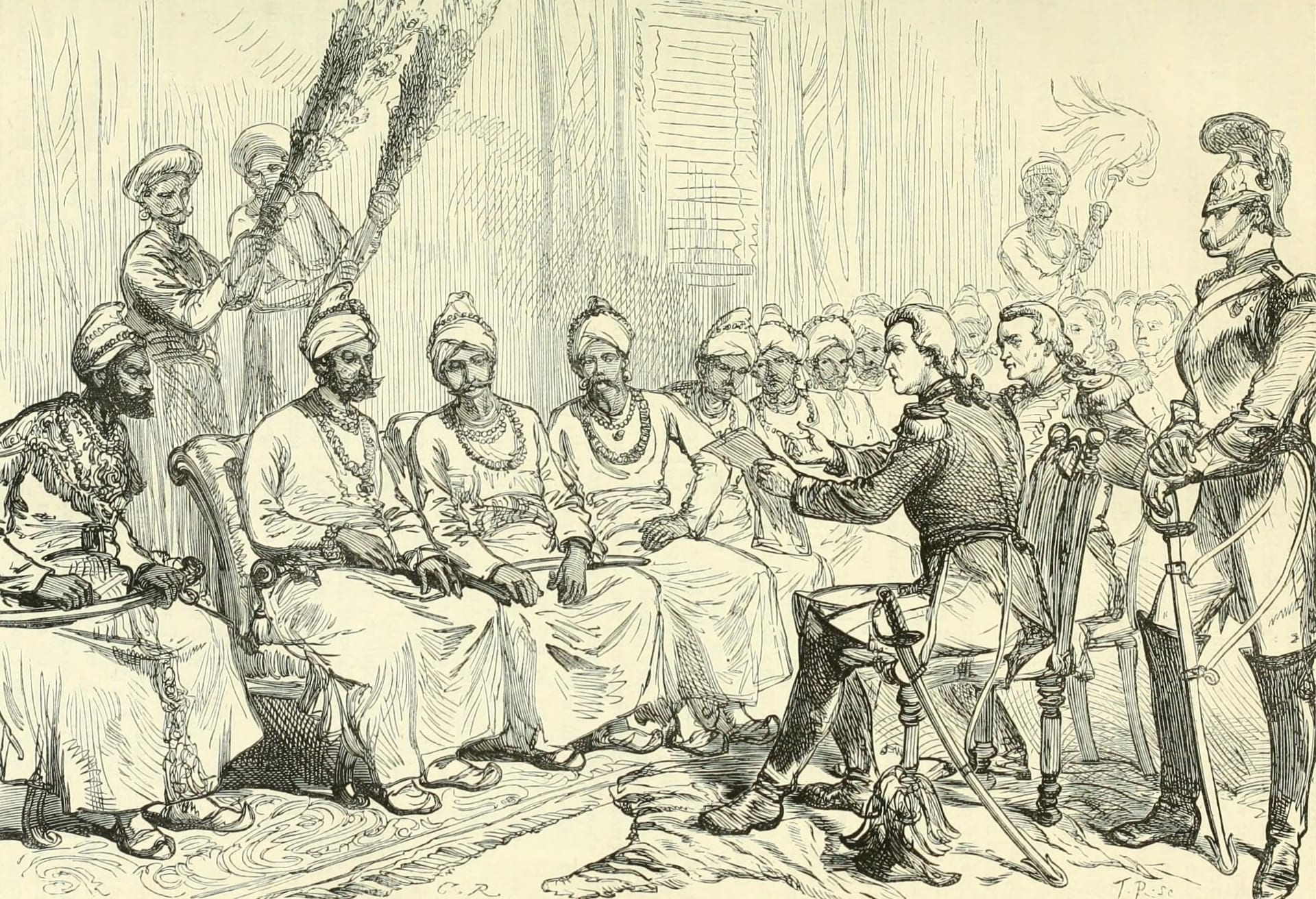
Plate 1.The peace negotiations. A nineteenth-century engraving of British and Burmese commissioners at the peace negotiations that closed the First Anglo-Burmese War, settled by the Treaty of Yandabo in 1826.Photograph: C. R. · Public domain · Wikimedia Commons
The treaty, 24 February 1826
The war ended at Yandabo, a village on the Irrawaddy within striking distance of the Burmese capital at Ava. There, on 24 February 1826, General Campbell for the Company and the Burmese governor of Legaing signed the treaty that closed the First Anglo-Burmese War. Its terms stripped Burma of the whole eastern conquest. King Bagyidaw of Ava renounced all claim to Assam and to Manipur, ceded Arakan and the Tenasserim coast, and undertook to cease all interference in Cachar and the Jaintia hills. Burma agreed besides to pay an indemnity of one million pounds sterling in instalments and to receive a British Resident at its court.
For Assam the effect of a single article was total. By the second article of the treaty the king of Ava gave up the country, and with it the valley passed to the East India Company.
The King of Ava renounces all claims upon, and will abstain from all future interference with, the principality of Assam and its dependencies...(English)
“Article II of the Treaty of Yandabo, 24 February 1826.”
Treaty of Yandabo (1826), full text in the OHCHR document archive.
Ahom rule had begun when Sukaphaa crossed the Patkai in 1228. Six centuries later it ended. It ended not by the conquest of the kingdom in the field, but by a bargain struck far away between two powers that were not Assamese. Neither had ruled the country a generation earlier. The Ahom state, which had outlasted the Mughals and thrown them back at SaraighatAhom · Chapter 3The Ahom-Mughal WarsThe seventeenth-century war that made Assam a military state., was extinguished as a diplomatic afterthought in someone else’s peace.
The Kingdom and Its Culture
8. Paik and Khel
The Ahom administrative system
The Ahom state ran for six centuries with very little money and a great deal of organisation. Its genius was administrative rather than fiscal. The system turned the labour of its subjects directly into roads, embankments, palaces, and armies. It did this without a cash economy or a salaried bureaucracy. That system rested on two institutions, the paik and the khel. Understanding them is the key to understanding how so small an elite governed so large a valley. Its seeds lay in the war-band organisation the Ahoms brought across the Patkai under Sukaphaa in 1228. But it took its mature, kingdom-wide form early in the seventeenth century, under the reforms told in ConsolidationAhom · Chapter 2ConsolidationHow a tribe became a state..
The paik
A paik was an able-bodied adult man, conventionally between about fifteen and fifty, who owed the state service rather than tax. Paiks were grouped into small units called a got, originally of four men and later of three. The members took turns. While one served the state, the others worked the land, including the absent man’s. So the household never went untended, and the state always had labour in hand. In return each paik held a fixed allotment of cultivable land, the ga-mati, conventionally about two puras, roughly two and a half acres. This was the system’s substitute for a wage. The grant was neither hereditary nor freely transferable. It went with the service, not the man. Service might be military. It might also be public works, craft production, or any of the hundred functions the state required, from the tanks and temples to the roads and palaces raised by that corvée and walked in The Stone CapitalAhom · Chapter 12The Stone CapitalJoysagar and the dols, the Ali roads and embankments, and the corvée that raised a built landscape..
The khel
Paiks were organised not only by locality but by function, into khels. These units cut across geography to group together men assigned to a common duty or craft. A khel might be a body of boat-builders, archers, goldsmiths, or the personal levy of a great officer. Some khels were very large. The Naubaicha Phukan, who managed the royal boats, is recorded with an allotment of a thousand men, and other phukans commanded several thousand paiks each. Over the khels and the paiks stood a decimal hierarchy of officials. The bora stood over twenty paiks, the saikia over a hundred, the hazarika over a thousand. Above them rose the rajkhowa, set over some three thousand, and the phukan, over about six thousand. Higher still stood the great ministers of state: the Gohains, the Borbarua and the Borphukan. Those two great offices were created under Pratap Singha (1603 to 1641). It was his first Borbarua, Momai-Tamuli Borbarua, who carried out the census and the systematic reorganisation around 1609. That work turned a war levy into a standing administrative machine, as told in ConsolidationAhom · Chapter 2ConsolidationHow a tribe became a state..
Who was a paik, and who was not
Not everyone owed paik service, and the exemptions map the society’s structure. The ordinary serving man was a kanri paik. The chamua were a privileged class: the literate, the artisans of rank, the petty gentry. They rendered a lighter or more honourable, non-manual service. The line was not sealed. A kanri paik of proven worth could rise into the chamua, and most of the lower officers, the boras, saikias and hazarikas, were drawn from that class. Brahmans, the great families, the monasteries and the officers stood outside the levy altogether. Instead they were granted paiks of their own, men assigned to work temple, sattra or noble lands. Below the free paik again were dependent and bonded people. These were the likchous, bahatiyas and others attached to households and institutions. The whole was held together by the census. Periodic enumerations fixed each man in a got and a khel. The accuracy of those registers was, quite literally, the strength of the state. When the registers decayed and the Moamoria rebellionAhom · Chapter 5The Moamoria RebellionThe forty-year insurgency that broke the state. of 1769 to 1805 shattered the population they counted, the paik system unravelled, and much of the kingdom’s strength went with it.
9. Material Culture
Architecture, coinage, textiles
More of the Ahom kingdom survives in brick and metal than in any other form. Its material culture is therefore the part of the state a visitor can still walk through. Three things stand out. The first is a distinctive architecture. The second is a coinage that announced the dynasty’s claims. The third is a textile tradition, above all the golden muga silk, that has outlived the kingdom entirely. Almost all of the great surviving works belong to a single phase. That phase is the golden age of the late seventeenth and eighteenth centuries. Each can be dated to the king who raised it.
By night a dead Swargadeo left the capital in secret and was laid under earth with the world of his life, while the living kept feeding the dead who had become gods.
Plate 1.The Rang Ghar near Sivasagar. The Rang Ghar near Sivasagar, the two-storeyed oval pavilion raised under Pramatta Singha around 1744 to 1751, crowned with carved finials.Photograph: Rangan Datta Wiki · CC BY-SA · Wikimedia Commons
Coinage
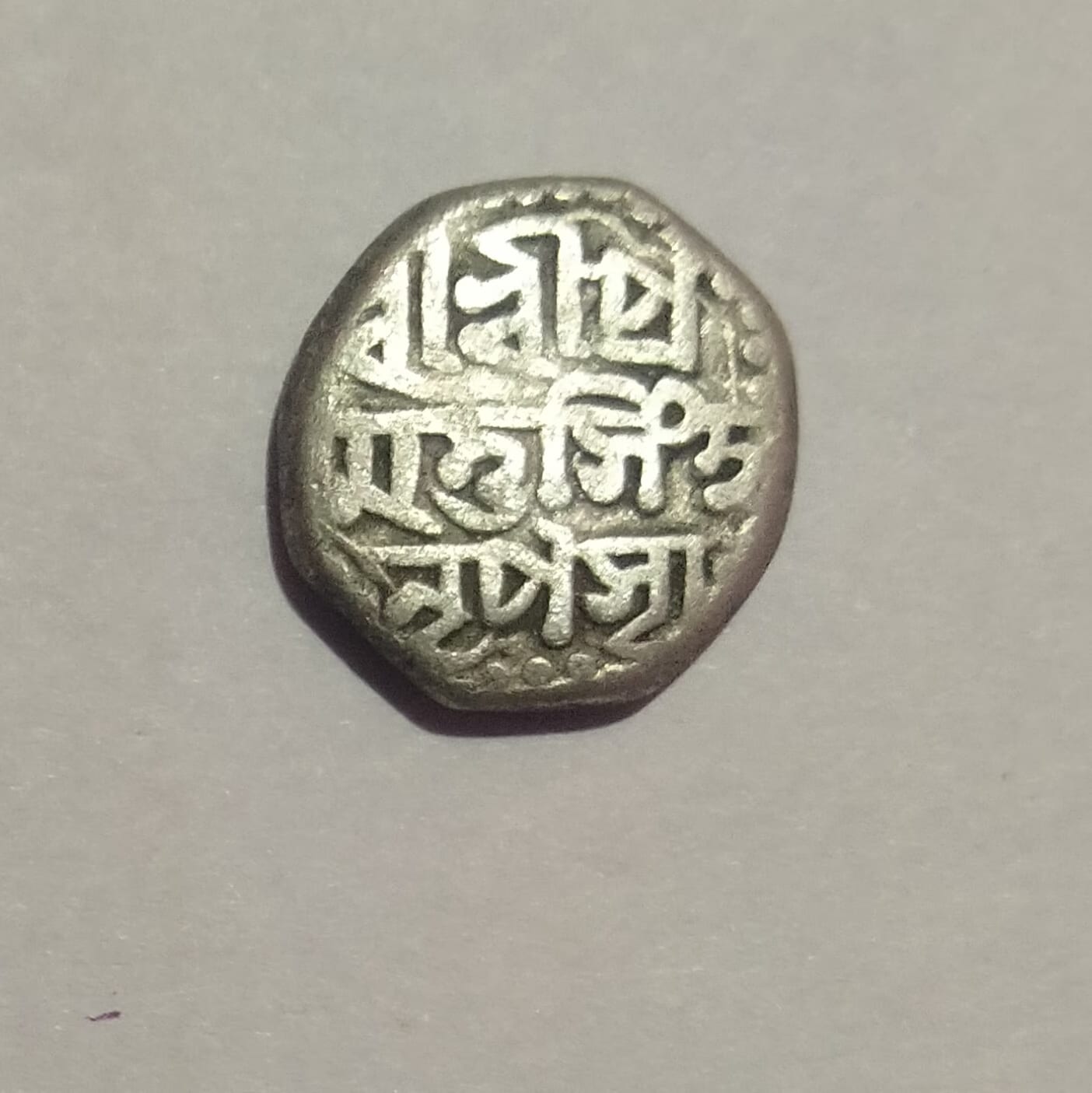
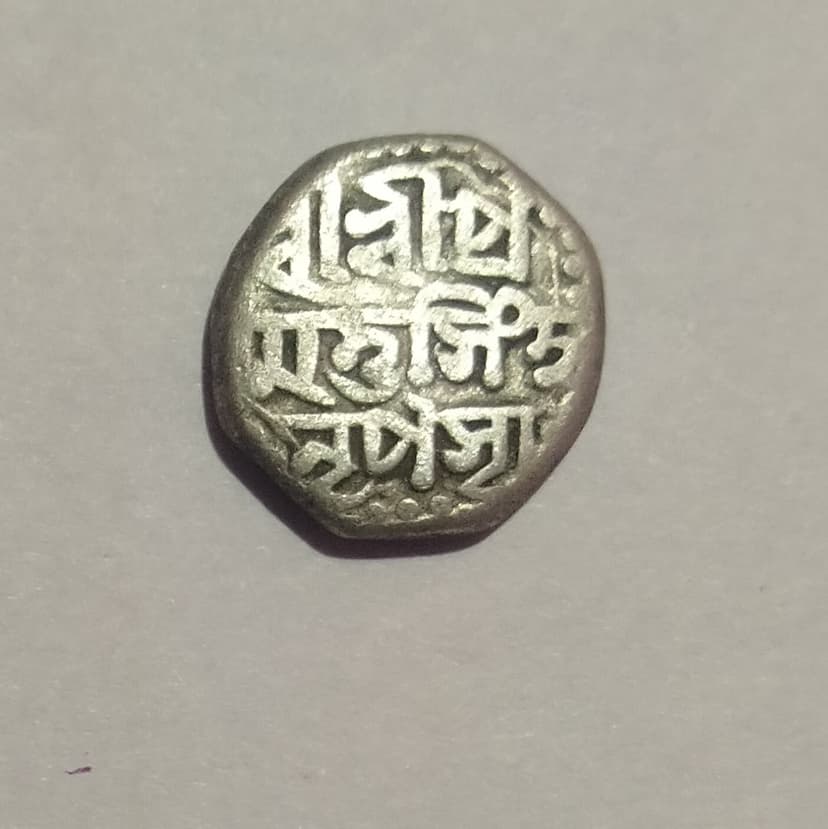
A regular royal coinage came late. It is generally credited to Jayadhwaj Singha in the mid-seventeenth century, and it grew under his successors. The Ahoms struck it in silver and occasionally gold. Much of it took the unusual octagonal form. Because the north-east has no silver mines, the metal itself came in through trade, and the mint was a great office of state under the Sonadar Barua, who served as master of the mint and chief jeweller.
The legends record the king’s name and titles. Increasingly, they also record his Hindu regnal style and the protection of the gods. The coins thus track, issue by issue, the same Hinduisation of the monarchy that began with Suhungmung’s Hindu title in the sixteenth century, told in ConsolidationAhom · Chapter 2ConsolidationHow a tribe became a state.. Coins were struck to mark accessions and victories as much as for everyday exchange. This fits a state whose economy ran more on service than on cash, the service being the paikAhom · Chapter 8Paik and KhelHow the state organised labour, land, and war. labour every free man owed the crown.
Plate 2.An octagonal Ahom silver rupee. An octagonal Ahom silver rupee of Pramatta Singha (1744 to 1751), its face bearing a multi-line legend in Assamese script with the king's name and titles.Photograph: Pranabnlp · CC BY-SA · Wikimedia Commons
Metal, cannon, and the painted manuscript
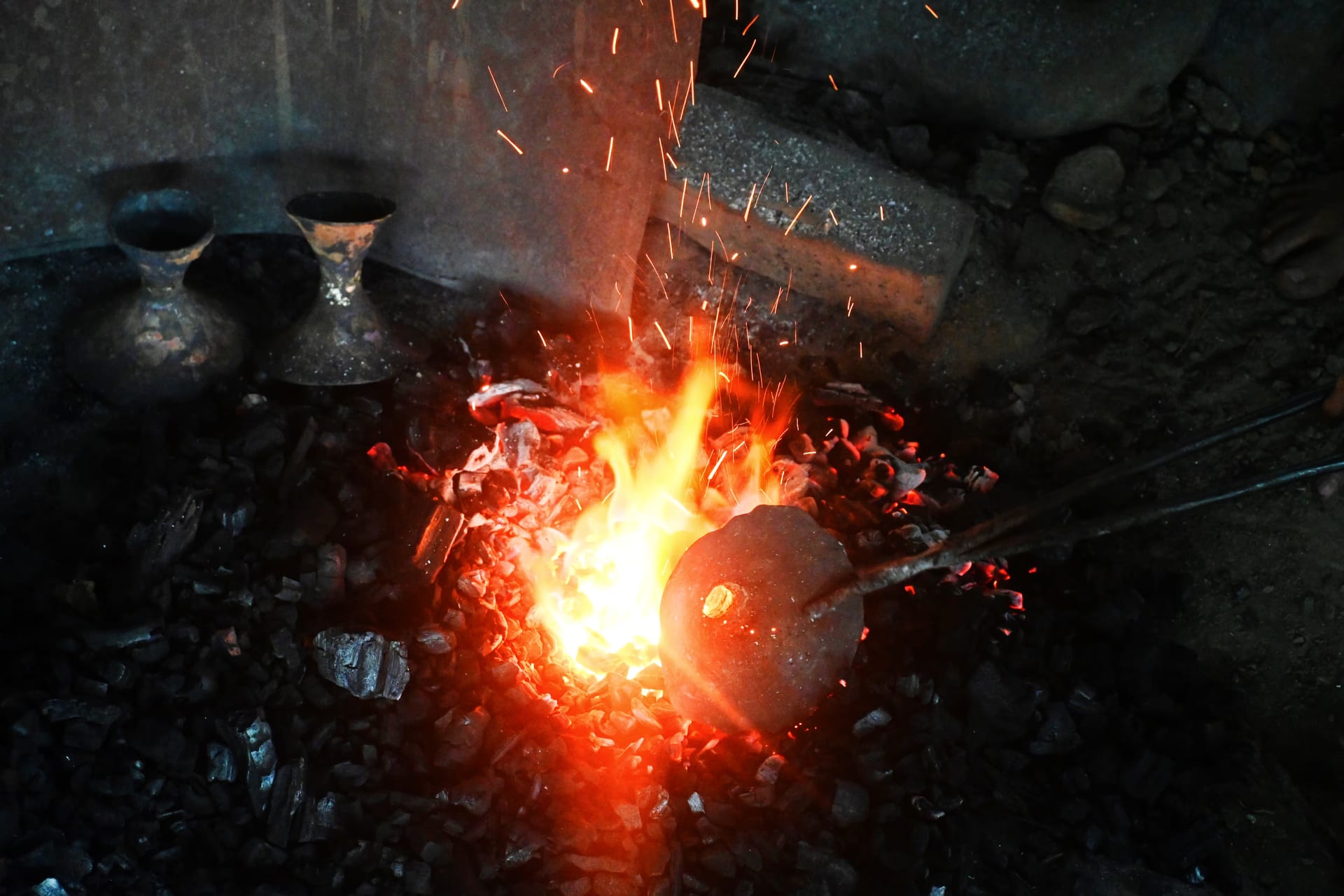
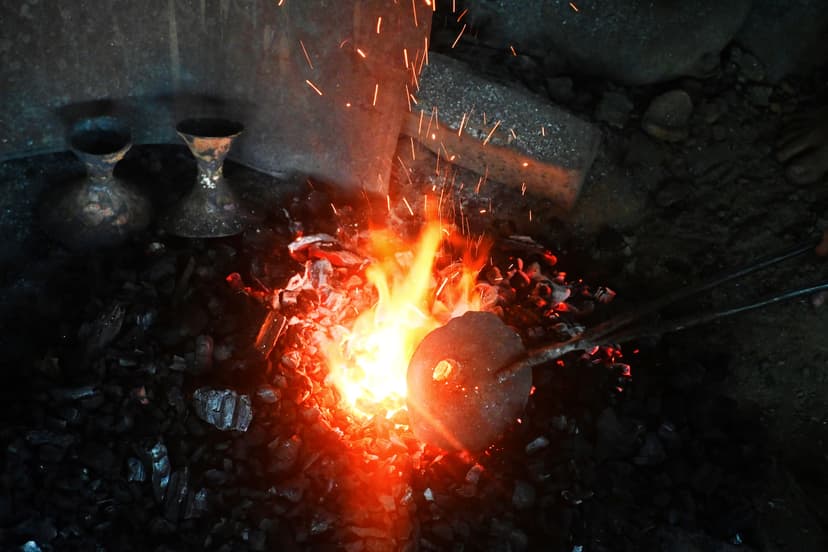
Beyond brick and coin, the Ahom state was a great organiser of metalwork. Whole khels of smiths cast the bell-metal and brass utensils still made at Sarthebari. The same foundries cast the kingdom’s firearms and heavier guns, the hilois and cannon, whose manufacture the buranjis treat as a matter of state. Firearms were in Ahom hands from about the early sixteenth century, and a dedicated officer, the Kharghariya Phukan, oversaw the making of gunpowder. How that ordnance was carried into battle on land, water, and through the earth belongs to The Army and the NavyAhom · Chapter 13The Army and the NavyBacharis and cannon, paik levies, the navy that won Saraighat..
Plate 3.Bell-metal worked over a charcoal forge. Bell-metal worked over a charcoal fire, the craft of the casting khels that supplied the Ahom kingdom.Photograph: পৱন বৰ্মন · CC BY · Wikimedia Commons
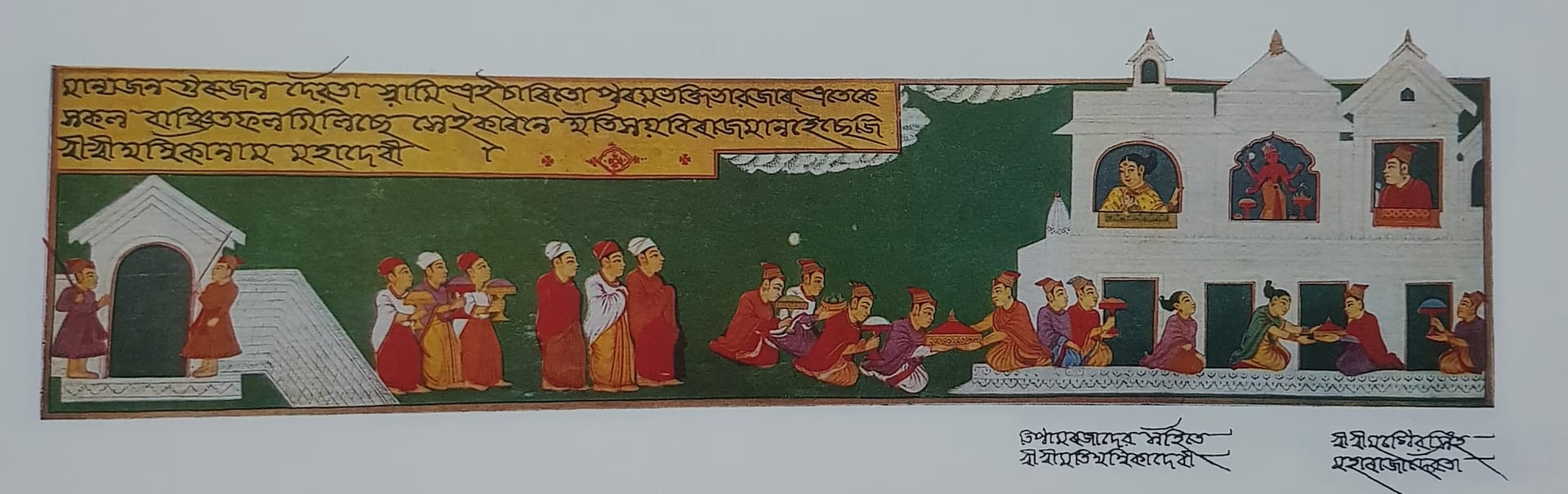
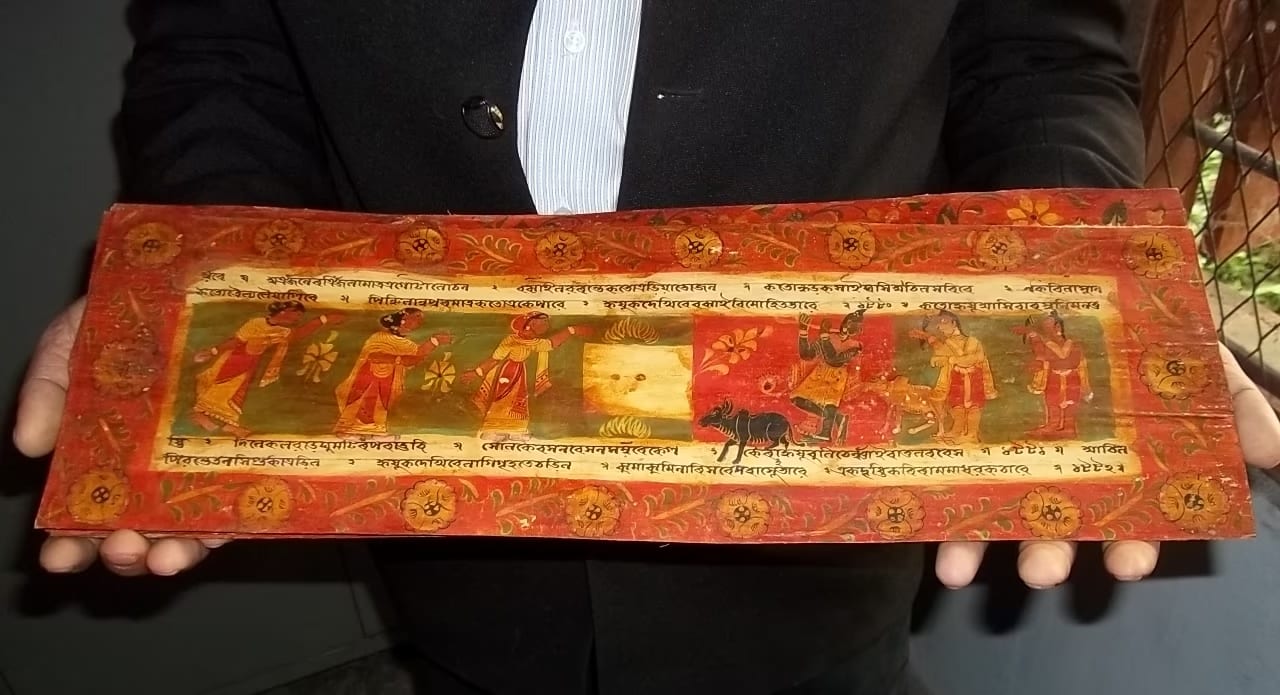
Alongside the metalworkers worked the scribes and painters of the manuscript tradition. These were illustrated manuscripts on bark and cloth, the sanchi-pat books, painted in the mineral pigments hengul (red) and haital (yellow orpiment). The surviving examples are the illustrated chronicles and the great court copies of treatises, among them the Hastividyarnava. These crafts, like the weavers, were administered through the same paik and khel systemAhom · Chapter 8Paik and KhelHow the state organised labour, land, and war. that organised all skilled and obligatory labour in the kingdom.
Plate 4.A folio of the Hastividyarnava. A folio of the Hastividyarnava, the illustrated manuscript made for the Ahom court, a courtly procession above a band of old Assamese script far from the modern hand.Photograph: Dilbar and Dosai · Public domain · Wikimedia Commons
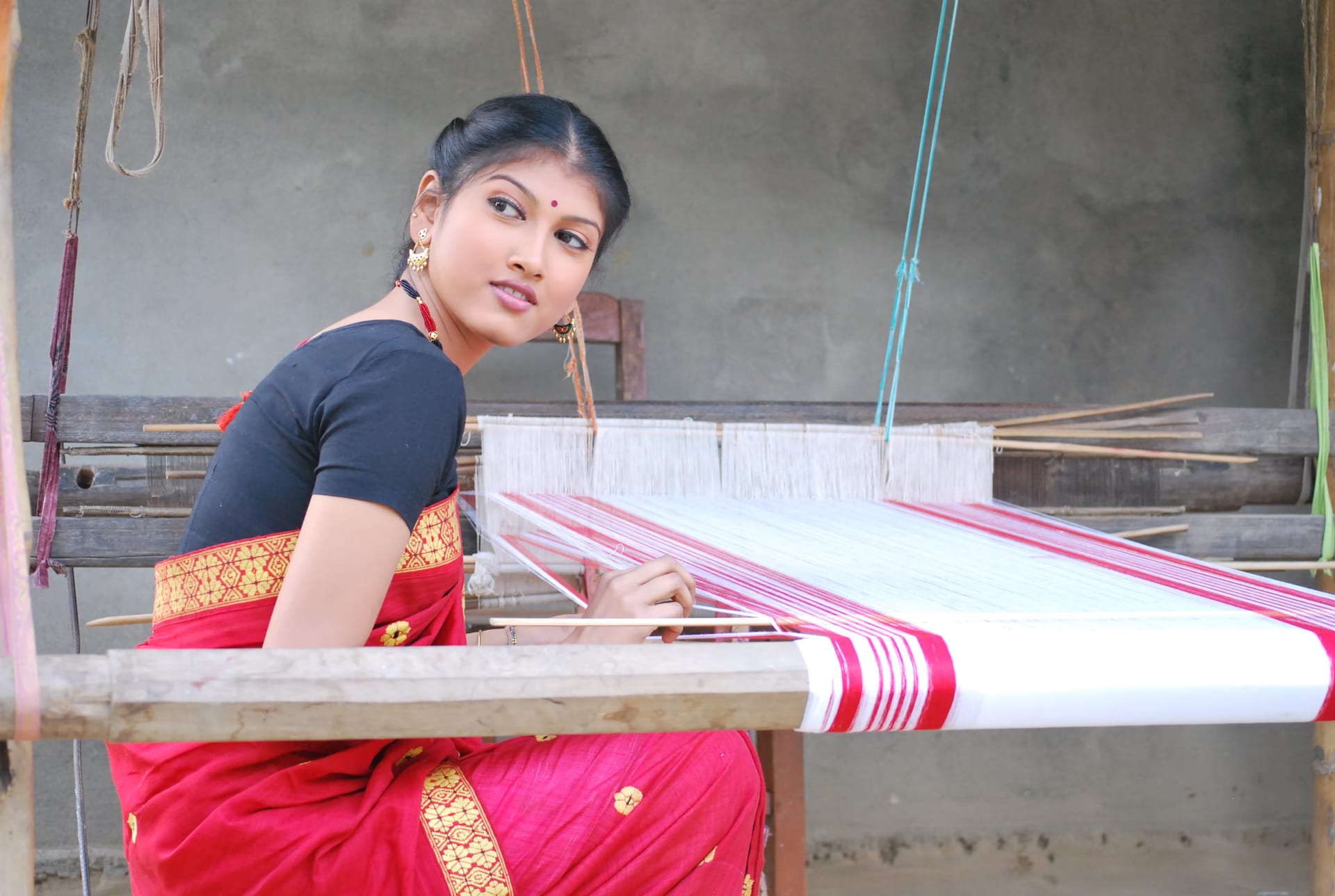
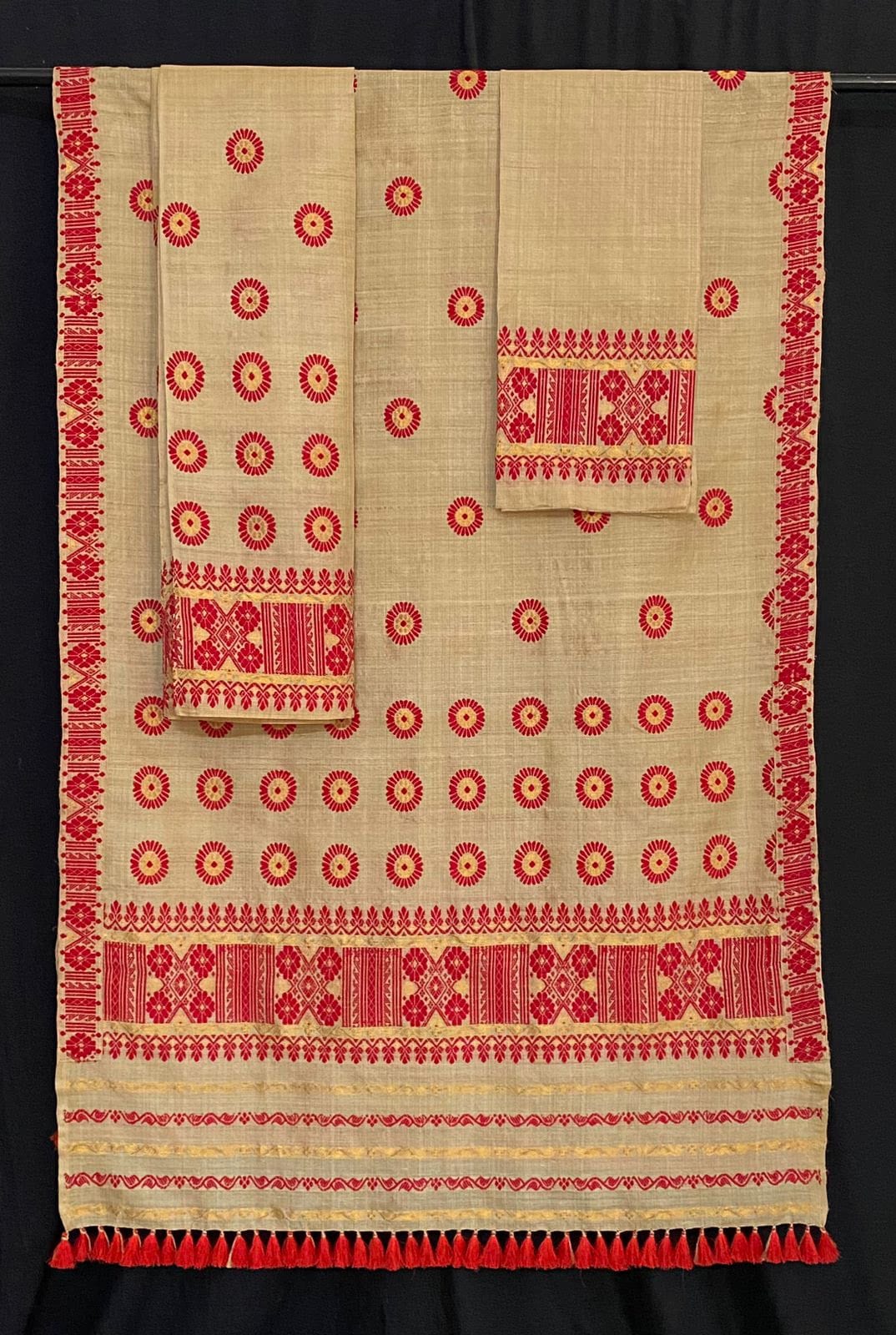
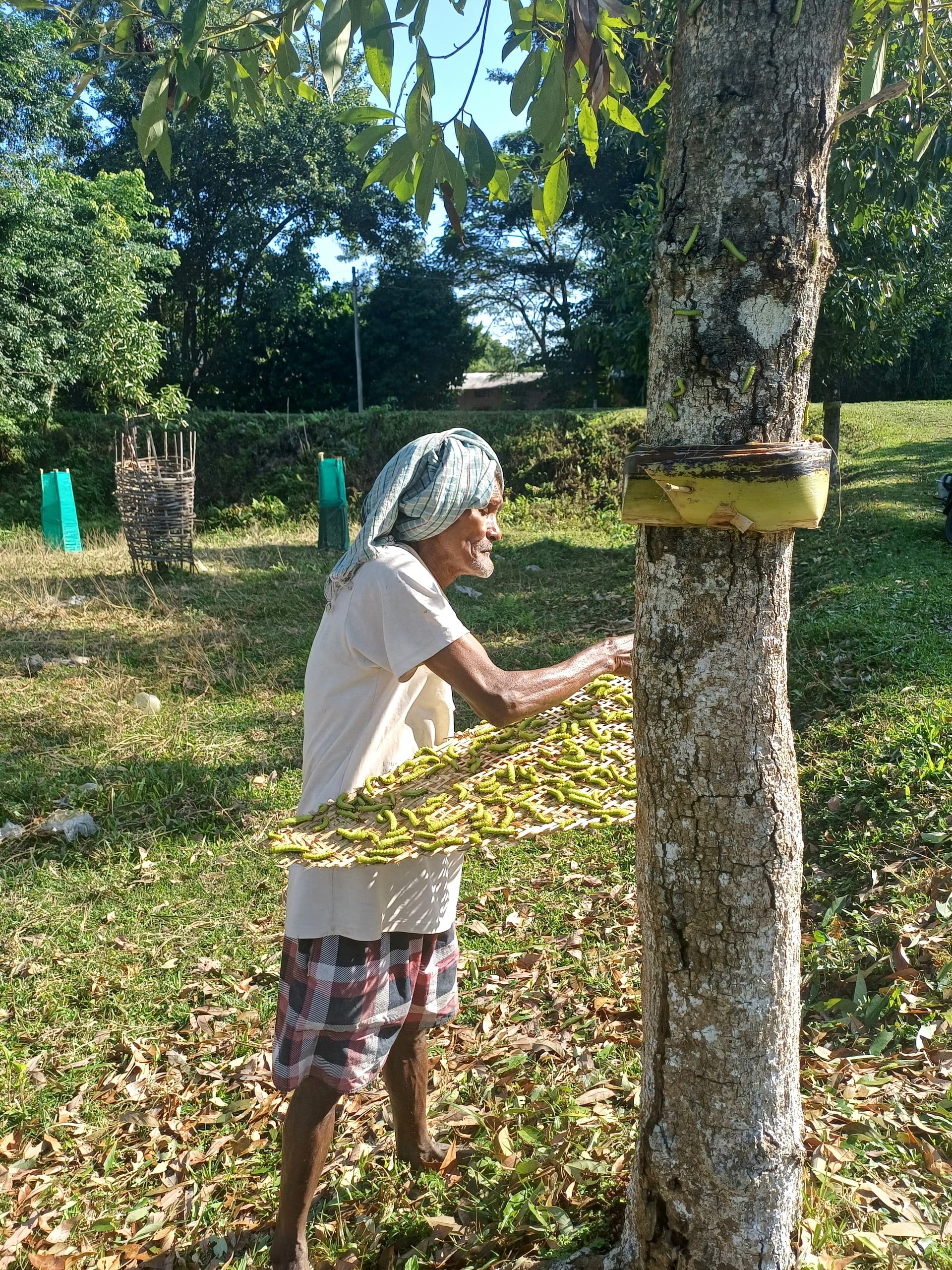
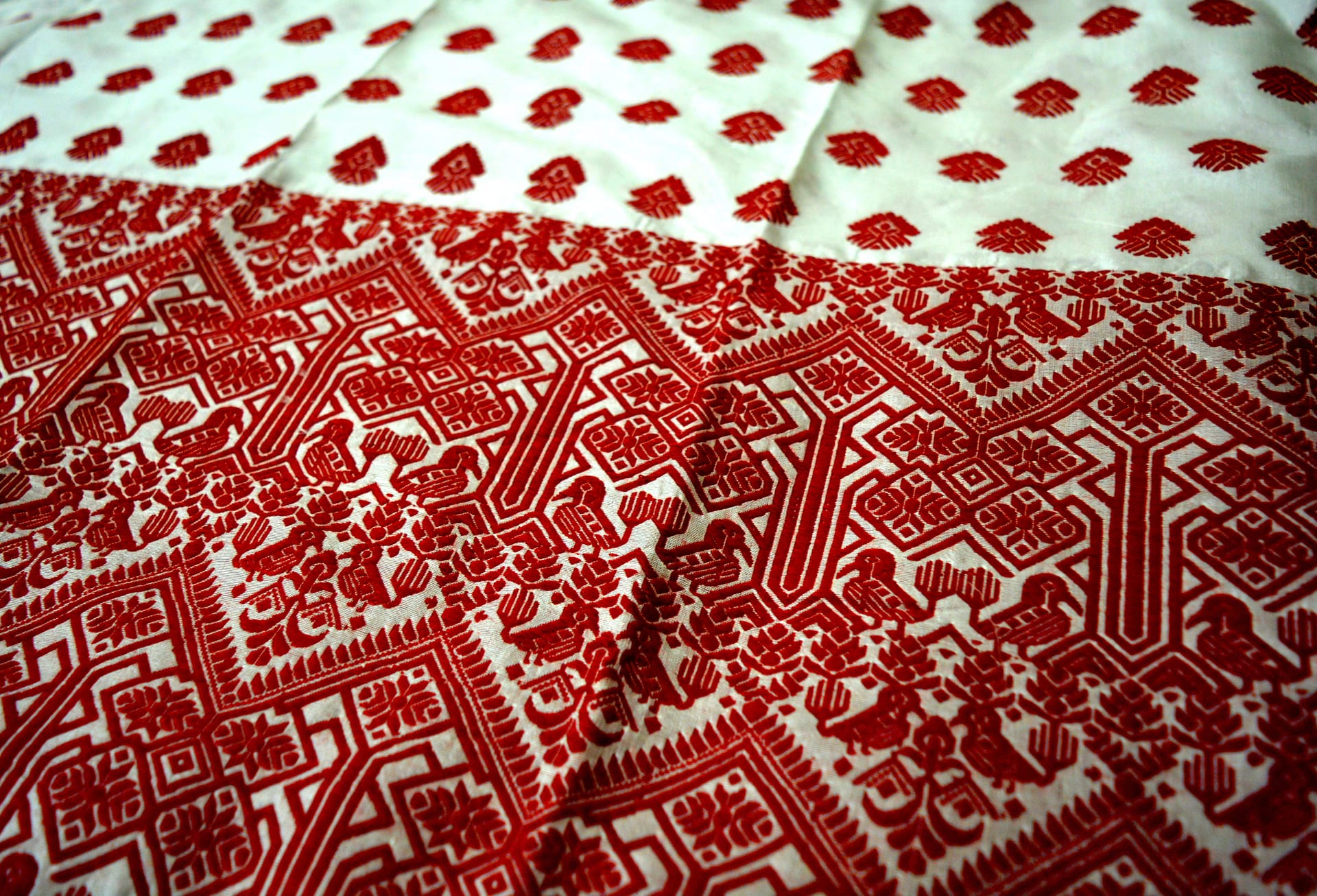
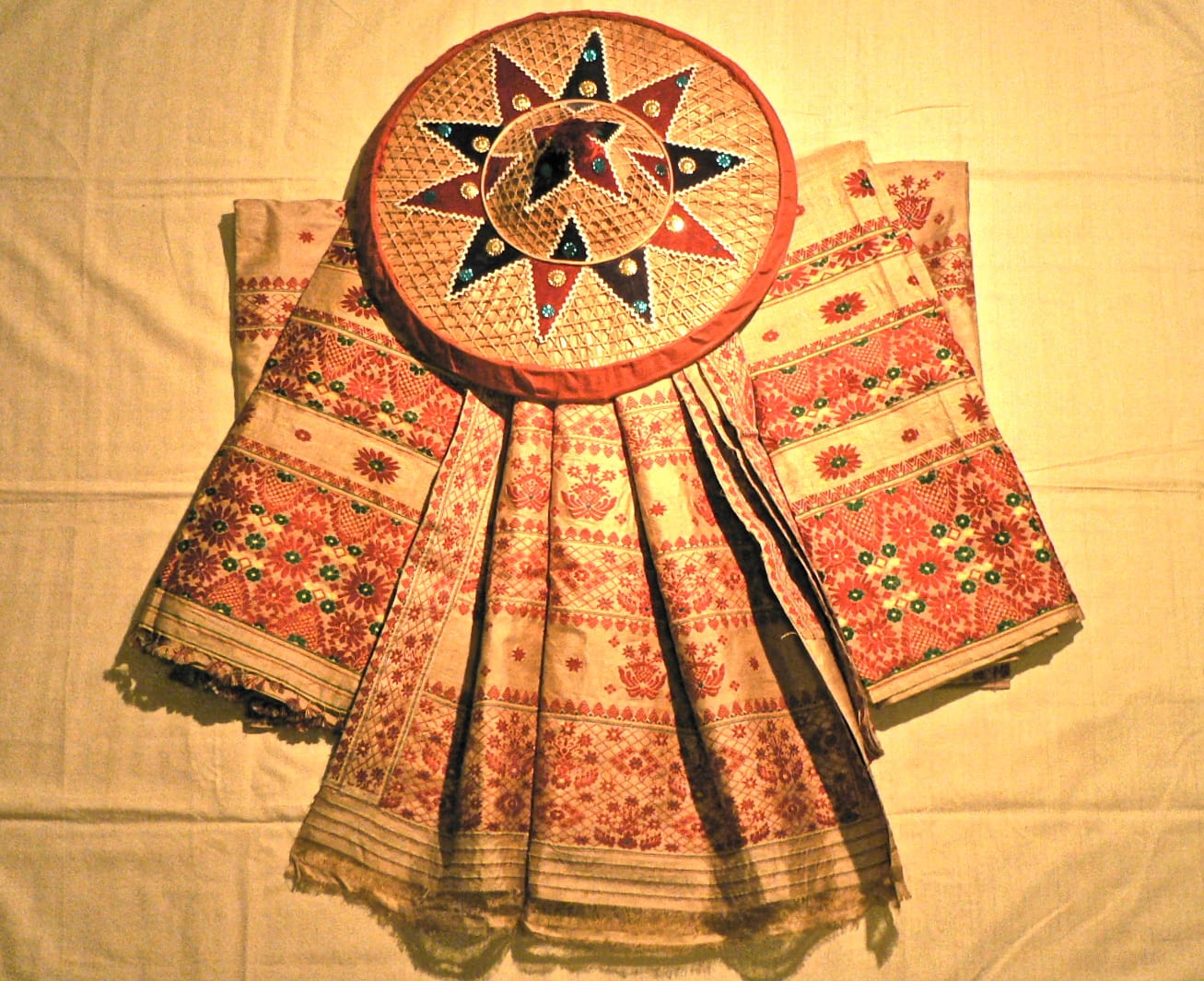
The weaving of these silks was not a village afterthought but a branch of statecraft. Its weaver communities, among them the silk-weavers of SualkuchiPlace to visitSualkuchiWeaving town on the north bank of the Brahmaputra. Household looms for centuries; today the engine of Assam's silk industry., were organised, like everything else, through the khel system that ran all skilled labour in the kingdom. Muga in particular clothed the court and signalled rank, its deep gold sheen reserved for those who could command it. That prestige has proved durable: muga’s protected origin in the Brahmaputra valley was later recognised in law when Assam Muga Silk was registered as a Geographical Indication in 2007. It remains one of the clearest threads of continuity between the Ahom kingdom and the Assam of today, for the weavers of muga, eri, and pat carried that skill unbroken across the fall of the state and into the present.
Plate 5.Muga silk woven into a mekhela-chador. Muga, the lustrous golden wild silk of Assam, woven into a mekhela-chador with red and gold floral borders and shown with a decorated japi.Photograph: Satnath · CC BY-SA · Wikimedia Commons
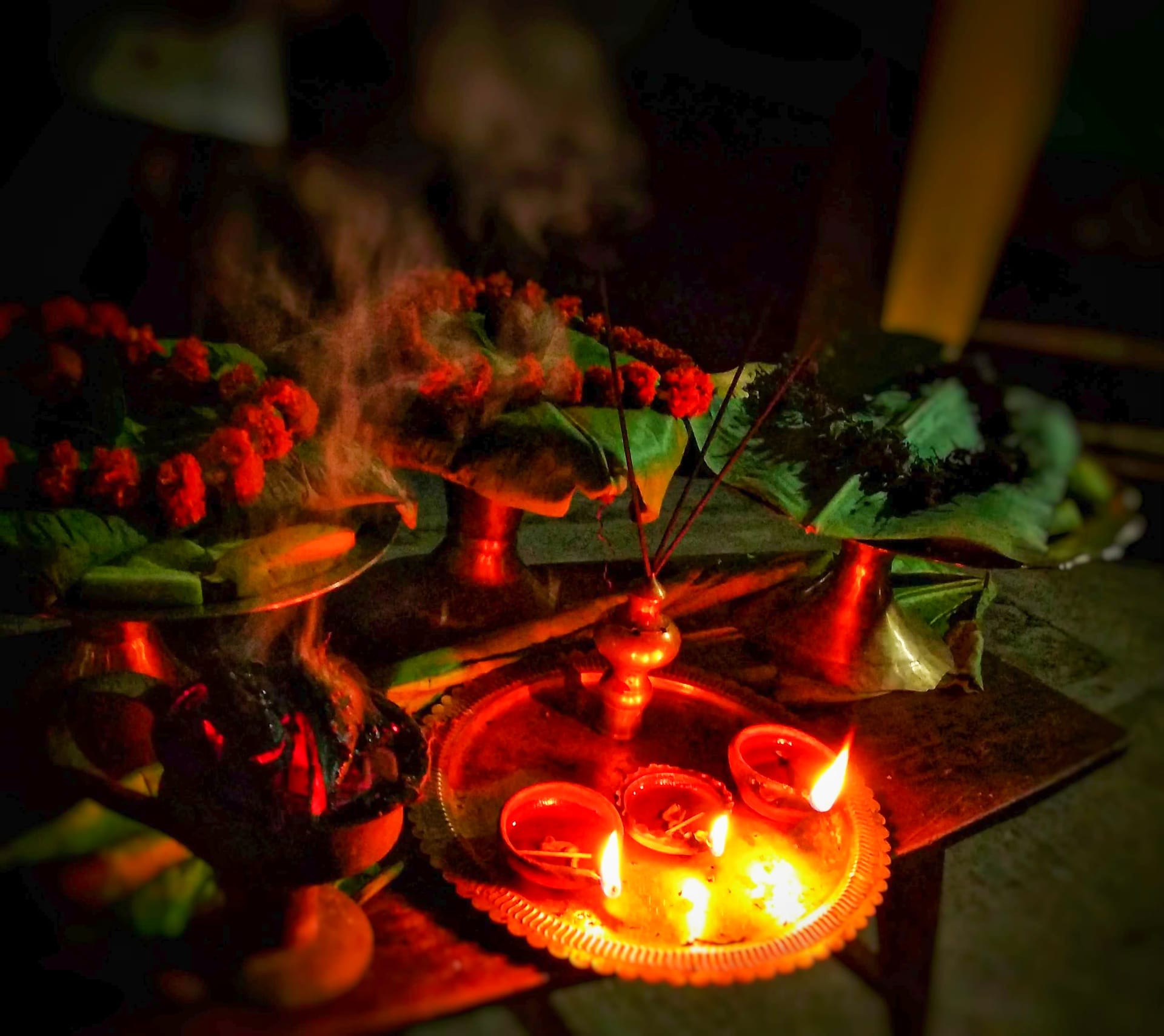
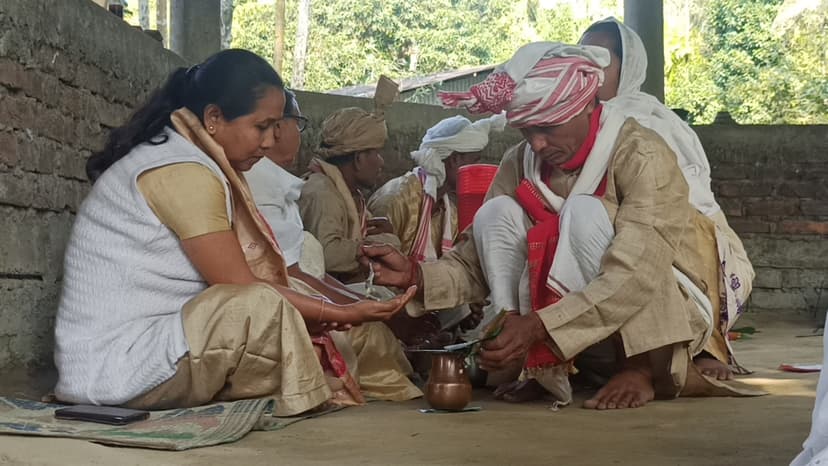
The religion the Ahoms brought across the Patkai was a Tai ancestral and spirit cult. It was served by a hereditary priesthood, the deodhai, mohan and bailung. These priests kept the ritual calendar, read omens, and conducted the worship of the royal and ancestral spirits. The faith saw the dead pass through stages. A newly dead forefather became a dam, a household spirit. After many generations that dam rose to a phi, a god worshipped by the whole clan. Its central observance was the propitiation of these ancestors, known as Me-Dam-Me-Phi. Above the family spirits stood a wider Tai pantheon, headed by the sky-god Lengdon, and a titular royal deity that the king alone could handle. The deepest expression of that faith was the burial of the Swargadeo himself, carried by night to the royal mounds at CharaideoPlace to visitCharaideo MaidamsThe royal necropolis of the Ahom dynasty, inscribed by UNESCO in 2024. and laid in the earth with the goods and the household of his life.
The Last Rites of an Ahom King
MB
Monimoy Bujarbaruah
By night a dead Swargadeo left the capital in secret and was laid under earth with the world of his life, while the living kept feeding the dead who had become gods.
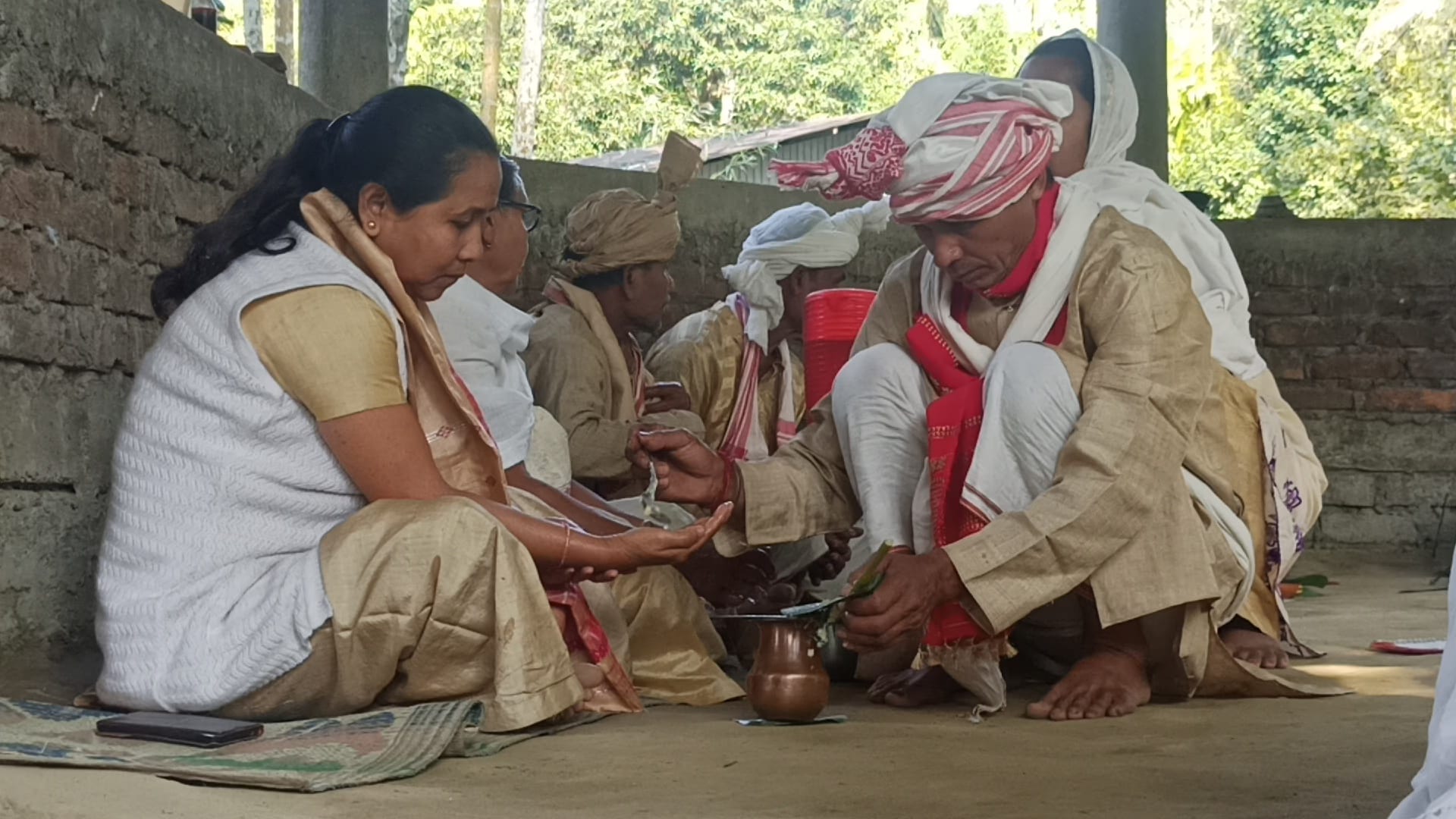
This rite survived at court alongside the Hindu rites the kings increasingly adopted, and then beneath them. It persists among Tai-Ahom communities today. This older layer never wholly disappeared, even as the monarchy turned Hindu. It was overlaid, not erased. The deodhais kept their place at court to the end of the kingdom, casting horoscopes and reading the old omens for kings who worshipped Durga in public.
Plate 1.The Me-Dam-Me-Phi offering to the ancestral dead. Celebrants in traditional Tai-Ahom dress make the oblation to the ancestral dead.Photograph: Afughat · CC BY-SA · Wikimedia Commons
The turn to Saktism
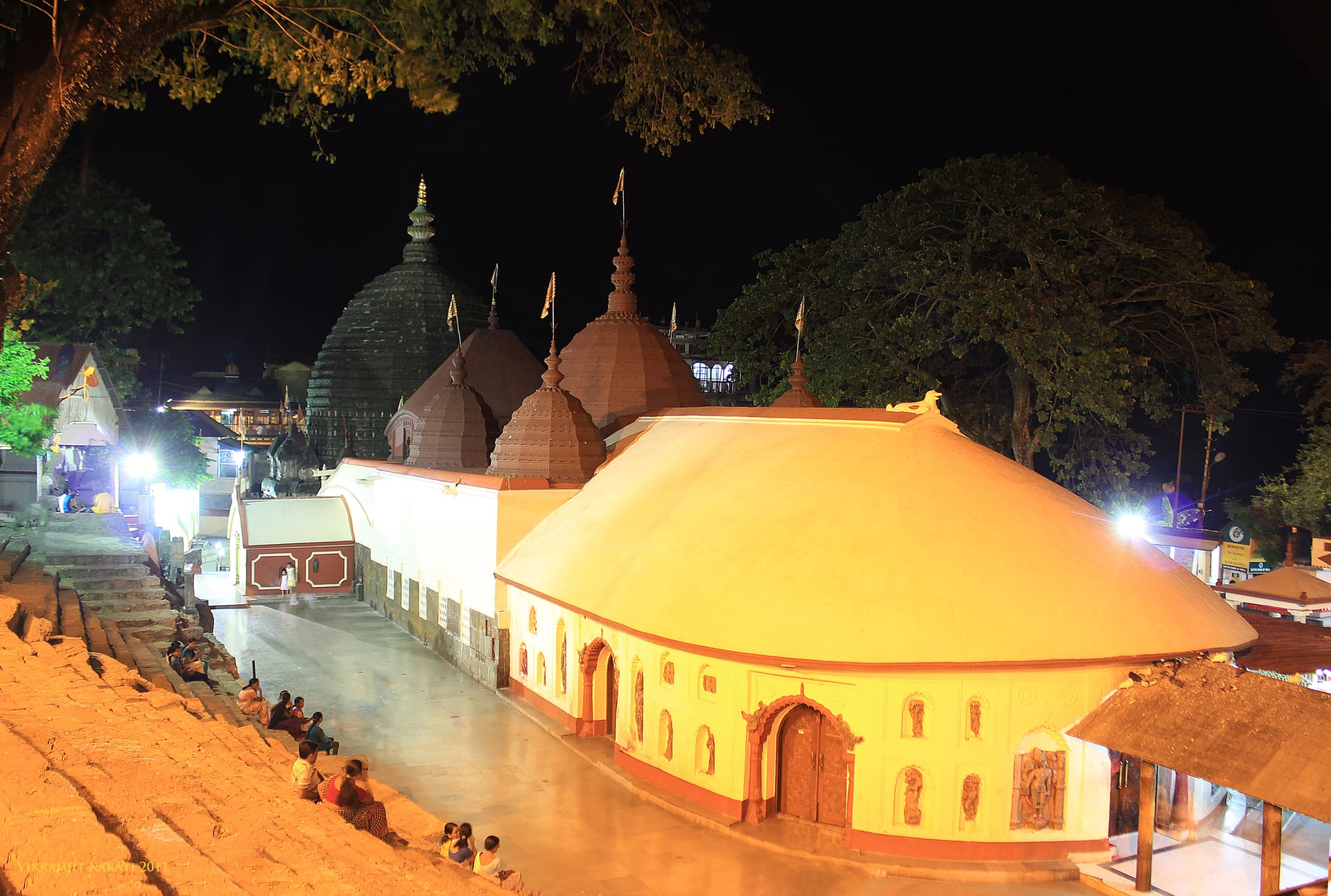
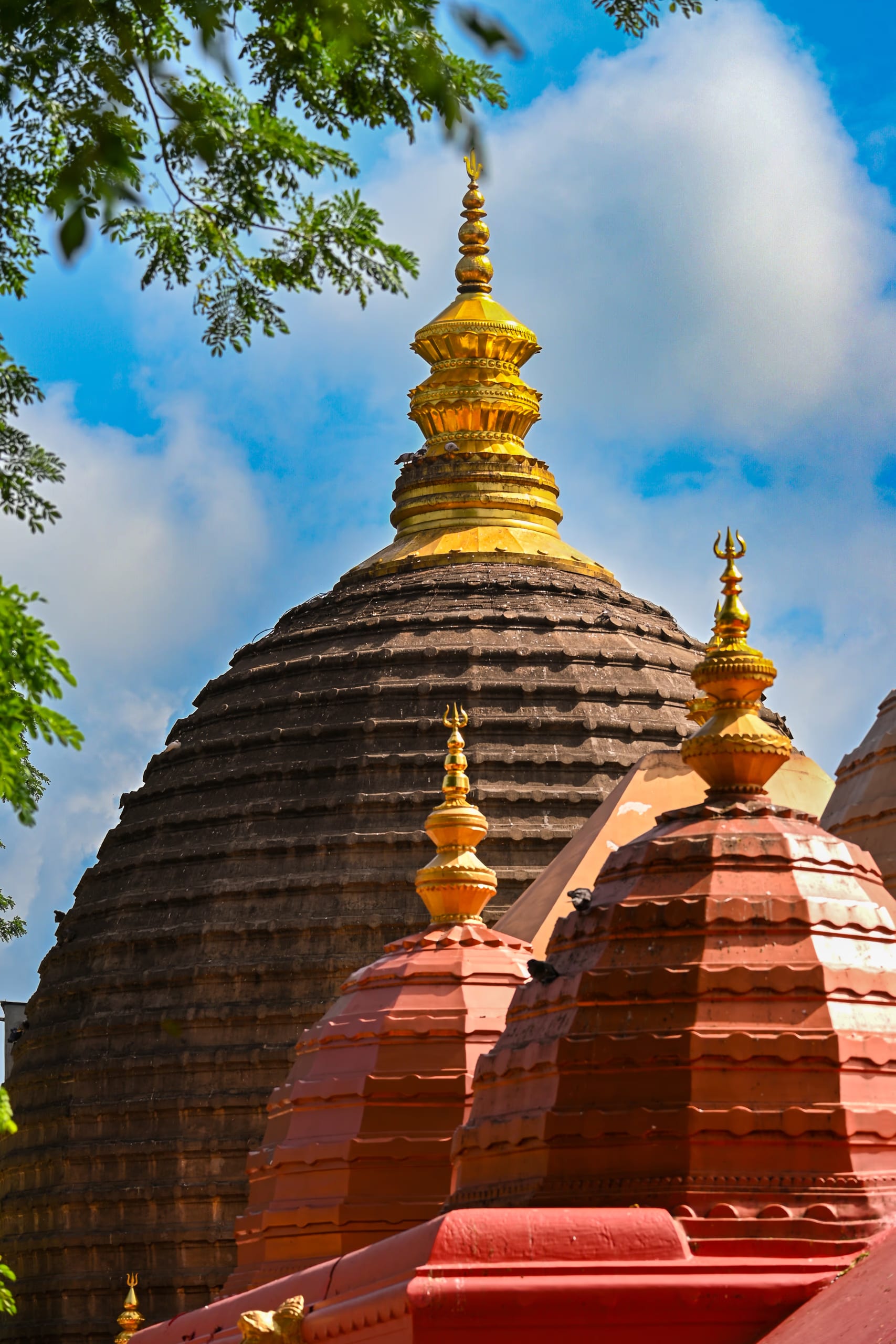
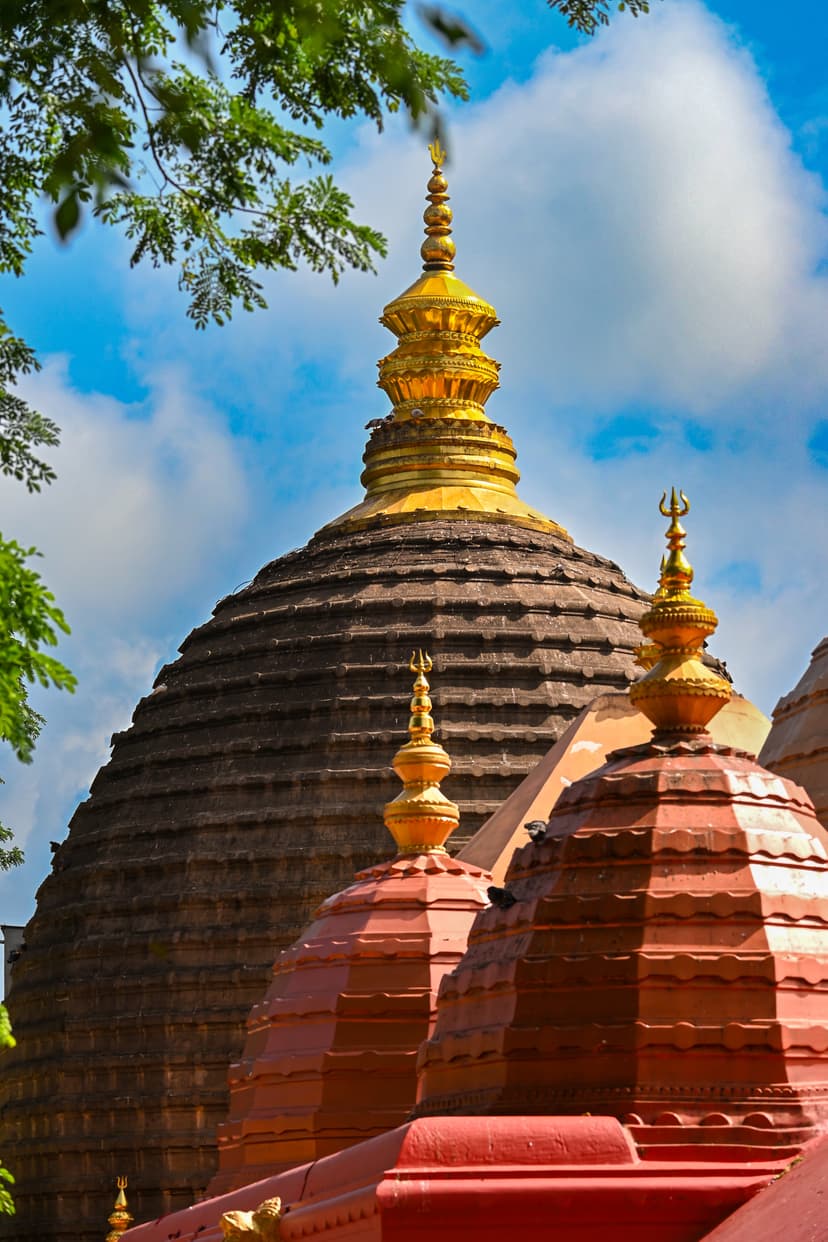
The dominant religion of the valley the Ahoms conquered was Sakta. This was the worship of the goddess, centred on KamakhyaPlace to visitKamakhya TempleOne of the oldest and most revered Shakti peethas, perched above Guwahati on the Nilachal hill, drawing pilgrims from across the subcontinent., and the monarchy was drawn steadily into it. The first step was Suhungmung’s adoption of the Hindu regnal title Swarganarayan in the sixteenth century, told in ConsolidationAhom · Chapter 2ConsolidationHow a tribe became a state.. The decisive step came in 1648, when Jayadhwaj Singha took formal initiation and became the first Swargadeo to embrace Hinduism as the religion of the king rather than as a court style. The high point came two centuries later under Siva Singha (1714 to 1744). His reign is treated in The Golden AgeAhom · Chapter 4The Golden AgeMonumental architecture, administrative reform, the high tide., and he made Saktism something close to a state cult. A devout Sakta, Siva Singha placed his queens in turn on the throne as Bar-Raja. He did this on the advice of astrologers who read danger in his own stars. He fell under the influence of his religious preceptor, the Sakta Gosain Krishnaram Bhattacharya, the Parbatiya (Parvatiya) Gosain. This preceptor was given charge of the Kamakhya temple and made royal priest. His ascendancy pushed the court toward open hostility to the Vaishnava sattras.
The first Bar-Raja, Phuleswari, carried that hostility furthest. Under the Parbatiya Gosain’s guidance she tried to make Saktism the state religion. By tradition she summoned the Vaishnava Gosains, among them the head of the Moamara sattra, to a Durga puja and had sacrificial blood smeared on their foreheads. To men who refused all animal sacrifice this was a deep defilement. The insult was never forgiven. It became a seed of the rising that would break the kingdom two generations later. By the golden age the Swargadeo was, in his public religion, a Hindu king.
Plate 2.The Kamakhya temple, the great Shakta pitha. The distinctive beehive shikhara of the Kamakhya temple on Nilachal Hill, its gilded finial above the red domes of the great Shakti pitha.Photograph: JyotiPN · CC BY-SA · Wikimedia Commons
Vaishnavism and the fatal quarrel
The third current was the neo-Vaishnavism of Sankardev. This was the Ekasarana faith, organised through the sattras, and it had won a mass following across the valley. The Ahom court’s relations with the sattras swung between patronage and suspicion. Early kings had sheltered the movement. Under the Sakta-leaning monarchy of the eighteenth century, relations turned to outright persecution of the Moamara sattra and its followers. That persecution lit the Moamoria rebellion of 1769 to 1805, the rising that broke the state, traced in The Moamoria RebellionAhom · Chapter 5The Moamoria RebellionThe forty-year insurgency that broke the state.. Assam’s religious history is thus not a backdrop to its politics but a driver of them. The same court that fused Tai and Sakta worship into a durable monarchy could not absorb the Vaishnava movement. That failure was mortal.
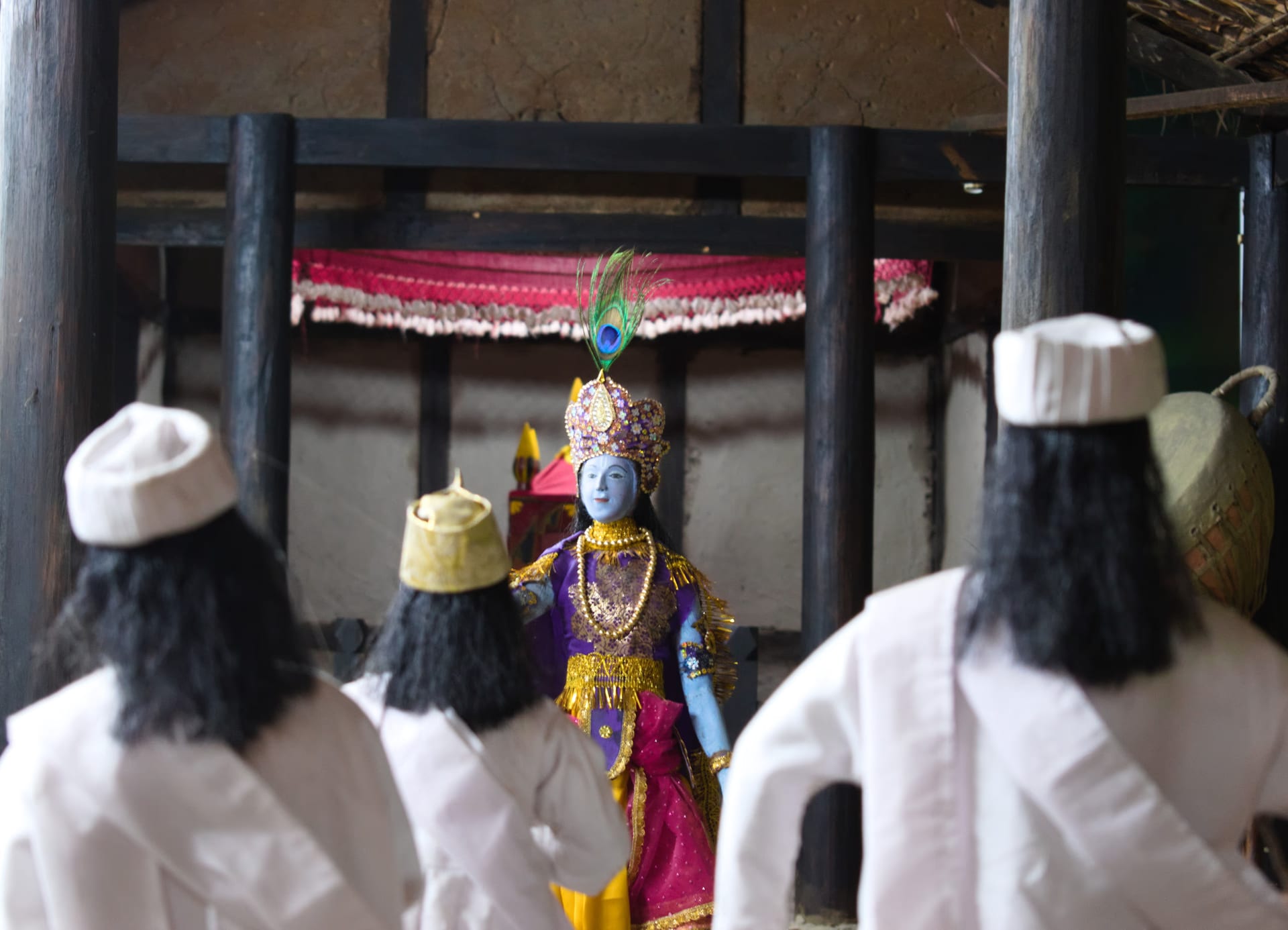
Plate 3.A bhaona, the dramatic form of Sankardev’s neo-Vaishnavism. A bhaona scene: the blue Krishna in crown and robe under the namghar canopy, white-clad gayan ranged before him, the staging of an Ankia Naat episode.Photograph: Rohit Sharma · CC BY-SA · Wikimedia Commons
A fourth presence: Islam
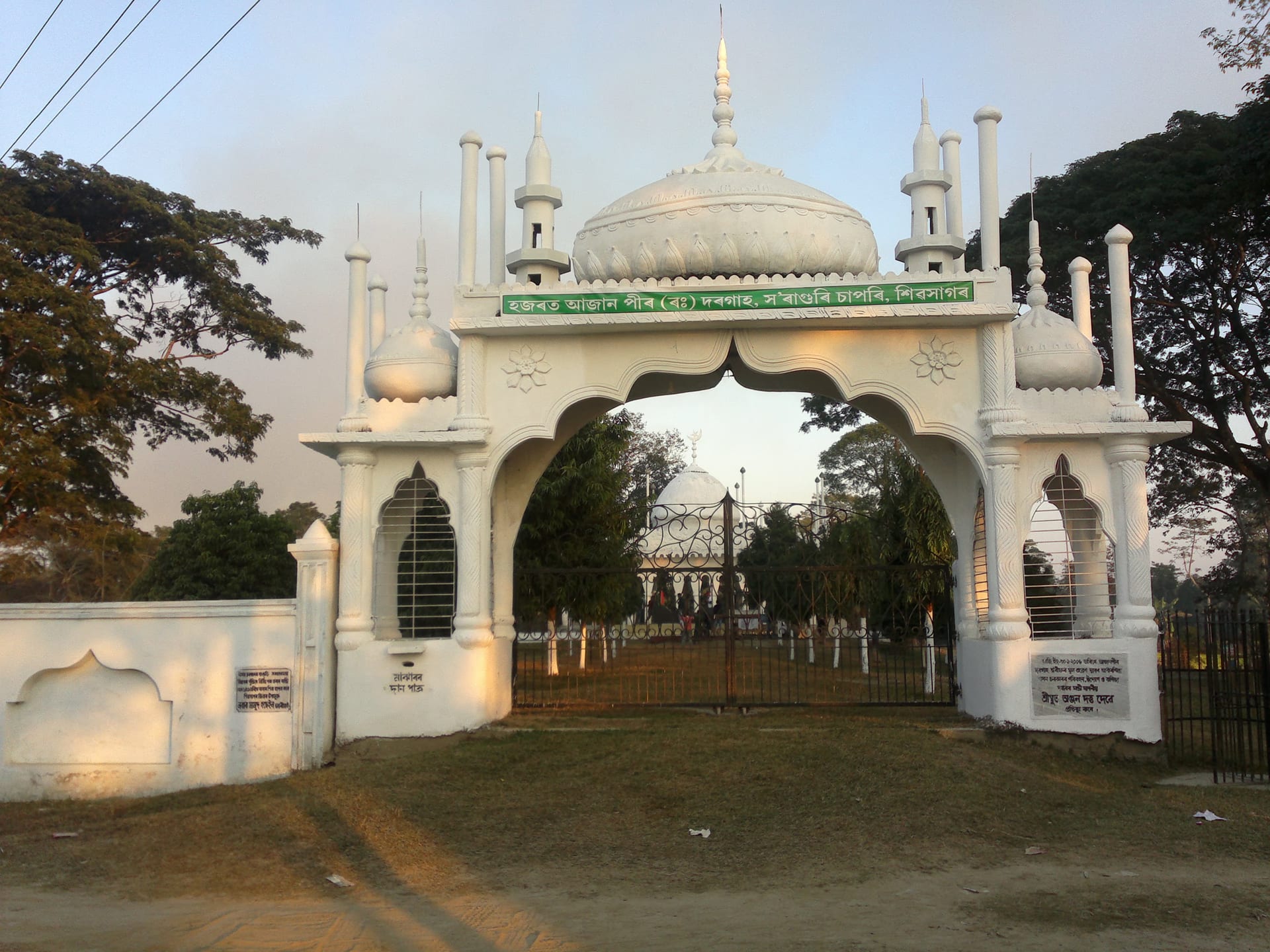
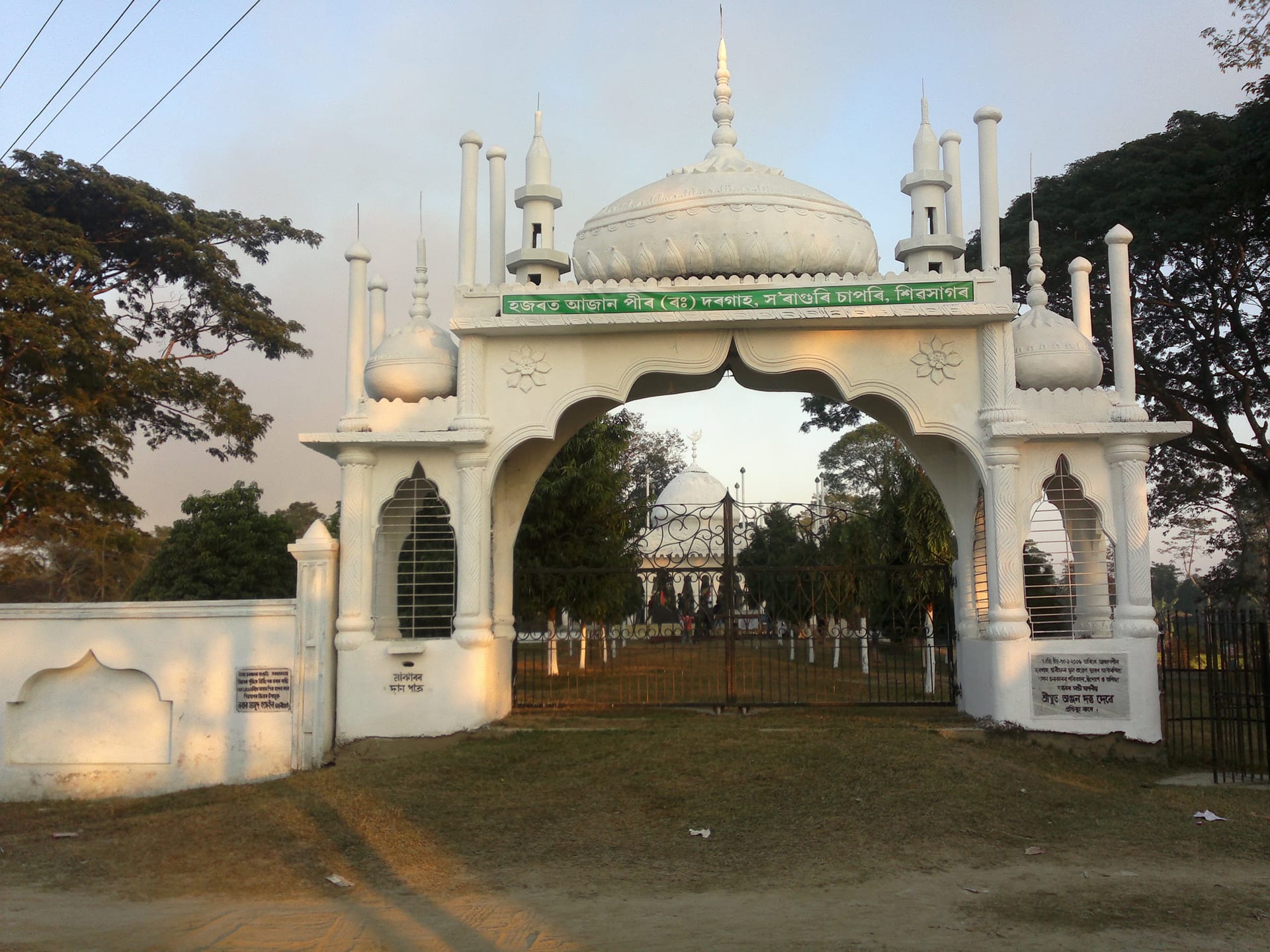
A fourth current, smaller but old, ran beneath these three. Muslims had lived in the valley since the medieval Bengal invasions, as soldiers, weavers and prisoners settled by the state. A Sufi devotional Islam took local root. Its memory centres on Azan Fakir, the seventeenth-century saint. He is credited with composing the Assamese-language Zikir devotional songs and with shaping a distinctly Assamese Islam. His shrine (dargah) at Saraguri Chapari near Sivasagar remains a place of pilgrimage.
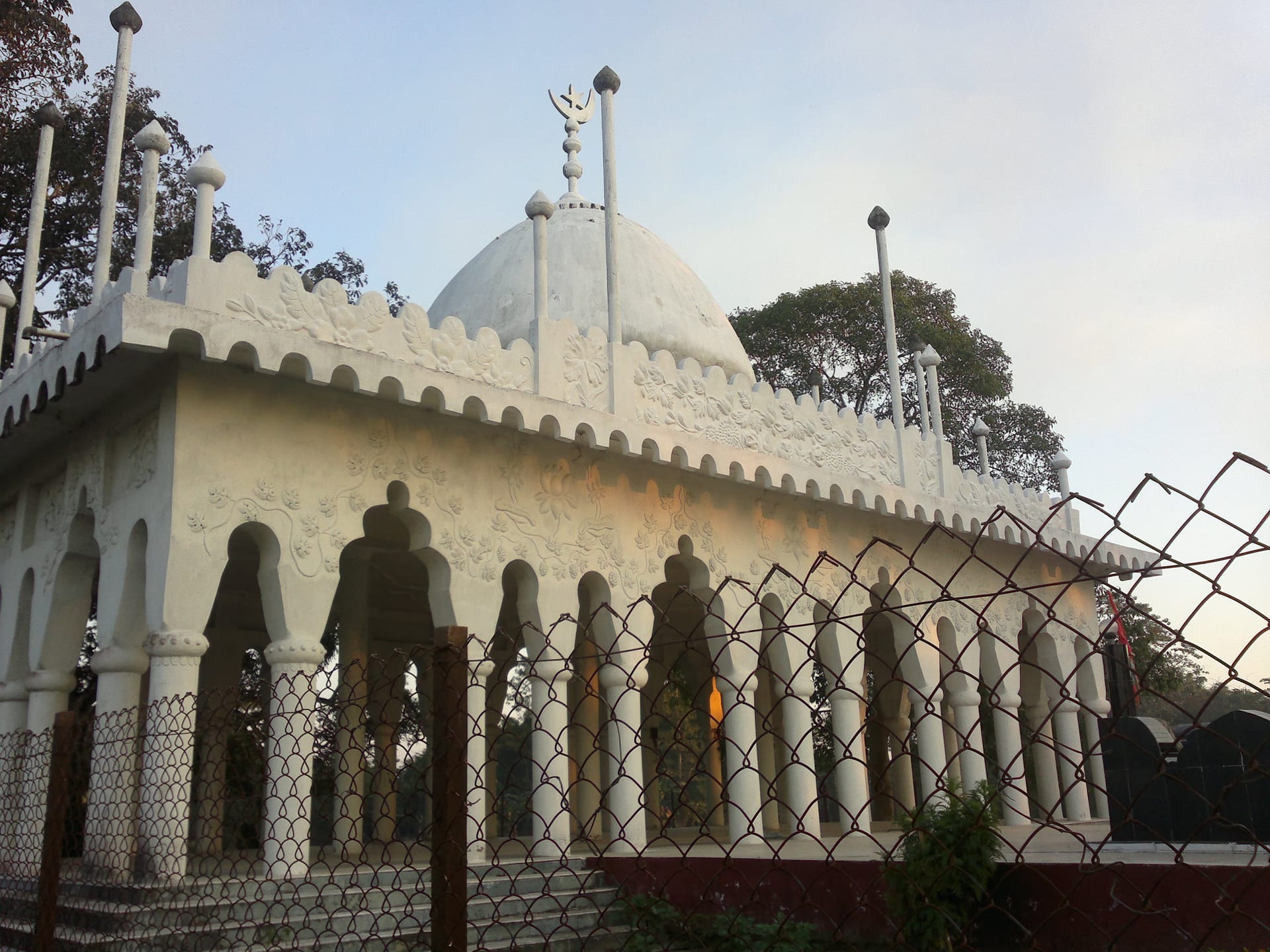
Plate 4.The dargah of Azan Fakir. The dargah of Ajan Pir at Saraguri Chapori near Sivasagar, its whitewashed dome crowned by a crescent finial above an arcaded verandah.Photograph: Aniruddha Buragohain · CC BY-SA · Wikimedia Commons
The Ahom court, for all its Sakta and anti-Vaishnava turns, generally absorbed this presence as it absorbed others, and the result is one more layer in a religious landscape the kingdom never made uniform.
11. Language and the Buranjis
The Ahoms gave Assam one of its most valuable inheritances: a habit of writing history down. The very word for it, buranji, is Tai. The chronicle tradition the Ahoms maintained is the reason the medieval history of the Brahmaputra valley can be written at all. The story of Ahom language and the story of the buranjis are the same story. It is the story of a Tai court that wrote, and of the slow passage from Tai-Ahom to Assamese.
Two languages of a court
The Ahoms arrived speaking Tai-Ahom, a Tai (Kra-Dai) language written in its own Brahmi-derived script. For a long time it was the language of the court, the chronicle, and above all the priesthood. But the kingdom governed a largely Assamese-speaking population. Over the centuries Assamese, the easternmost Indo-Aryan language, became the working tongue of administration and then of the court itself. The decisive turn is generally traced to Suhungmung (1497 to 1539). His reign, told in ConsolidationAhom · Chapter 2ConsolidationHow a tribe became a state., first drew Assamese and Brahman officials into the administration.
From the seventeenth century Assamese steadily displaced Tai-Ahom, first in daily speech and then at court. By the later period Tai-Ahom survived mainly as a sacred and scholarly tongue in the hands of the priestly clans, the deodhai, mohan, and bailung, while the living speech of the state was Assamese. Its everyday use is generally held to have ceased entirely by the early nineteenth century. The full account of the language, its script, its lost tones, and its modern revival is set out in the Tai-Ahom language article. Here the concern is what the language, and then its successor, was used to write. The shift tracks the kingdom’s wider absorption into the valley it ruled.
The buranji tradition
What did not lapse in the change of language was the writing of history. The word buranji is itself Tai, generally derived from a root meaning “ancient” and glossed as a store of instruction drawn from the past. The buranjis are prose chronicles, the earliest in Tai-Ahom and the great bulk in Assamese, recording reigns, campaigns, embassies and treaties, and kept with an eye to precedent, so that a minister might know how a matter had been handled before. Their prose is factual and, by the standards of the time, soberly dated. That habit of secular, chronological record is unusual in pre-modern India, whose memory ran more often through myth and genealogy, and it is why the medieval history of the valley can be written in the detail that it can.
The writing was in part an office of state. Official chronicles were compiled by appointed scribes and kept in a royal repository, while the great noble houses kept their own family buranjis alongside them. They survive as a scatter of named texts rather than one book. The Tungkhungia Buranji carries the last, golden-ageAhom · Chapter 4The Golden AgeMonumental architecture, administrative reform, the high tide. line of the dynasty down to the kingdom’s end. The Deodhai Asam Buranji preserves the oldest matter, including the traditional account of the dynasty’s origins. The Padshah Buranji chronicles the Mughal emperors and Assam’s long contest with Delhi from the Ahom side. Others, the various Assam Buranjis, the Kamrupar Buranji of the western frontier and the compiled Satsari Buranji, fill out the reigns, wars and the neighbouring Kachari and Jaintia kingdoms. Written on strips of sanchi bark in the manuscript form the valley calls puthi, they were copied and recopied, and many were lost before they could be gathered.
Plate 1.A painted buranji manuscript leaf, an Ahom king enthroned. A painted manuscript leaf showing an Ahom king enthroned, named in Assamese script, the kind of illustrated manuscript in which the chronicle tradition was kept.Photograph: Unknown · Public domain · Wikimedia Commons
Their modern survival is owed above all to Surya Kumar Bhuyan (source: Studies in the History of Assam), who through the Department of Historical and Antiquarian Studies collected, collated and edited the manuscripts in the 1930s and after, several with English translation. The tradition is thus a double inheritance, a medieval Tai habit of keeping the record and a modern Assamese labour of recovering it, and the citations in these volumes rest on both.
12. The Stone Capital
Tanks, temples, roads, and the labour that built them
The most staggering of the Ahom works are not the temples but the tanks. These are the sagars and pukhuris, immense excavated reservoirs that still hold water three centuries on. The largest is JoysagarPlace to visitJoysagar TankThe 318-acre tank dug by Swargadeo Rudra Singha in 1697 in memory of his mother Joymoti. On its banks stand the Joydol, the smaller Baidyanath Sivadol and the Devighar., near the old capital of Rangpur. It was dug in 1697 on the order of Rudra Singha, in memory of his mother Joymoti, the Ahom princess tortured to death for shielding her husband. The chronicles preserve a tradition that the whole tank, one of the largest in India and spread over hundreds of acres with its banks, was excavated in about forty-five days. That figure, true or rounded, only makes sense against a state that could put tens of thousands of paiks onto a single site at once. A tank on that scale is not a public amenity. It is a demonstration of what the labour system could do.
Plate 1.Joysagar tank. The Joysagar tank at old Rangpur, among the largest man-made tanks in India, with the bankside Joydol, the Vishnu temple raised under Rudra Singha, above the reservoir.Photograph: Rangan Datta Wiki · CC BY-SA · Wikimedia Commons
Plate 2.The Sivasagar tank, the Borpukhuri. The Sivasagar tank with the Sivadol and its companion temples on the raised bank, the engineered landscape of water and tower that gives the town its name.Photograph: Shrikant Bansod · CC BY-SA · Wikimedia Commons
The temples on the banks
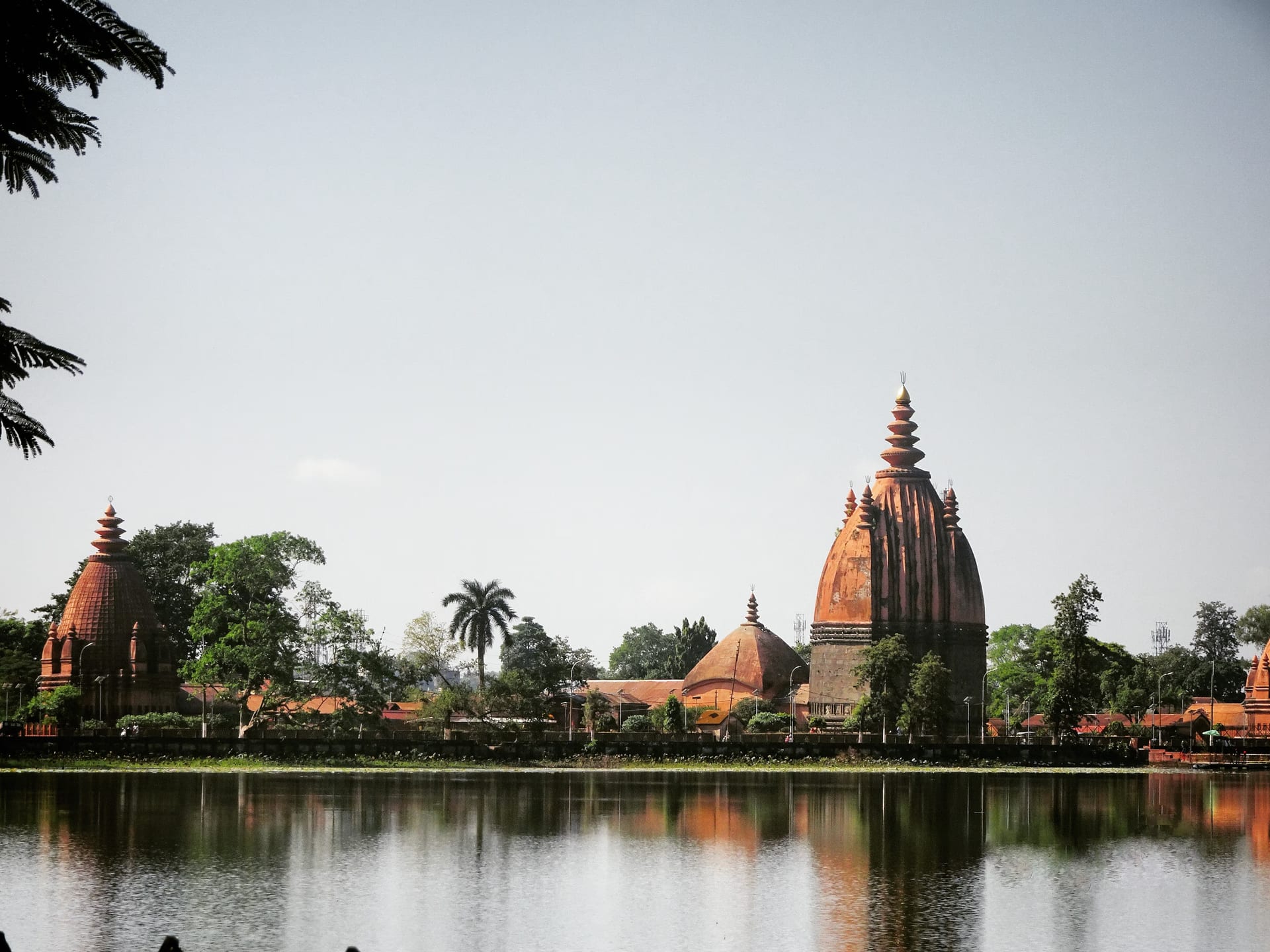
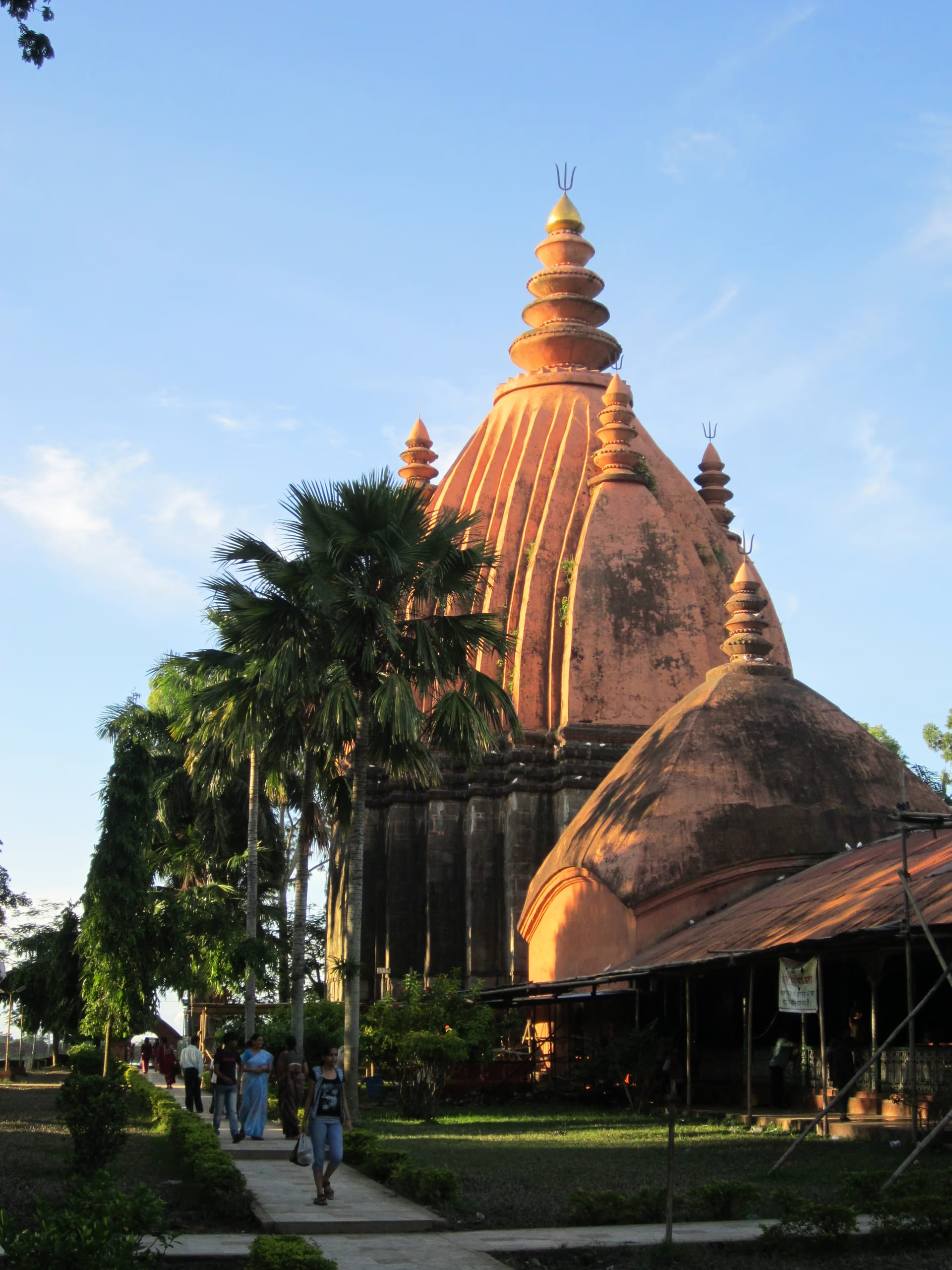
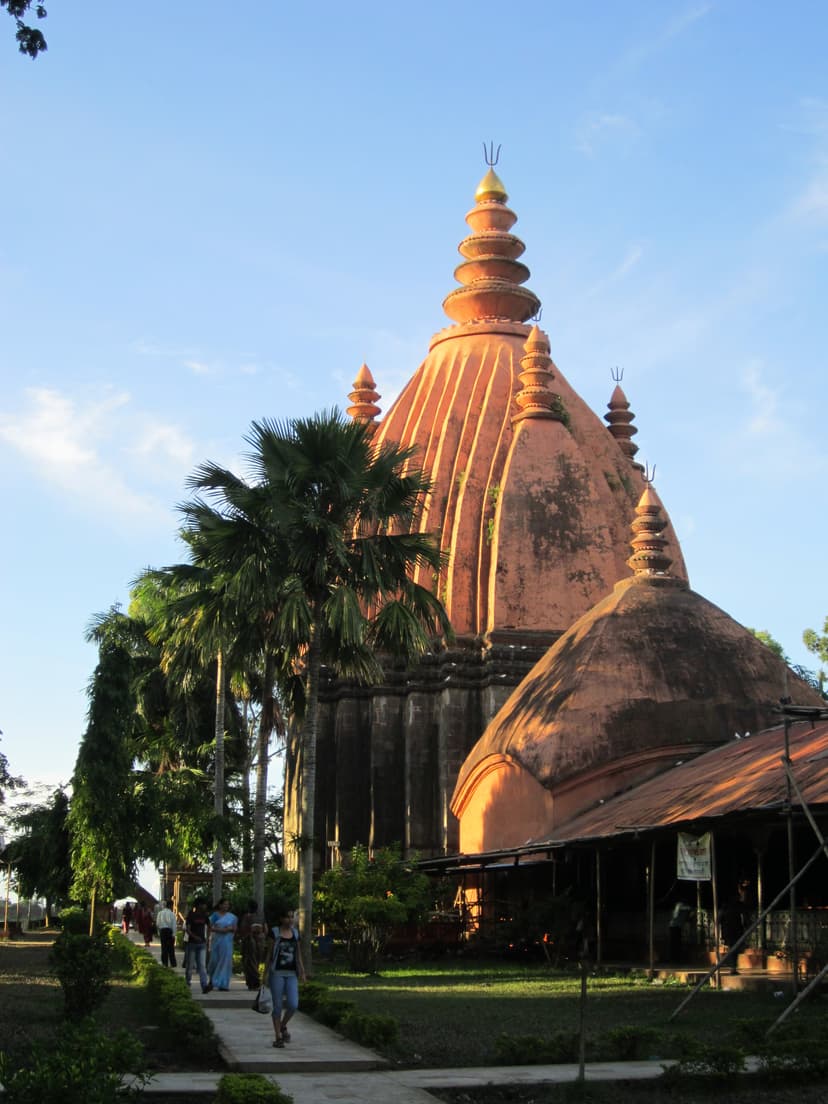
Each great tank was given a skyline. On the bank of the Borpukhuri stands the group the queen Ambika raised in 1734. At its centre is the towering SivadolPlace to visitSivasagar SivadolBuilt by queen Ambika under Siva Singha. Among the tallest Shiva temples in India, beside Vishnudol and Devidol on the bank of the Sivasagar tank., by tradition among the tallest Siva temples in India. It is flanked by the Vishnudol and the Devidol. These are a Saiva, a Vaishnava and a Sakta shrine set side by side, a deliberate statement of a court that patronised all three. The same triad of Siva, Vishnu and Devi temples was built at Gaurisagar and at Joysagar, where the Joydol (Keshabrai) still stands. The Negheriting Sivadol, which Rajeswar Singha raised in 1765 over a far older Siva shrine of the Kachari country, and other temples of the period extend the pattern across the kingdom. The architecture, the bee-hive sikhara on a high plinth, the carved stone and indigenous mortar, is treated in detail in the chapter on Material CultureAhom · Chapter 9Material CultureRang Ghar, the maidams, the rupahi muga.. The point here is that temple and tank were built together, as a single act of royal piety and display.
Plate 3.The Sivadol at Sivasagar. The Sivadol at Sivasagar in late-afternoon light, its curvilinear brick tower of 1734 climbing about 104 feet to a gold finial, among India's tallest Siva temples.Photograph: Sardar Hironjyoti Beshra · CC BY-SA · Wikimedia Commons
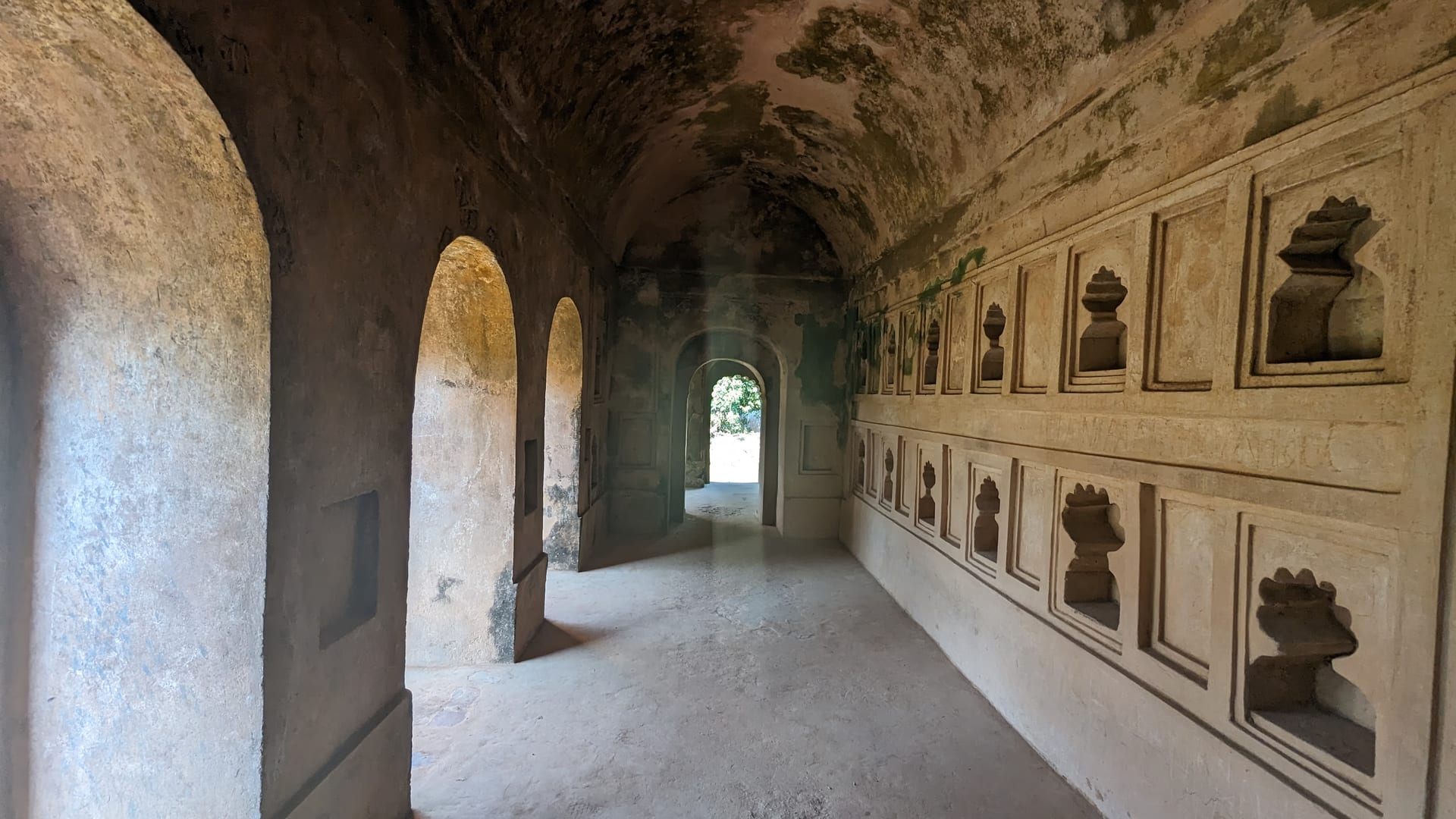
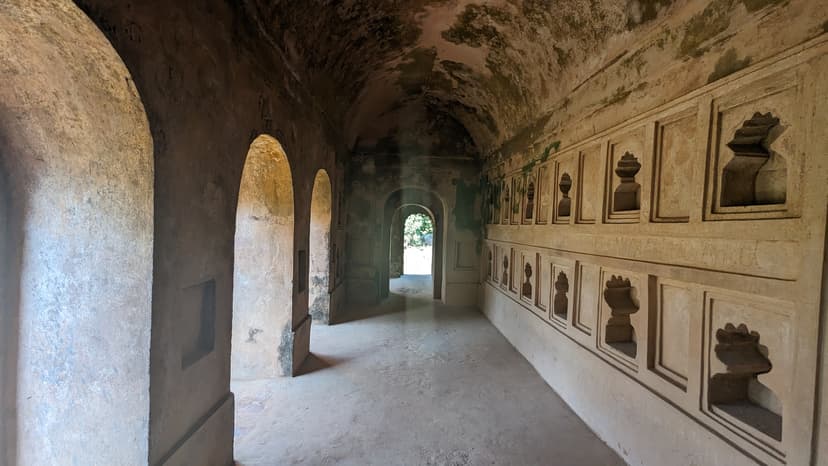
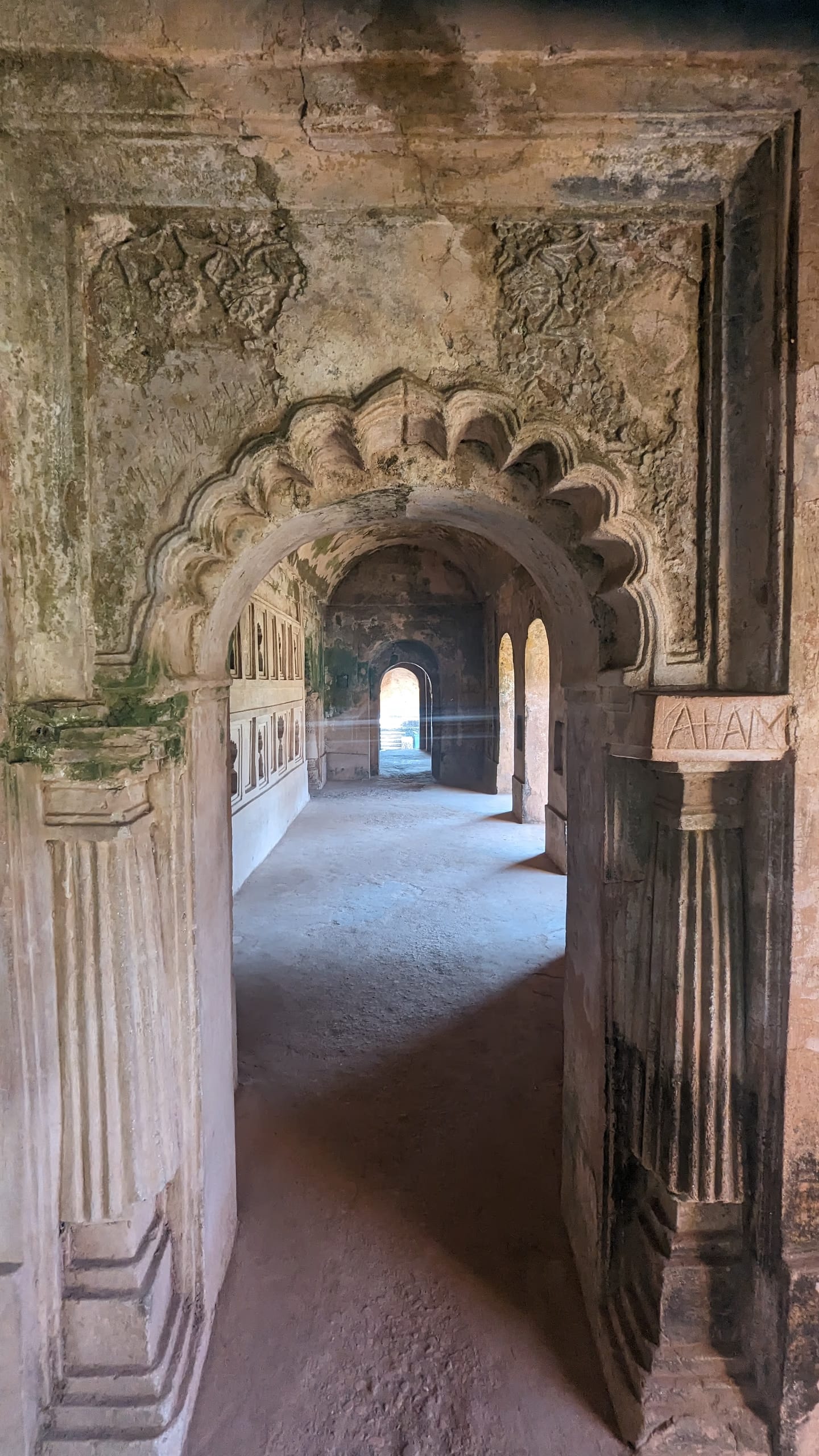
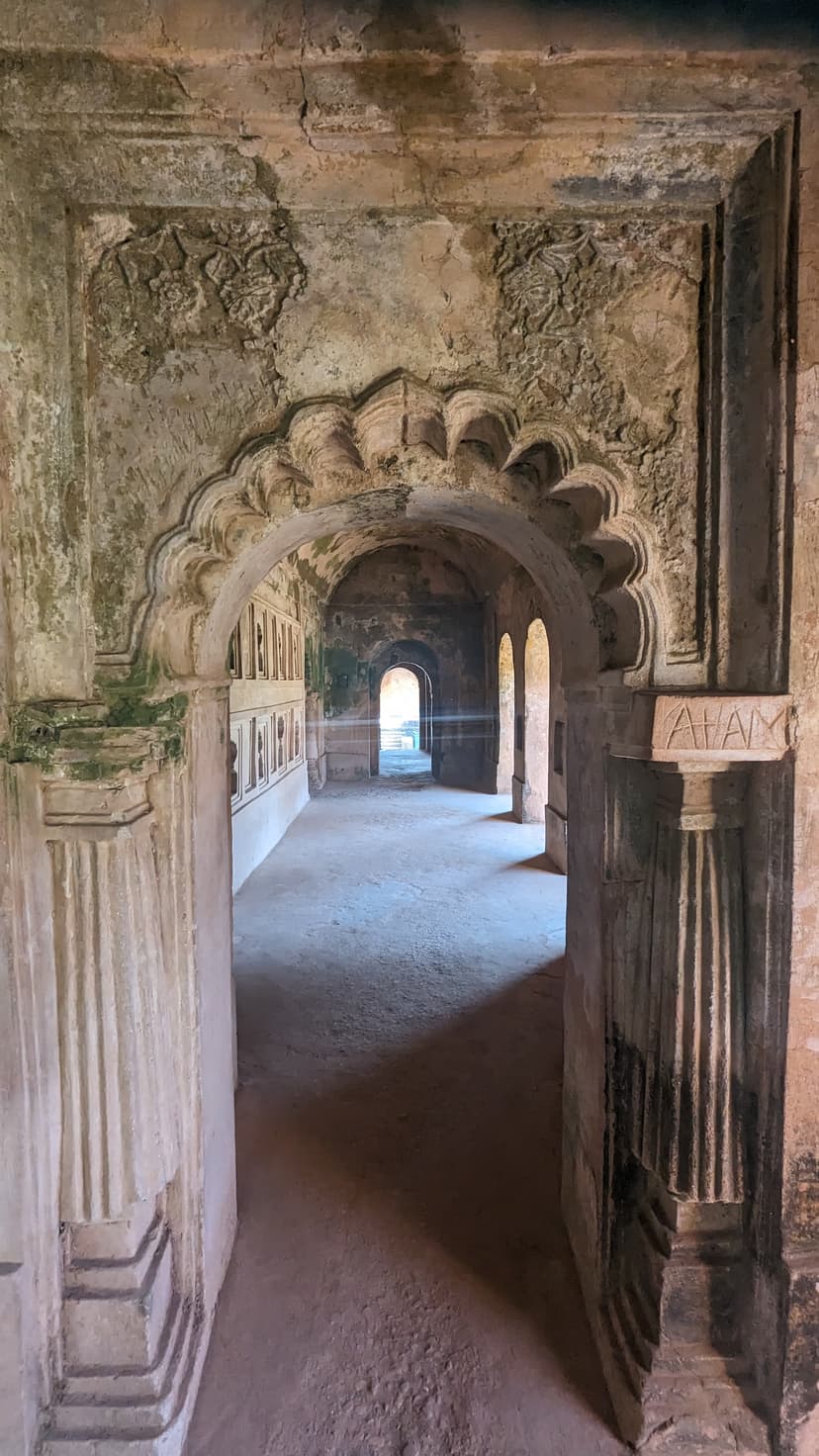
Plate 4.Inside the Talatal Ghar at Rangpur. A vaulted brick walkway inside the Talatal Ghar, Sivasagar, its arched openings and carved niches the secular building craft of the Ahoms.Photograph: Joli Rumi · CC BY-SA · Wikimedia Commons
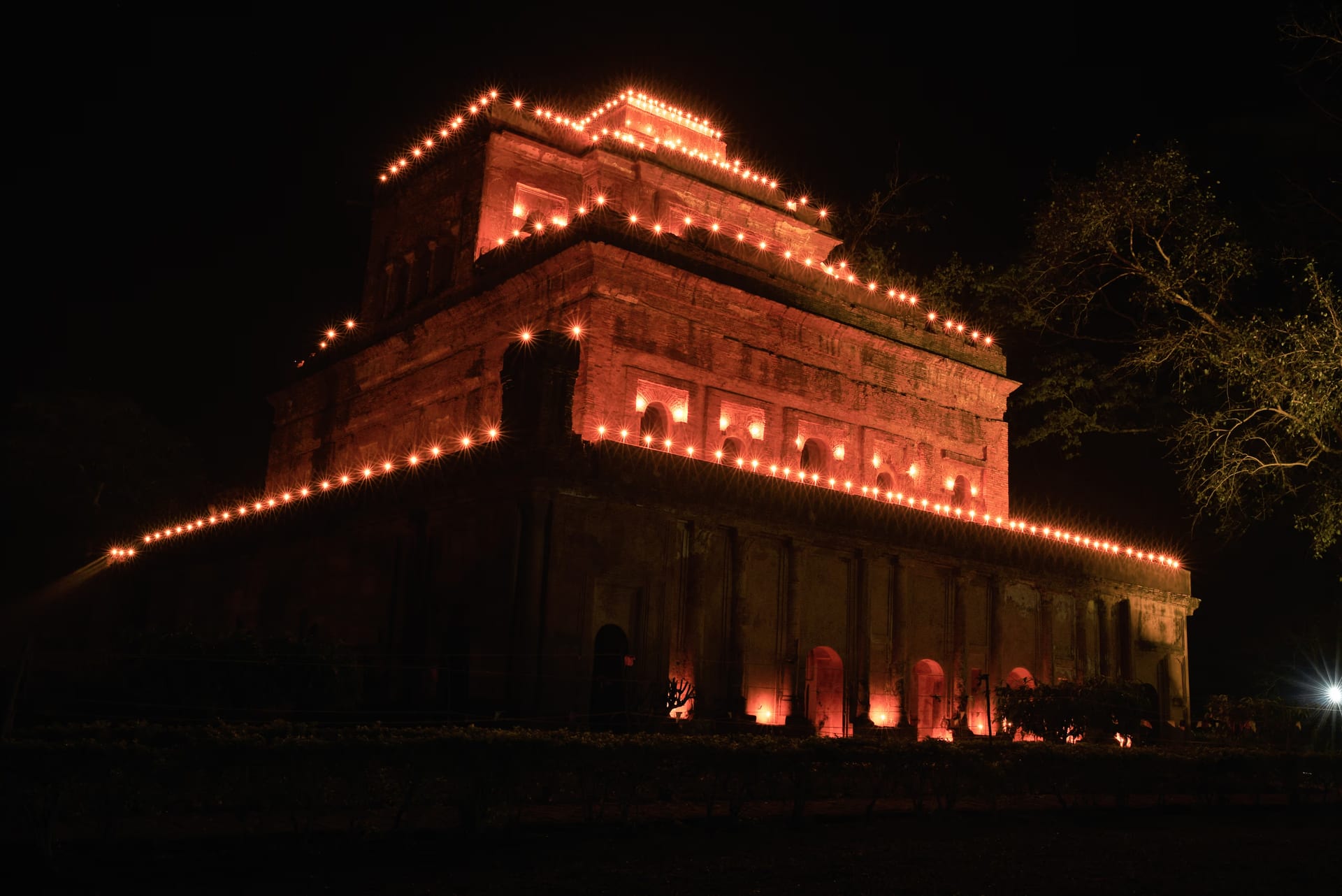
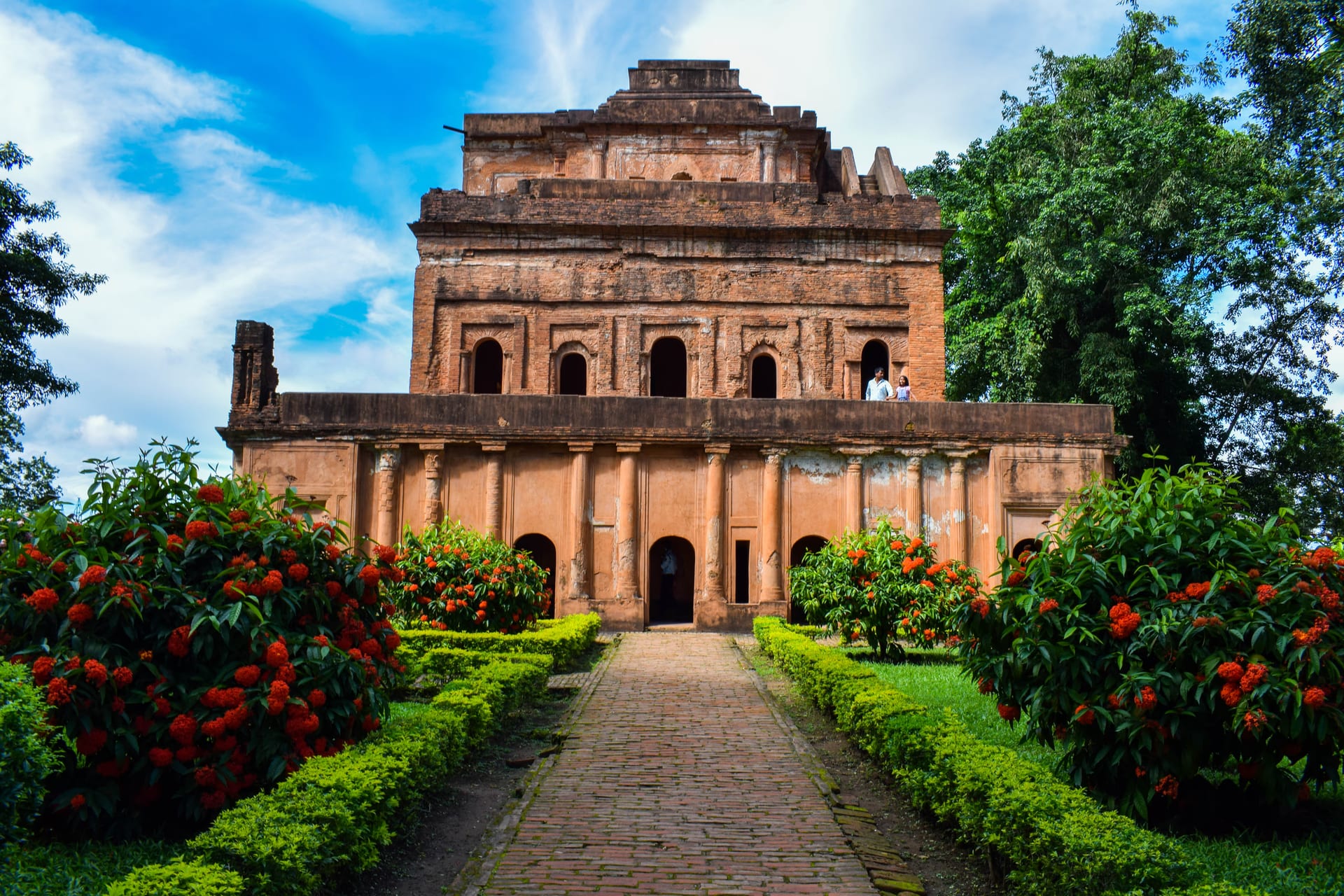
Plate 5.The Kareng Ghar at Garhgaon. The Kareng Ghar at Garhgaon, the surviving brick palace of the old Ahom capital, its upper storeys stepping back above the arched ground floor.Photograph: Gurpreetsingh1010 · CC BY-SA · Wikimedia Commons
Plate 6.The Rang Ghar at Rangpur. The Rang Ghar at Sivasagar, the two-storey oval pavilion completed by Pramatta Singha in 1746, its upper terrace roofed in the form of an inverted boat.Photograph: Kumud Ghosh · CC BY · Wikimedia Commons
Roads, rivers and embankments
The same command of mass labour reshaped the valley floor. The Ahoms drove long raised roads, the alis, across the country, embanked against the floods and doubling as dykes. The greatest is the Dhodar Ali, the trunk road of upper Assam. Tradition assigns it to Gadadhar Singha (1681 to 1696). It holds that the road was built by setting the idle and the disaffected, the dhod, to forced labour, so that the road’s very name records the punishment that dug it. Water was statecraft. The kingdom managed the Brahmaputra’s floods with embankments and channels. In war it turned that engineering into defence. Before SaraighatAhom · Chapter 3The Ahom-Mughal WarsThe seventeenth-century war that made Assam a military state., Lachit Borphukan threw up a system of earthen ramparts around GuwahatiPlace to visitGuwahatiThe oldest continuously settled city in the region and today the metropolis of northeastern India. that made the ground almost impassable to Mughal cavalry. This was the land half of the victory the river half is famous for. Road, dyke and rampart were the same skill in different uses.
13. The Army and the Navy
The war machine that held the valley
The Ahom kingdom held the Brahmaputra valley for six centuries. It fought off Chutias, Kacharis, Koches, Mughals and finally the Burmese. It did so with an army that cost almost nothing in cash. There was no standing professional force in the European sense, and no military budget worth the name. Instead the whole free male population was the army. It was mobilised through the same paik and khelAhom · Chapter 8Paik and KhelHow the state organised labour, land, and war. system that in peacetime dug the tanks and built the temples. This chapter is about how that militia-state actually made war: on the water, with gunpowder, on land, and through the earth itself. Much of what we know of it in action comes, strikingly, from the enemy. The Mughal chroniclers came up the river and wrote down what they saw.
The militia in arms
When the state called out the levy, the khels delivered men by the thousand. Each paik brought his own provisions. Each served under the officers who commanded him in civil life: the bora over twenty, the saikia over a hundred, the hazarika over a thousand, the rajkhowa over three thousand, and above them the phukans and the great captains of state. The system’s strength was numbers and self-supply. The kingdom could put an enormous host into the field at no fiscal cost, then dissolve it back into the rice-fields when the campaign ended. Its weakness was that the same host could not be kept embodied indefinitely. So Ahom strategy favoured the swift blow, the ambush, the fortified line and the long defensive war of attrition over the set-piece battle. That was exactly the war that broke Mughal expeditions.
The navy: war on the water
The valley is a country of one giant river and a thousand channels. So the decisive arm of the Ahom state was its navy. The war-boats, the bacharis, were large, strong vessels. They mounted cannon and carried seventy to eighty fighting men apiece. A dedicated officer, the Naosaliya Phukan, supervised the fleet. The boats were built and maintained in state dockyards: the Barnaosal for the great boats and the Naosal for smaller craft. The buranji tradition counts the fleet of the Mughal wars in the tens of thousands of boats. Even discounted, that figure speaks to a riverine war machine without rival in the region. It was this navy that broke the larger, clumsier Mughal river fleets. How it did so, in the narrows off SaraighatAhom · Chapter 3The Ahom-Mughal WarsThe seventeenth-century war that made Assam a military state. in 1671 under Lachit Borphukan and again at Itakhuli in 1682, belongs to the chapter on the Ahom-Mughal warsAhom · Chapter 3The Ahom-Mughal WarsThe seventeenth-century war that made Assam a military state. and to the story below. What matters here is that the river, not the open field, was the arm on which the state staked its wars.
The Night of Saraighat
MB
Monimoy Bujarbaruah
A dying general, a wavering fleet, and the river that kept the Mughals out of Assam.
Gunpowder, cannon and the rocket
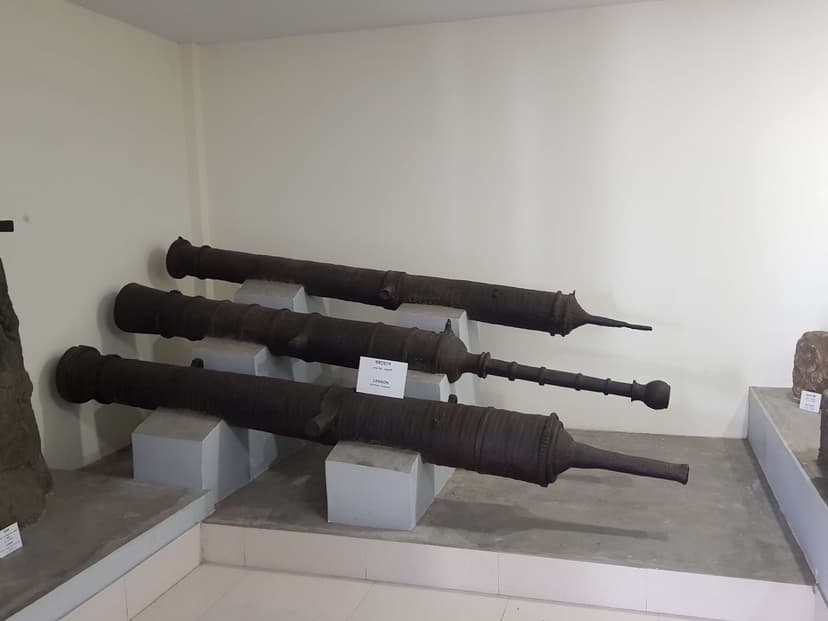
The Ahoms were not, as colonial-era condescension sometimes implied, a people of bows and spears who happened to win. They were skilled gun-founders. The chronicles record that the kingdom acquired firearms early. It took sixty-nine guns from the Chutias when it annexed that kingdom in 1523. It went on to cast its own match-locks, light field-pieces and heavy cannon, the hilois, in state foundries, along with the gunpowder to serve them. They used war-rockets and a range of artillery. The manufacture of guns and powder was organised, like everything else, through specialist khels. Mughal accounts of the wars take Ahom firepower seriously, which is the surest evidence that it was real.
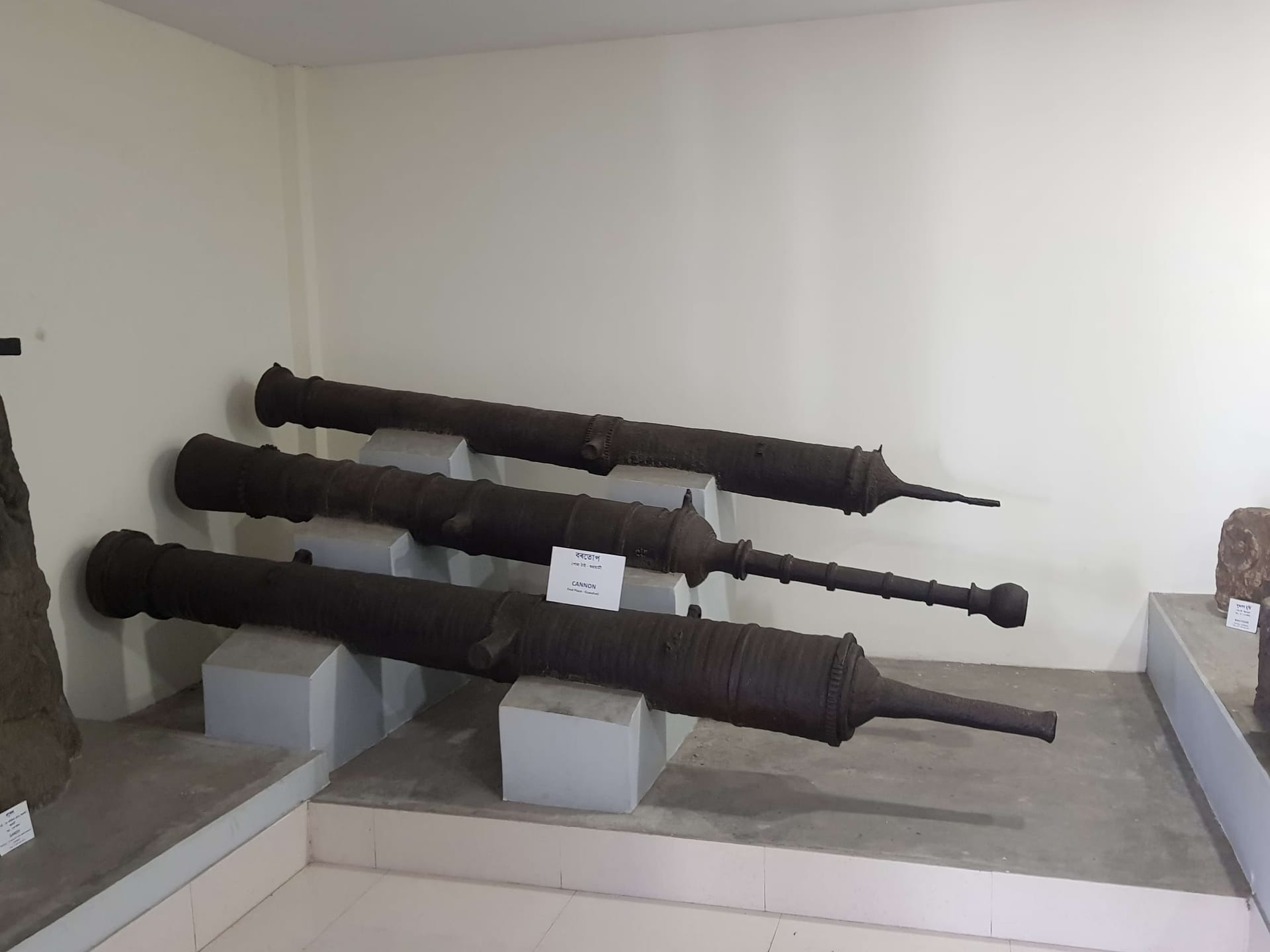
Plate 1.Ahom cannon. Three cast-iron cannon of the Ahom period, preserved at Sivasagar, the heavy guns the chronicles call hilois cast in the state foundries.Photograph: ComparingQuantities · CC BY-SA · Wikimedia Commons
Cavalry, elephants, and the limits of the host
Where the Ahoms were genuinely weak was in cavalry. The valley bred few horses. Against the Mughals, whose strength was their cavalry, this mattered. It is part of why Ahom commanders fought on water and behind earthworks rather than meeting horse with horse in the open. It is also why the one great land battle of the Saraighat campaign, at Alaboi in 1669, went so badly that the war was carried back to the water. That defeat is told in the Ahom-Mughal warsAhom · Chapter 3The Ahom-Mughal WarsThe seventeenth-century war that made Assam a military state.. If horses were the animal the valley lacked, elephants were the one it had in plenty. They were managed by the Hati Barua and used for transport, for breaking fortifications and as mobile platforms. The capture and training of war-elephants was important enough that the court later produced an entire illustrated treatise on the subject, the Hastividyarnava.
Plate 2.Folio of the Hastividyarnava. A folio of the Hastividyarnava, the illustrated manuscript made for the Ahom court, a courtly procession above a band of old Assamese script far from the modern hand.Photograph: Dilbar and Dosai · Public domain · Wikimedia Commons
Forts, earthworks, and the war of the ground
If the open field beat the Ahoms, prepared ground was their answer. Their way of war turned the land itself into a weapon. The kingdom defended itself with garhs, ramparts and stockades, and above all with the embanked lines that the same labour force built as roads and dykes in peacetime. This is the reason there was no sharp line between civil and military engineering. A raised embankment, an ali, carried an army and its supplies in the dry season and held back the flood in the wet. The same bank, thrown across an enemy’s path, became a rampart. The paiks who dug it in peace defended it in war. So the kingdom entered a campaign already possessing much of the earthwork it would fight behind.
The spine of the western defence was a chain of paired forts straddling the river, so that no fleet could pass without running between two fortified banks. Three pairs guarded the approaches in the Mughal wars: Jogighopa and Pancharatna at the mouth of the Manas, Saraighat and Pandu just west of the Barnadi, and Samdhara and Simalugarh at the Bharali. Each stood on high ground behind water, forest or hill. Their walls were earth and mud mounted with cannon, and their approaches were sown with ditches and panjis, pointed bamboo stakes set in hidden holes to lame a warhorse. It was this chain an invader had to reduce fort by fort, as Mir Jumla’s army of 1662 found, the campaign told in the story of his retreat.
Plate 3.Inside the Talatal Ghar. A carved multifoil arch inside the Talatal Ghar at Rangpur, opening onto the niched halls of the Ahom palace-fort whose brick mass turned building itself into defence.Photograph: Joli Rumi · CC BY-SA · Wikimedia Commons
The enemy’s testimony
The most vivid evidence for all this comes from the Mughals themselves. Mirza Nathan, an officer of Jahangir’s wars on the frontier, left an eyewitness account in the Baharistan-i-Ghaibi. It covers the early seventeenth-century campaigns against the Koch and Ahom country. Half a century later, the chronicler Shihabuddin Talish accompanied Mir Jumla’s great invasion of 1662. In the Fathiyya-i-Ibriyya he recorded the Mughal capture of GarhgaonPlace to visitKareng Ghar (Garhgaon Palace)Garhgaon served as the Ahom capital from 1540 under Suklenmung. Its surviving multi-storeyed brick palace, the Kareng Ghar, is from Rajeswar Singha's rebuilding in 1752. and the disaster that overtook the army afterwards, wrecked not in battle but by flood, hunger and disease. That was exactly the attritional defence the Ahom system was built to wage, and its course is told in the story of Mir Jumla’s retreat. The kingdom’s military history can be cross-read from its own buranjis and from these hostile Persian chronicles. That is one of the reasons it can be written with confidence at all.
Mir Jumla's Retreat
MB
Monimoy Bujarbaruah
In 1662 Aurangzeb's ablest general took the empty Ahom capital and thought he had won Assam, until the monsoon, the floods and the fever rotted his army to nothing.
Also from this age31
The places, communities, faiths, and traditions rooted in this age. Open any for its full Lore article.
Vaishnavite monastic culture founded by Srimanta Sankardev in the 16th century. Mask-making, satriya dance, an ecology that shifts with every flood.
Coming soon
Place
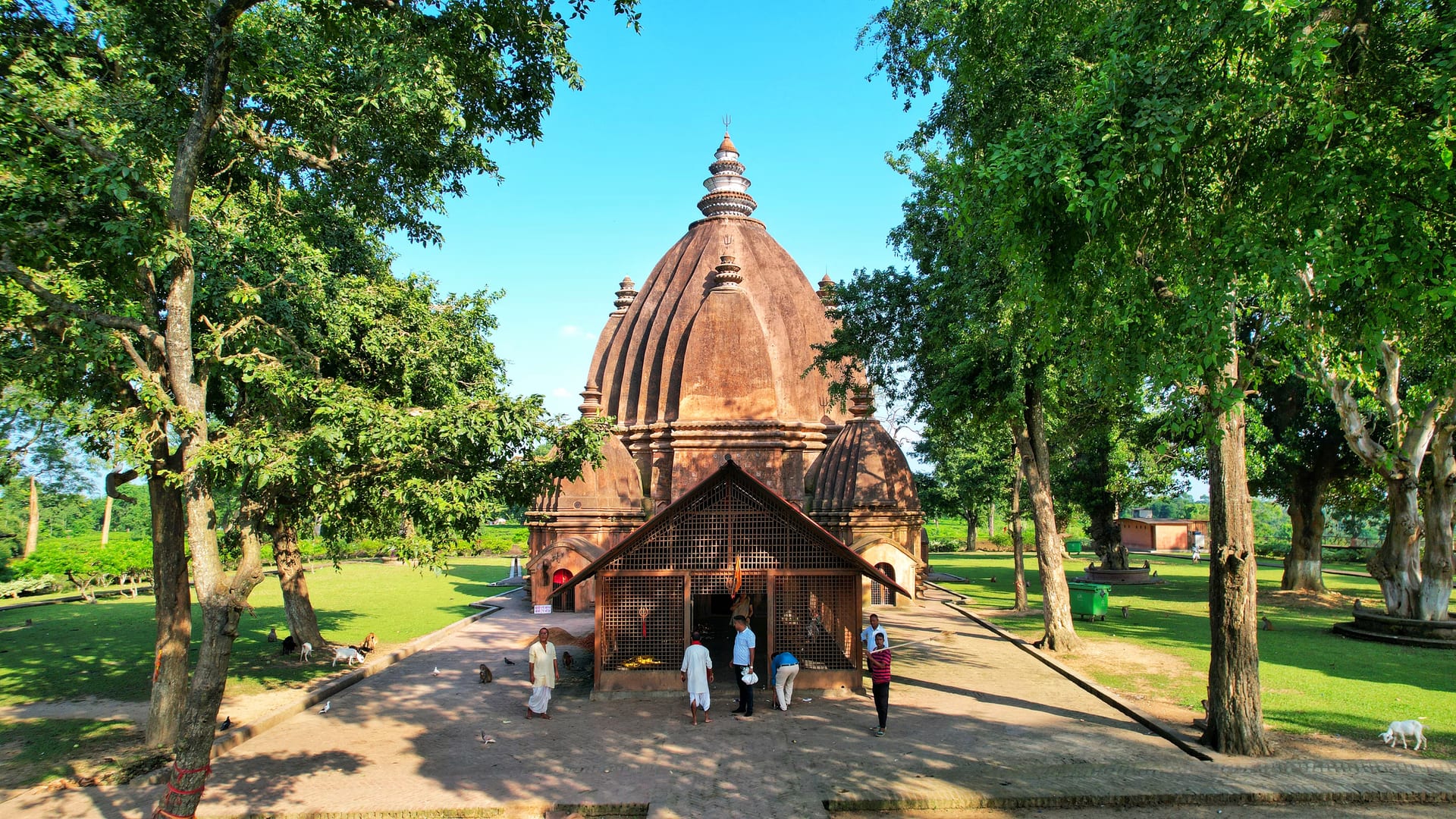
Negheriting Sivadol
Built by Ahom king Rajeswar Singha after consolidating earlier shrines on Negheriting hill. The principal Shiva-lingam is housed in the central tower with subsidiary shrines around it.
Coming soon
Place
Dakhinpat Sattra
One of Majuli's great sattras, founded by Banamalidev under Ahom patronage and known across Assam for its grand Raas Mahotsav.
Coming soon
Place
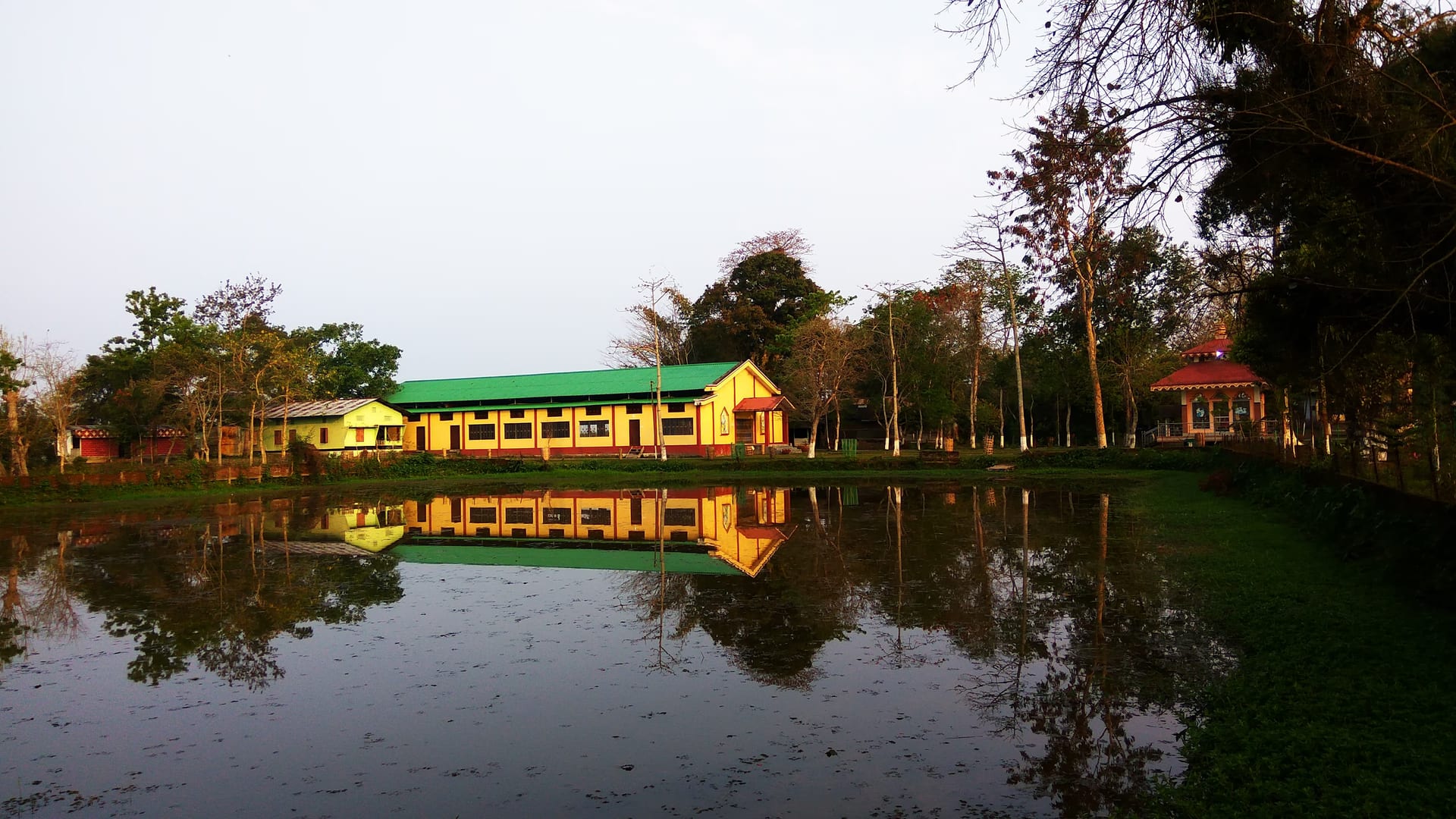
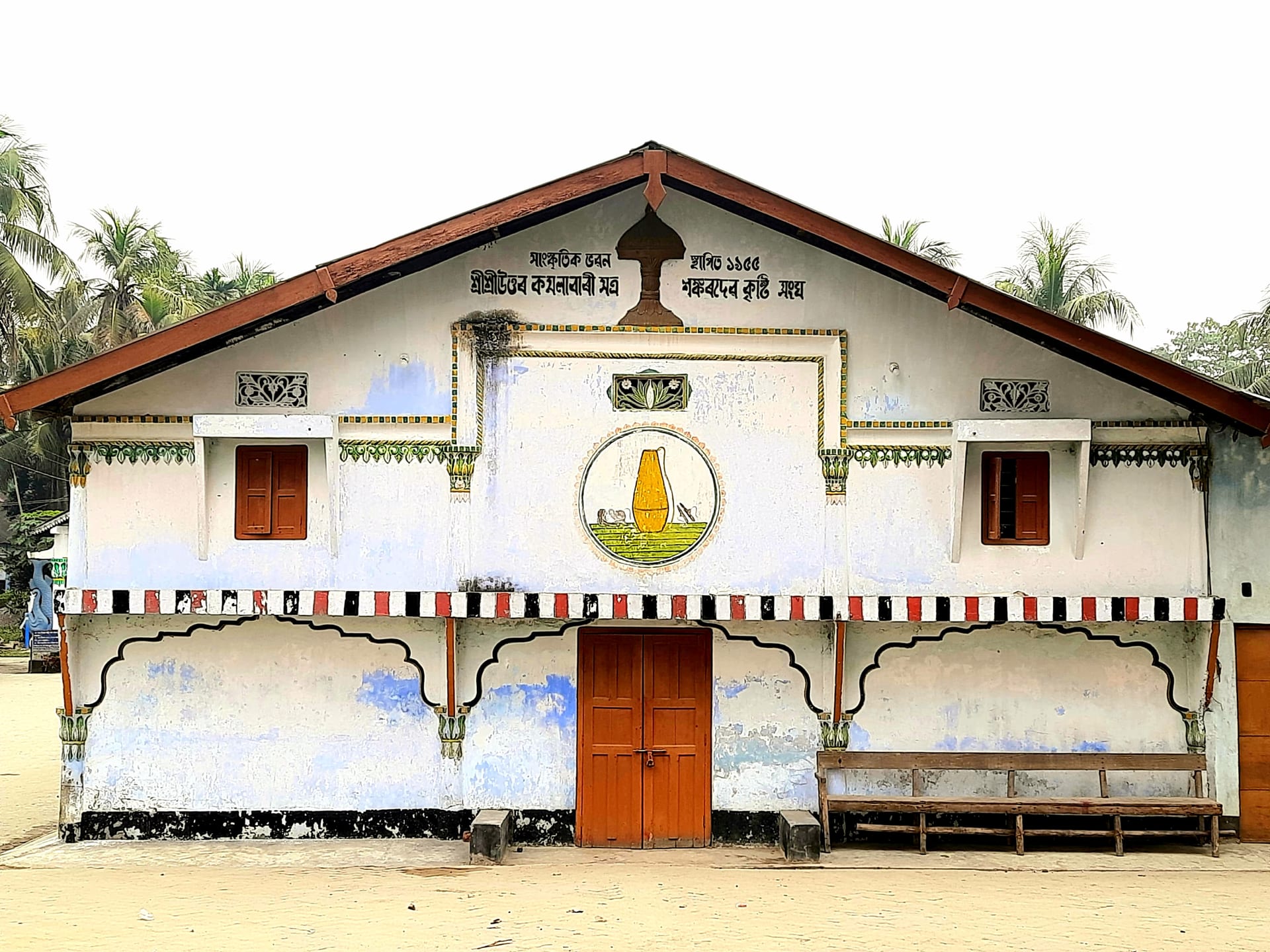
Kamalabari Sattra
A sattra long regarded as Majuli's centre of culture and learning, and through its Uttar Kamalabari branch the foremost custodian of sattriya dance.
Coming soon
Place
Bengenaati Sattra
An early-seventeenth-century sattra holding a remarkable treasury of antiquities, including possessions of Ahom royalty and rare manuscripts.
Coming soon
Place
Auniati Sattra
Founded under the Ahom king Jayadhwaj Singha, a wealthy and powerful sattra known for its Paalnaam liturgy, apsara dance, and great festival gatherings.
Coming soon
Place
Garamur Sattra
One of Majuli's four principal royal sattras, a centre of Raas and of a notable collection of antique weapons and ceremonial objects.
Coming soon
Place
Samaguri Sattra
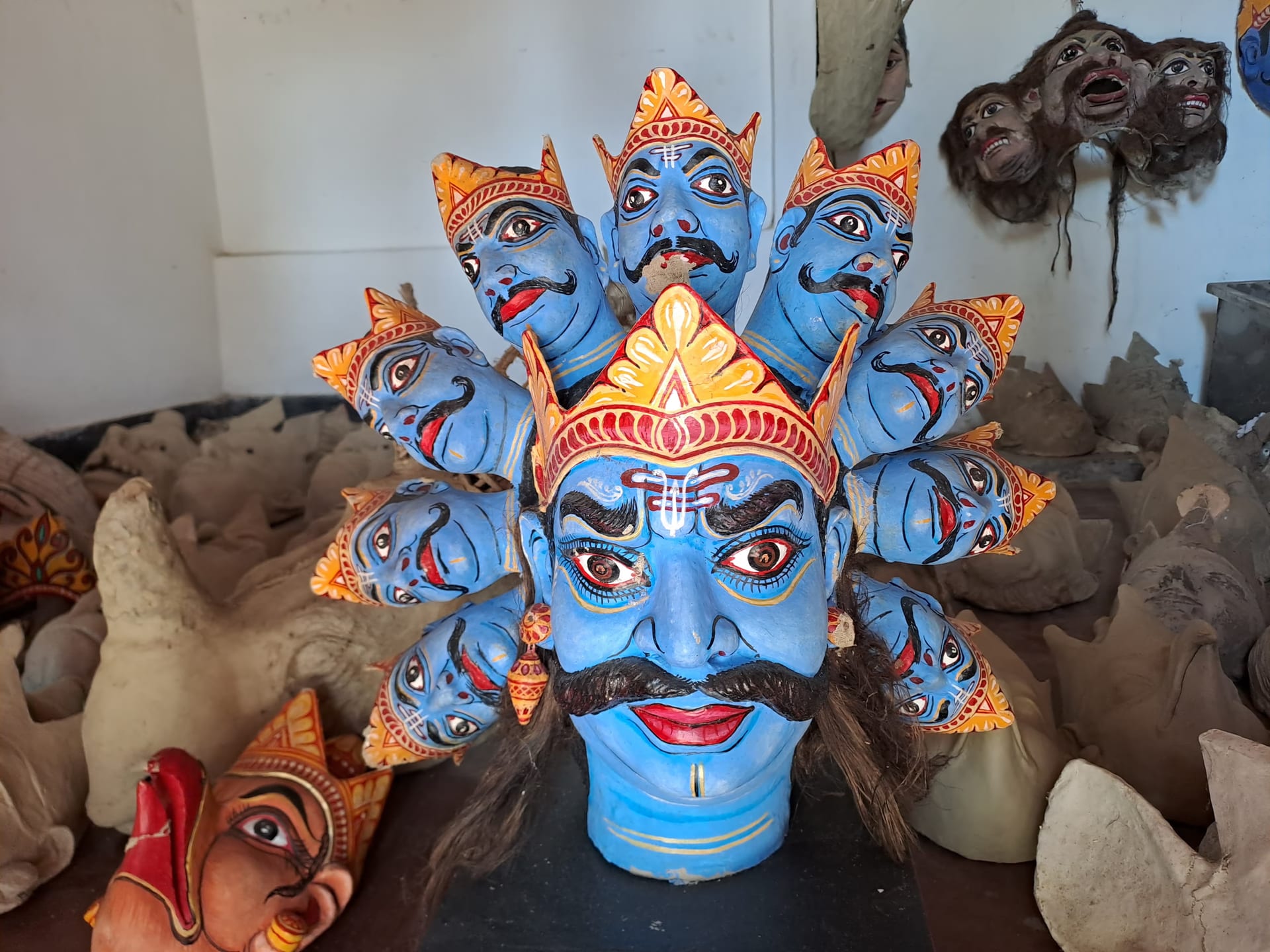
The sattra that has kept alive mukha-shilpa, the bamboo-and-clay mask-making for bhaona theatre, now carried to galleries and stages well beyond the island.
Coming soon
Place
Biswanath Ghat
A serene river village on the Brahmaputra, scattered with old Siva temples and winter sandbars, named India's Best Tourism Village in 2023 yet still little known.
Coming soon
Place
Hatimura Temple
An Ahom-built Sakta temple to Durga on a hillock at Silghat in Nagaon, raised over an older centre of goddess worship, with wide views over the river.
Coming soon
Place
Ajan Pir Dargah
The riverside shrine near Sivasagar of Ajan Fakir, the seventeenth-century Sufi who composed the Zikir, devotional songs in Assamese, a place of cross-community pilgrimage.
Coming soon
Place
Lachit Maidam
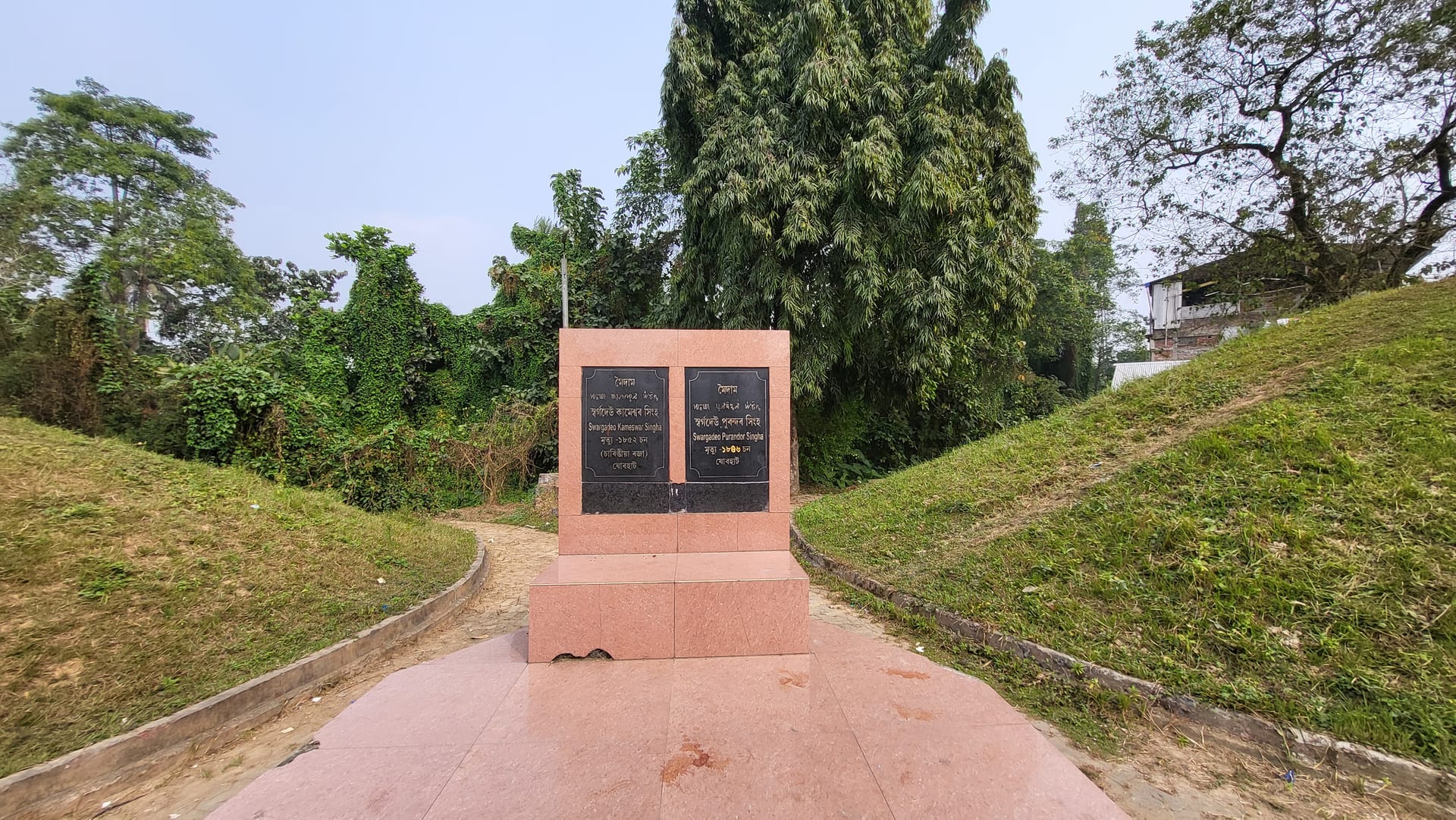
The maidam (Ahom burial mound) of Lachit Borphukan at Hoolungapar near Jorhat, raised by royal command for the commander who broke the Mughals on the river in 1671.
Coming soon
Place
Gurudwara Damdama Sahib
A historic gurudwara at Dhubri marking the visits of Guru Nanak, who is said to have met Sankardev here, and Guru Tegh Bahadur, who came with the Mughal army in 1670.
Coming soon
Place
Jorhat
The final capital of the Ahom kingdom, founded in the 1790s, today the cultural and tea capital of upper Assam and the gateway by which travellers cross to Majuli and on to the Sivasagar monuments.
Coming soon
Place
Raja Maidam
The maidam complex in Jorhat holding the tomb of Purandar Singha, the last king of the Ahom line, and his son.
Coming soon
Place
Bangalpukhuri
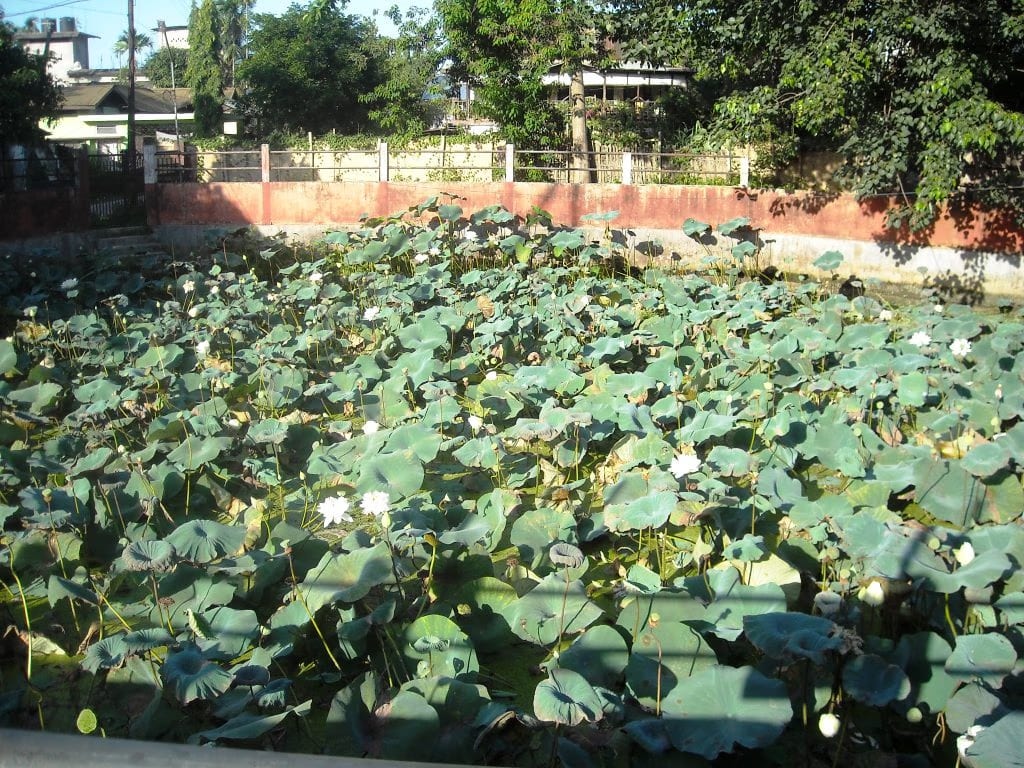
An Ahom-era tank in Jorhat wrapped in a folk memory of blood money and a curse, whose water, by tradition, was never used.
Coming soon
Place
Burhi Gosani Devalaya
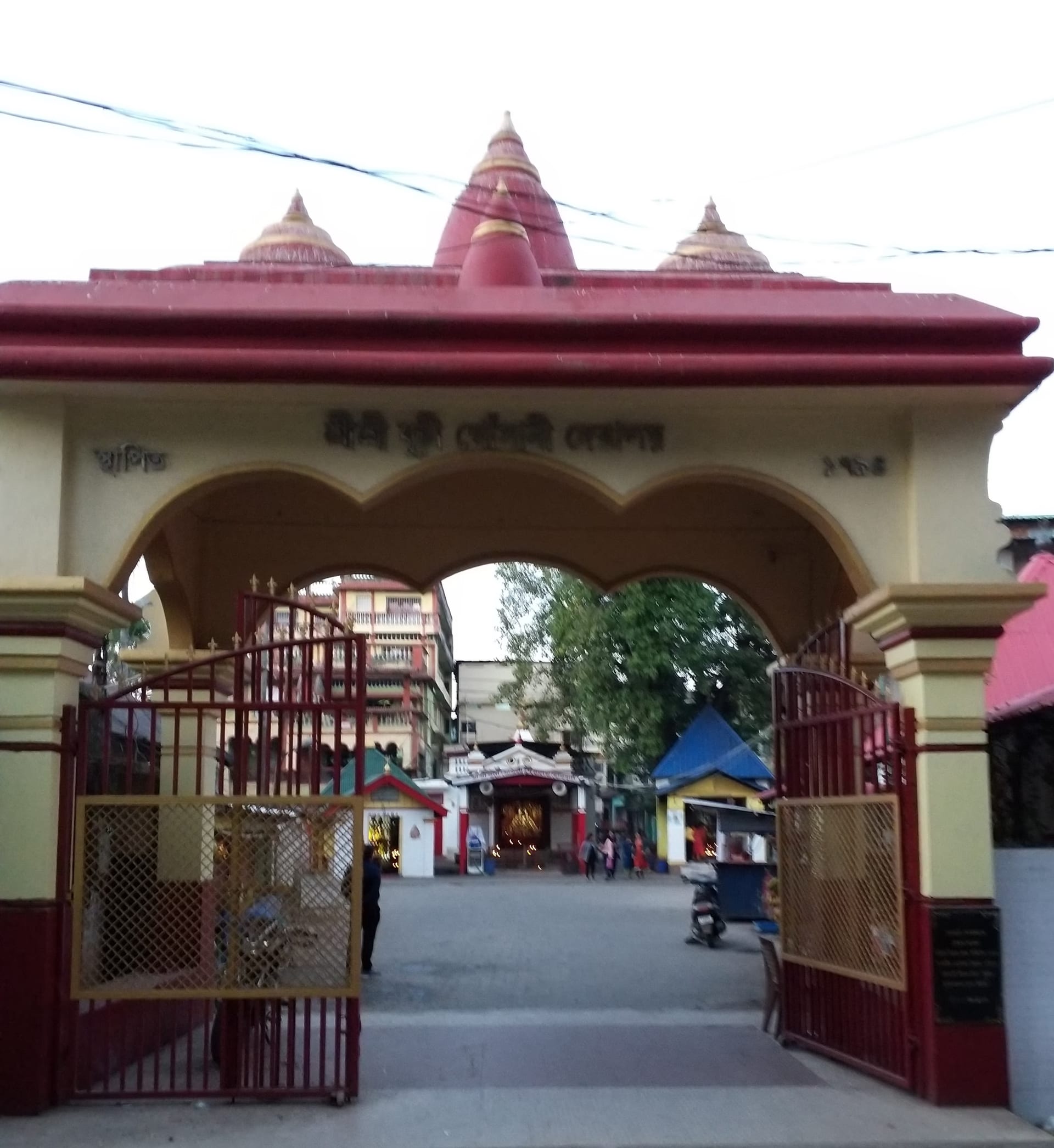
The principal Shakta temple of Jorhat town, established around 1794 as the Ahom capital moved here, its Durga Puja the great festival of the city.
Coming soon
B
Place
Boiragimoth
An Ahom-period hermitage, now a Dibrugarh neighbourhood, that carries a rare pre-colonial layer beneath the tea town.
Coming soon
M
Place
Moiramora Doul and Sattra
An old stone temple site and an active neo-Vaishnavite sattra at Khamtighat on the Burhi Dihing, layering early archaeology with living faith.
Coming soon
Festival
Me-Dam-Me-Phi
The Ahom festival of ancestor worship, observed across Assam on 31 January. Offerings to the departed (dam) and to the gods (phi), and a remembrance of the dynasty's dead.
Coming soon
Music & dance
Zikir and Zari
The Islamic devotional songs in Assamese, given to the valley's Muslims by the Sufi saint Azan Fakir.
Coming soon
Craft
Bell-Metal and Brass of Sarthebari
The bell-metal and brass craft of Sarthebari, producing the xorai, bota, and the ritual and household vessels of Assam.
Coming soon
Craft
The Japi
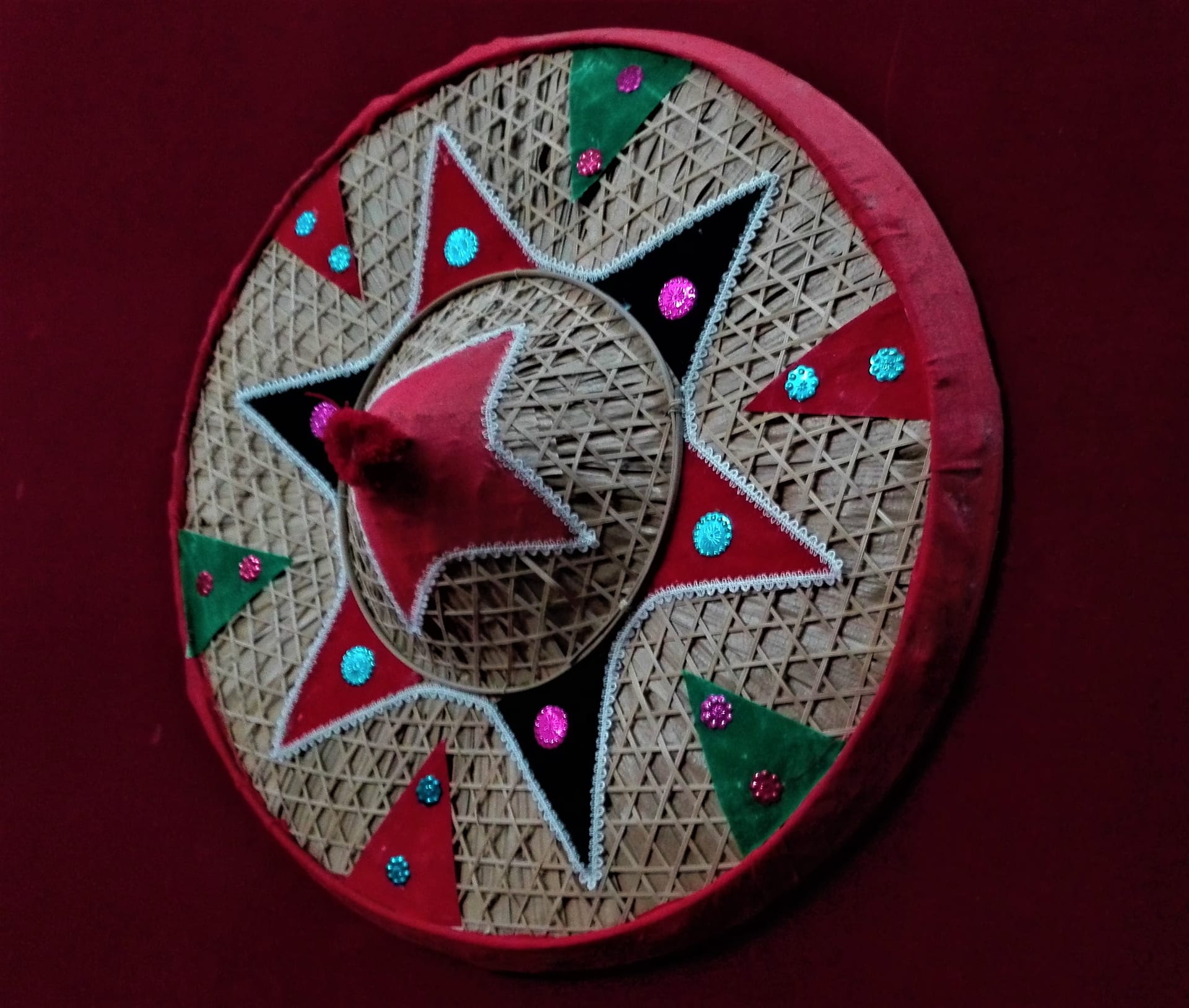
The conical hat of bamboo and tokou-palm leaf, the plain field hat of the cultivator and the gilded phulam japi of welcome and ceremony.
From the stories8
The stories that run through this page. Each piece weaves several people, places and kingdoms into one thread.
Itakhuli, 1682
MB
Monimoy Bujarbaruah
Saraighat is the battle the songs remember. But the river gate it defended was sold to the empire eight years later by Lachit's own brother, and it was won back for good in 1682, at a rock called Itakhuli.
Mir Jumla's Retreat
MB
Monimoy Bujarbaruah
In 1662 Aurangzeb's ablest general took the empty Ahom capital and thought he had won Assam, until the monsoon, the floods and the fever rotted his army to nothing.
The Burmese Days
MB
Monimoy Bujarbaruah
One nobleman's grudge invited three Burmese armies over the eastern mountains, in a terror remembered as the Manor Din that ended six centuries of Ahom rule.
The Last Rites of an Ahom King
MB
Monimoy Bujarbaruah
By night a dead Swargadeo left the capital in secret and was laid under earth with the world of his life, while the living kept feeding the dead who had become gods.
The Night of Saraighat
MB
Monimoy Bujarbaruah
A dying general, a wavering fleet, and the river that kept the Mughals out of Assam.
Woven in a Night
MB
Monimoy Bujarbaruah
An Ahom noblewoman could not weave her husband the armour-cloth that was held to make a warrior unkillable. When he fell, she armed a band of women and rode to the war herself.
The Three Names of the Land
MB
Monimoy Bujarbaruah
Pragjyotisha, Kamarupa, Asam. A valley that has worn three names across three ages, each with its own legend, from the place of eastern light to the name the whole country carries still.
The Fort of Fire
MH
Meghali Hazarika
A princess dreamed of a prince she had never met. Her father raised a wall of fire to keep him out, and Tezpur became the city of blood.